
Delhi’s Air Pollution: Causes, Consequences and Long-Term Solutions
Context
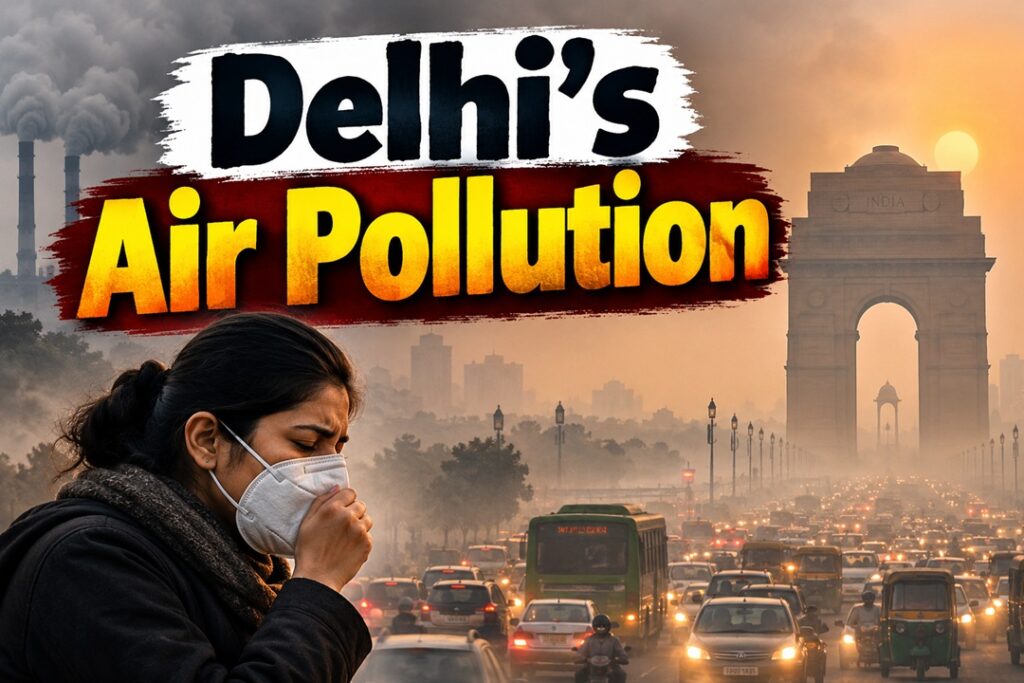
Delhi’s Air Quality Index (AQI) increased from 179 to 244 on October 21, 2026, moving into the ‘poor’ category. The deterioration highlights the combined influence of festive firecrackers, vehicular emissions, agricultural residue burning and unfavourable meteorological conditions that intensify pollution during the post-monsoon period.
Major Causes of Delhi’s Air Pollution
1. Firecrackers and Festive Activities
Fireworks release fine particulate matter (PM2.5), coarse particles (PM10) and other harmful pollutants. An IIT Delhi study found that fireworks contributed over 85% of the measured elemental mass in PM2.5 during Diwali celebrations between 2019 and 2021, after accounting for differences in atmospheric dispersion.
2. Adverse Weather Conditions
- Temperature inversion: Prevents pollutants from dispersing vertically and traps them close to the ground.
- Shallow atmospheric boundary layer: Limits the volume of air available to disperse emissions. A 2026 study reported that the boundary layer remained below 1 km in Delhi from November to January.
- Low wind speeds: Winds below 10 kmph can restrict the dispersal of pollutants, allowing their concentration to increase near the surface.
3. Agricultural Residue Burning
Burning paddy stubble in Punjab, Haryana, Uttar Pradesh and neighbouring regions releases smoke that can reach Delhi under favourable wind conditions. On October 21, 2026, the Indian Agricultural Research Institute detected 85 fire events across seven states and regions, illustrating the regional dimension of the problem.
4. Transport and Industrial Emissions
Vehicular emissions contribute substantially to Delhi’s particulate pollution. The IITM Decision Support System estimated that transport accounted for around 21% of the city’s PM2.5 pollution, making it the largest identified source in that assessment.
Industrial operations, power generation, construction activities, road dust and open waste burning further contribute to pollution throughout the year.
Impacts of Air Pollution
- Public health: Increases the risk of respiratory and cardiovascular diseases, aggravates asthma and can impair lung development in children.
- Environmental degradation: Reduces visibility, affects vegetation and contributes to the deposition of pollutants on soil and water.
- Economic losses: Raises healthcare expenditure, reduces labour productivity and disrupts aviation and road transport.
- Social inequality: Children, older people, outdoor workers and economically vulnerable communities often face greater exposure and have fewer resources to mitigate its effects.
Government Initiatives to Curb Air Pollution
1. Graded Response Action Plan (GRAP)
GRAP introduces progressively stricter emergency measures according to pollution levels. These include restrictions on construction activities, enhanced road cleaning, water sprinkling and curbs on certain polluting vehicles.
2. Commission for Air Quality Management (CAQM)
Established in 2021, the CAQM coordinates air-pollution management across Delhi-NCR and adjoining areas, addressing transport, industries, construction dust and agricultural residue burning.
3. National Clean Air Programme (NCAP), 2019
The programme promotes city-specific clean-air action plans, improved pollution monitoring and reductions in particulate matter through coordinated interventions.
4. Transport and Industrial Reforms
Measures include promoting electric vehicles and CNG, strengthening public transport, enforcing Pollution Under Control Certificates, encouraging cleaner industrial fuels and installing emission-monitoring systems.
5. Dust, Waste and Stubble Management
Authorities promote mechanised road sweeping, construction-site dust control, scientific waste disposal, crop-residue management machinery and alternative uses of agricultural waste.
6. Firecracker Regulation and Public Awareness
Government directions regulate the sale and use of firecrackers, while public-awareness campaigns encourage less polluting festive practices.
7. Monitoring and Public Participation
Continuous ambient air-quality monitoring stations and the CPCB’s SAMEER application help communicate pollution levels and facilitate pollution-related complaints.
8. Other Supporting Measures
| Initiative | Primary objective |
|---|---|
| Comprehensive Action Plan for Delhi-NCR | Coordinate pollution-control measures across agencies and sectors. |
| Green-cover development | Expand urban vegetation and improve the urban environment. |
| Cleaner public transport | Reduce dependence on private vehicles and associated emissions. |
| Air Ambience Fund | Support designated pollution-control interventions and cleaner technologies. |
Major Challenges in Controlling Pollution
- Fragmented governance: Pollution travels across administrative boundaries, requiring coordinated action by Delhi and neighbouring states.
- Seasonal pollution spikes: Fireworks, stubble burning and winter weather can cause rapid deterioration in air quality.
- Inadequate enforcement: Construction dust, industrial violations and open waste burning continue despite existing regulations.
- Growing transport demand: Increasing vehicle use places sustained pressure on urban air quality.
- Dependence on emergency measures: Temporary restrictions may reduce immediate exposure but cannot replace structural changes in pollution sources.
- Limited alternatives for farmers: Crop-residue management requires affordable machinery, reliable collection systems and economically viable alternatives to burning.
Way Forward
- Adopt a regional airshed approach: Delhi-NCR states should coordinate through the CAQM, using shared emission inventories, common targets and joint monitoring.
- Prioritise year-round pollution reduction: Address transport, industries, power generation, construction dust and waste management continuously instead of relying mainly on winter restrictions.
- Transform urban mobility: Expand reliable buses, metro connectivity, last-mile transport, walking and cycling infrastructure, alongside cleaner vehicle technologies.
- Make alternatives to stubble burning viable: Improve access to residue-management machinery, develop biomass-based industries, strengthen crop diversification and provide timely support to farmers.
- Strengthen compliance: Use real-time monitoring, transparent reporting, inspections and proportionate penalties to improve enforcement against polluters.
- Improve scientific forecasting: Integrate weather forecasts, satellite observations, emission inventories and air-quality models to anticipate pollution episodes and target interventions.
- Encourage citizen participation: Promote public reporting of violations, responsible festive practices and awareness of health-protection measures during high-pollution periods.
Conclusion
Delhi’s air pollution is a persistent regional and urban governance challenge arising from multiple emission sources and adverse weather conditions. Lasting improvement requires a transition from reactive emergency restrictions to sustained, science-based pollution prevention. Coordinated regional action, cleaner transport, sustainable agricultural practices and effective enforcement are essential to protect public health and achieve cleaner air.
Source : The Indian Express