
India’s Ramsar Network Expands to 103 Wetlands: Conservation, Challenges and the Way Forward
Context
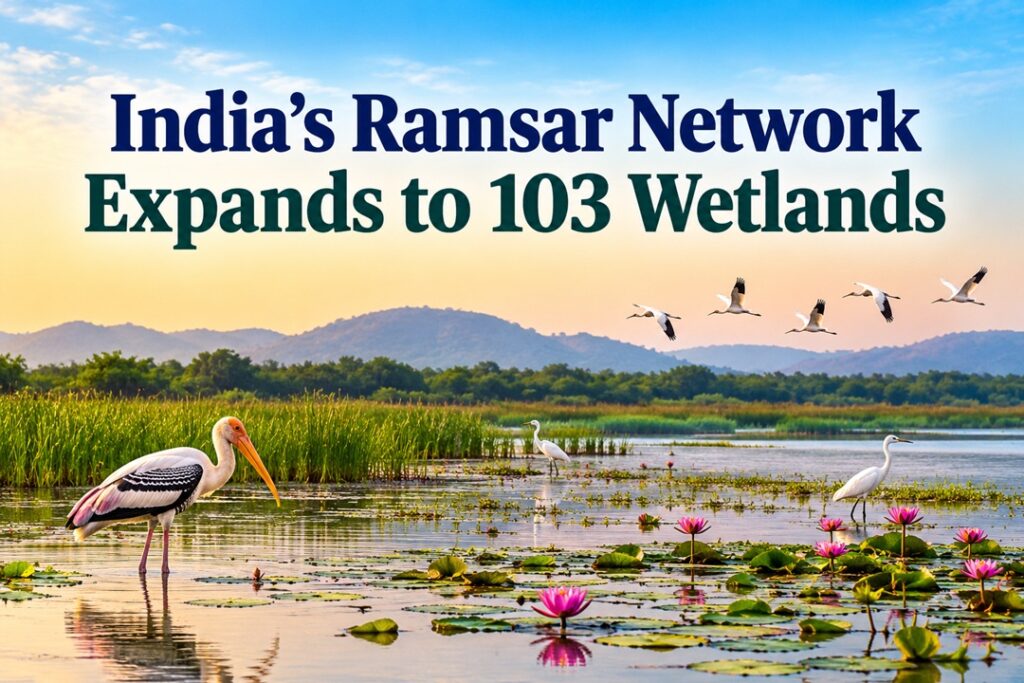
India’s network of wetlands recognised under the Ramsar Convention has expanded to 103 sites covering over 13.87 lakh hectares, following the designation of Sukhna Wetland in Chandigarh and Sauj Jheel in Uttar Pradesh in October 2026. This milestone strengthens India’s efforts to conserve ecologically significant wetlands, protect biodiversity and enhance climate resilience.
What Are Ramsar Sites?
A Ramsar Site is a wetland recognised as being of international importance under the Ramsar Convention on Wetlands, an intergovernmental treaty adopted in Ramsar, Iran, in 1971.
The Convention promotes the conservation and sustainable utilisation of wetlands through the principle of wise use, which seeks to maintain their ecological character while allowing sustainable human activities.
Wetlands covered by the Convention include marshes, peatlands, lakes, floodplains, mangroves and certain shallow marine areas, whether natural or artificial, permanent or seasonal, and freshwater or saline.
India’s Ramsar Network: Key Features
- Total sites: India has 103 Ramsar Sites, covering more than 13.87 lakh hectares.
- Geographical spread: These wetlands are distributed across 28 States and Union Territories.
- Leading states: Tamil Nadu has the highest number of Ramsar Sites at 20, followed by Uttar Pradesh with 14.
- Ecological diversity: The network includes high-altitude lakes, riverine wetlands, mangroves, coral reef ecosystems, reservoirs and urban wetlands.
Criteria for Ramsar Site Designation
A wetland must satisfy at least one of the nine internationally recognised criteria for designation.
- Unique wetland ecosystems: Represents a rare or characteristic wetland type within a biogeographical region.
- Threatened biodiversity: Supports threatened species, vulnerable ecological communities or important populations of native plants and animals.
- Waterbird populations: Regularly supports at least 20,000 waterbirds or at least 1% of the population of a particular waterbird species or subspecies.
- Fish diversity and breeding: Provides important habitats for native fish, including spawning grounds, migration routes and nursery areas.
Recent Additions to India’s Ramsar Network
India has accelerated the identification and recognition of ecologically significant wetlands in recent years.
- 2025: Eleven wetlands were added, taking the national tally to 96.
- June 2026: Surha Tal, also associated with Jai Prakash Narayan Bird Sanctuary in Uttar Pradesh, became India’s 100th Ramsar Site.
- August 2026: Glaw Lake in Arunachal Pradesh became the 101st site, recognised for its Eastern Himalayan biodiversity.
- October 15, 2026: Sukhna Wetland in Chandigarh was designated the 102nd site. This artificial, rain-fed reservoir provides habitat for migratory birds along the Central Asian Flyway.
- October 15, 2026: Sauj Jheel in Mainpuri district, Uttar Pradesh, became the 103rd site. This perennial floodplain lake supports large waterbird populations and provides important nesting habitat for the vulnerable sarus crane.
Why Are Ramsar Sites Important?
1. Flood Control and Water Security
Wetlands act as natural sponges by absorbing excess rainfall, storing floodwater and gradually releasing it. They also contribute to groundwater recharge and help regulate local hydrological systems.
Example: The East Kolkata Wetlands support wastewater treatment and fisheries while contributing to the management of the city’s water environment.
2. Biodiversity Conservation
Wetlands provide feeding, breeding, nesting and resting habitats for resident wildlife and migratory birds. They are especially important for species dependent on interconnected riverine, coastal and freshwater ecosystems.
Example: Keoladeo National Park in Rajasthan and Chilika Lake in Odisha support diverse waterbird populations, while Chilika also provides habitat for the Irrawaddy dolphin.
3. Climate Change Mitigation and Adaptation
Mangroves, peatlands and other wetland ecosystems store substantial amounts of carbon. Coastal wetlands also reduce wave energy, limit erosion and provide natural protection against storm surges.
Example: The Sundarban Wetland helps protect vulnerable coastal communities from cyclonic surges and saltwater intrusion while storing carbon in mangrove vegetation and sediments.
4. Livelihoods and Local Economies
Wetlands sustain fisheries, agriculture, livestock, tourism and the collection of reeds and other natural resources. Their degradation can therefore undermine both food security and rural incomes.
Example: The East Kolkata Wetlands support extensive fish cultivation and provide livelihoods to local fishing communities.
5. Ecological Connectivity
Wetlands connect rivers, floodplains, forests and coastal habitats. They serve as important links along migratory bird routes, including the Central Asian Flyway, enabling species to move between distant ecosystems.
Government Initiatives for Wetland Conservation
1. Wetlands (Conservation and Management) Rules, 2017
Notified under the Environment (Protection) Act, 1986, these rules provide a framework for wetland identification, notification and management through State and Union Territory Wetland Authorities. They also restrict specified activities that threaten notified wetlands, including encroachment and certain forms of pollution.
2. Amrit Dharohar Initiative
The initiative seeks to conserve Ramsar Sites by improving biodiversity, promoting sustainable livelihoods and supporting ecologically responsible tourism. Scientific inventories and carbon-stock assessments can further strengthen evidence-based management.
3. Mission Sahbhagita and Save Wetlands Campaign
These initiatives encourage public participation in wetland conservation, community stewardship and citizen-led monitoring. They recognise that long-term protection requires the involvement of local communities alongside government institutions.
4. MISHTI
The Mangrove Initiative for Shoreline Habitats and Tangible Incomes promotes mangrove restoration and sustainable livelihoods in coastal areas. Mangrove conservation contributes to shoreline protection, biodiversity preservation and carbon sequestration.
5. National Plan for Conservation of Aquatic Ecosystems
The NPCA supports the conservation and restoration of identified lakes and wetlands through measures such as pollution abatement, catchment treatment and ecological improvement.
Major Challenges in Wetland Conservation
1. Urbanisation and Encroachment
Real estate development, road construction, land reclamation and unplanned urban expansion reduce wetland areas and obstruct natural drainage channels. The conversion of wetlands into built-up land also increases urban flood risks.
Example: Encroachment and degradation threaten wetlands such as Deepor Beel in Guwahati and Pallikaranai marsh in Chennai.
2. Sewage, Industrial Pollution and Eutrophication
Untreated sewage, industrial effluents and agricultural runoff introduce excessive nutrients and pollutants into wetlands. These can trigger eutrophication, reduce dissolved oxygen and damage aquatic food chains.
Example: Invasive water hyacinth can proliferate in nutrient-rich waters, obstructing sunlight and degrading habitats in wetlands such as Harike and Loktak.
3. Altered Hydrology and Siltation
Dams, barrages, excessive water extraction, upstream construction and deforestation can disrupt the natural flow of water into wetlands. Sediment accumulation reduces storage capacity and can weaken their ability to moderate floods.
Example: Siltation and changes in hydrological connectivity pose challenges to the ecological functioning of Wular Lake in Jammu and Kashmir.
4. Invasive Alien Species
Invasive plants and animals can outcompete native species, alter food webs and obstruct fishing and navigation. Their spread is often accelerated by pollution and disturbed ecological conditions.
5. Fragmented Governance
Wetland management frequently involves several departments responsible for land revenue, irrigation, fisheries, forestry, urban planning and wildlife protection. Overlapping responsibilities can delay action and weaken enforcement.
6. Climate Change and Reduced Environmental Flows
Changing rainfall patterns, prolonged dry spells, rising temperatures and extreme weather events can alter wetland water levels and species composition. Excessive upstream withdrawals further threaten the seasonal and perennial water supplies on which these ecosystems depend.
Way Forward
– Strengthen wetland mapping and legal protection: Use GIS, satellite imagery and updated land records to demarcate wetland boundaries, catchments and ecologically sensitive buffer zones. Prevent illegal reclamation through consistent monitoring and enforcement.
– Prepare site-specific Integrated Management Plans: Develop and implement scientifically grounded plans for every Ramsar Site, addressing hydrology, biodiversity, pollution, livelihoods and climate-related risks.
– Improve sewage and pollution management: Ensure effective treatment of municipal wastewater and industrial effluents, regulate agricultural runoff and establish regular water-quality monitoring.
– Maintain ecological flows: Coordinate upstream dams, barrages and irrigation withdrawals to preserve the seasonal water regimes and connectivity essential to wetland ecosystems.
– Promote community-led conservation: Involve local residents, fishing communities, farmers, researchers and civil society in monitoring, restoration and decision-making. Sustainable tourism and benefit-sharing can create incentives for conservation.
– Integrate wetlands into urban planning: Protect natural drainage networks, prevent construction in floodplains and restore degraded urban wetlands. Wetland-sensitive urban planning can reduce flood vulnerability and improve water security.
– Strengthen scientific monitoring: Regularly assess biodiversity, water quality, invasive species, carbon stocks and changes in wetland boundaries. Update Ramsar Information Sheets and management measures in accordance with applicable requirements.
– Build climate resilience: Prioritise restoration of mangroves, floodplains and other carbon-rich wetlands while incorporating wetlands into disaster-risk reduction and climate-adaptation strategies.
Conclusion
India’s expansion to 103 Ramsar Sites marks an important step towards recognising the ecological and economic value of its wetlands. However, international designation must translate into effective conservation on the ground. Stronger enforcement, scientific management, pollution control and community participation are essential to preserve wetland biodiversity, secure water resources, reduce disaster risks and sustain livelihoods. Protecting wetlands is therefore not merely an environmental obligation but a critical investment in India’s long-term ecological and developmental security.
Source : PIB