
Keen Sword 27: Strengthening US–Japan Military Cooperation
Context
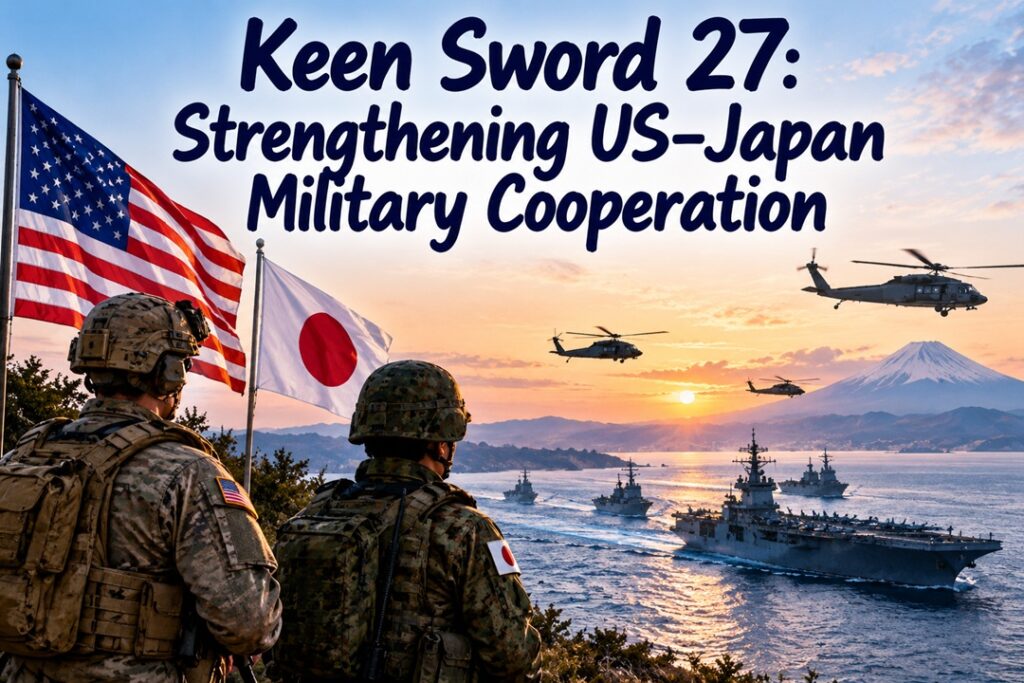
The United States and Japan launched Exercise Keen Sword 27, their largest joint field-training military exercise to date, across the waters and islands of southwestern Japan. The exercise aims to enhance bilateral defence coordination and strengthen deterrence amid rising strategic tensions in the Indo-Pacific, particularly around the Taiwan Strait.
About Exercise Keen Sword 27
Exercise Keen Sword is a biennial joint military exercise conducted by Japan and the United States to improve combat readiness, operational coordination and interoperability between the Japan Self-Defense Forces (JSDF) and US Armed Forces.
- Host Country: Japan
- Participating Nations: Japan and the United States
- Nature: Joint field-training exercise involving multiple military domains.
- Scale: Approximately 56,000 military personnel, supported by warships, submarines and combat aircraft.
Key Features of the Exercise
1. Large-Scale Military Deployment
The mobilisation of around 56,000 personnel demonstrates the growing depth of US–Japan defence cooperation and their ability to conduct coordinated military operations.
2. Strengthening Island Defence
The exercise rehearses island defence, amphibious operations, the recapture of strategically important islands and the protection of maritime approaches.
3. Deployment of Coastal Defence Systems
Mobile anti-ship missiles and coastal defence systems are deployed on islands such as Yonaguni and Ishigaki, enhancing maritime surveillance and defensive capabilities near Taiwan.
4. Integrated Air and Missile Defence
The participating forces practise coordinated responses to aerial and missile threats, alongside maritime security operations and civilian evacuation during emergencies.
5. Multi-Domain Military Coordination
The exercise integrates land, sea, air, cyber, space and electronic warfare capabilities to improve joint command structures and preparedness for complex military contingencies.
6. Strategic Monitoring and Regional Tensions
Chinese naval and aerial surveillance of allied activities highlights the strategic sensitivity of the exercise. Increased monitoring and interceptions reflect the wider security competition in the waters surrounding Japan and Taiwan.
Strategic Significance
- Strengthens deterrence: Enhances the ability of the US–Japan alliance to respond to potential military threats in the western Pacific.
- Secures the southwestern islands: Improves operational preparedness in strategically important areas close to Taiwan and major maritime routes.
- Reinforces the US–Japan alliance: Promotes interoperability, intelligence coordination and joint operational planning.
- Reflects Japan’s evolving defence posture: Highlights Japan’s growing emphasis on forward defence, counterstrike capabilities and integrated deterrence.
- Supports Indo-Pacific stability: Signals a commitment to maintaining regional security and freedom of navigation, although large-scale military exercises may also intensify strategic competition.
Way Forward
- Strengthen crisis communication: Establish reliable communication channels to prevent military encounters from escalating into conflict.
- Maintain a defensive orientation: Ensure that enhanced military preparedness remains consistent with international law and regional stability.
- Promote diplomatic engagement: Combine deterrence with dialogue involving China and other regional stakeholders.
- Improve humanitarian preparedness: Expand cooperation in disaster response, civilian evacuation and protection of critical infrastructure.
Conclusion
Exercise Keen Sword 27 reflects the deepening strategic partnership between the United States and Japan and the growing importance of joint military preparedness in the Indo-Pacific. While improved interoperability can strengthen deterrence, a balance between defence readiness, diplomatic engagement and crisis management remains essential to prevent regional tensions from escalating.
Source : DD News