
E100 Flex-Fuel Vehicles: Advancing India’s Biofuel-Based Mobility
Context
The Ministry of Road Transport and Highways (MoRTH) has amended the Central Motor Vehicles Rules (CMVR), 1989, to enable the testing, certification and commercial introduction of flex-fuel vehicles capable of operating on ethanol blends up to E100. This regulatory change aims to promote cleaner transport, reduce dependence on imported crude oil and strengthen the domestic biofuel ecosystem.
What Are E100 Flex-Fuel Vehicles?
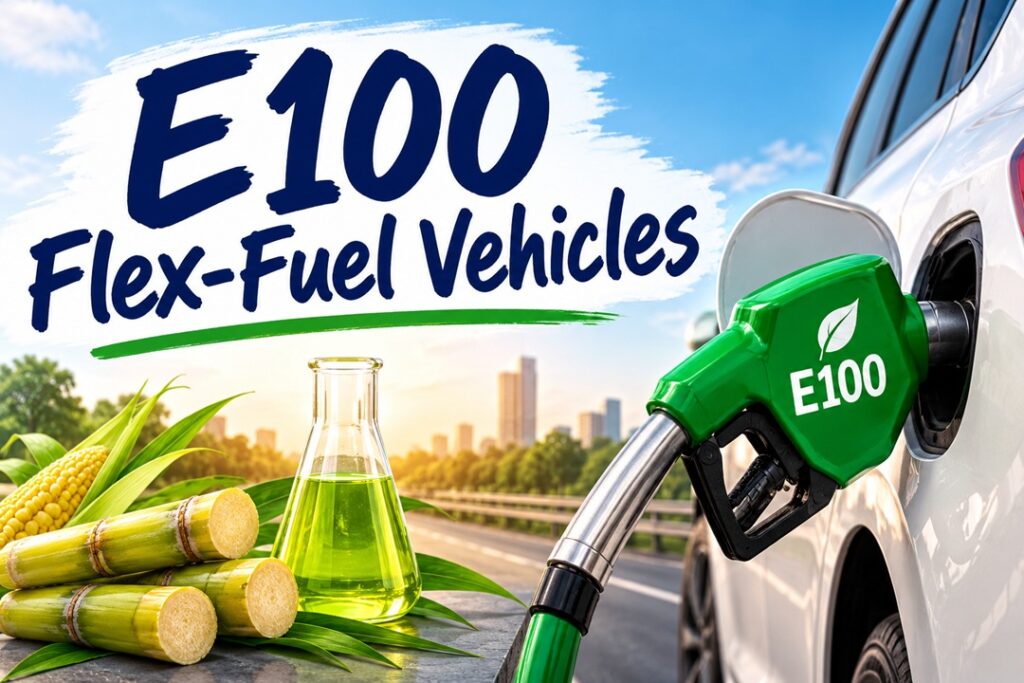
E100 fuel is a biofuel consisting predominantly of ethanol, which can be produced through the fermentation of sugarcane juice, molasses, maize and damaged food grains. It may contain small quantities of additives for denaturing and protecting the fuel system.
Flex-Fuel Vehicles (FFVs) are internal combustion engine vehicles designed to operate on petrol, pure ethanol or different mixtures of the two. Electronic sensors and engine management systems automatically adjust engine operation according to the fuel composition.
- Regulatory framework: Central Motor Vehicles Rules, 1989, amended under the Motor Vehicles Act, 1988.
- Nodal ministry: Ministry of Road Transport and Highways, in coordination with the Ministry of Petroleum and Natural Gas.
- Primary objective: To facilitate ethanol-based mobility, diversify transport fuels and expand the market for domestically produced biofuels.
Key Technological Features
– Ethanol-resistant fuel systems: Specialised stainless-steel components, resistant polymers and suitable seals help prevent corrosion and deterioration caused by ethanol and moisture.
– Electronic engine management: Sensors and electronic control modules adjust the air-fuel mixture and ignition timing to accommodate different ethanol concentrations.
– High-octane engine design: Ethanol’s high octane rating, generally around 100–105 RON depending on the fuel, helps resist engine knocking and can support higher compression ratios.
– Enhanced fuel delivery: Larger-capacity fuel pumps and injectors compensate for ethanol’s lower energy content per litre by supplying greater fuel volumes.
– Cold-start technology: Fuel heating systems or supplementary petrol injection can improve ignition in cold conditions, when ethanol vaporises less readily.
Significance of E100 Flex-Fuel Vehicles
1. Energy Security
- Reduces dependence on imported petroleum by creating an alternative domestic transport fuel.
- Limits exposure to fluctuations in international crude oil prices and associated import expenditure.
- Diversifies India’s road transport energy mix.
2. Agricultural and Rural Development
- Creates additional demand for sugarcane, maize, molasses and other suitable feedstocks.
- Provides potential supplementary markets for farmers and agricultural processing industries.
- Can generate employment in ethanol distilleries, biofuel supply chains and rural transport infrastructure.
3. Environmental Benefits
- Can reduce net lifecycle greenhouse gas emissions compared with petrol, depending on feedstock cultivation, production methods, processing energy and transportation.
- Supports the broader decarbonisation of road transport.
- Offers opportunities to utilise certain agricultural residues and surplus feedstocks, provided their use is economically and environmentally sustainable.
4. Development of the Biofuel Industry
- Encourages investment in ethanol production, fuel distribution and vehicle technology.
- Establishes a regulatory pathway for the wider adoption of flexible-fuel vehicles.
- May strengthen domestic technological capabilities in alternative-fuel engines and automotive components.
Major Challenges and Concerns
1. Lower Fuel Economy
Ethanol has approximately 30% less energy per litre than petrol. Consequently, vehicles operating on high ethanol blends generally consume more fuel by volume. The financial benefit to consumers will depend on ethanol prices, taxation, vehicle efficiency and fuel availability.
2. Water Stress and Food Security
Large-scale ethanol production from water-intensive crops such as sugarcane and paddy may increase pressure on groundwater resources. Diverting food crops towards fuel production can also create competition between food security and energy requirements.
3. Compatibility with Existing Vehicles
Conventional petrol vehicles certified for E10 or E20 may not be suitable for E100. Higher ethanol concentrations can damage incompatible fuel lines, seals and other engine components, potentially causing leakage or mechanical failure.
4. Fuel Distribution Infrastructure
The commercial viability of E100 vehicles depends on the availability of suitable storage facilities, distribution networks, fuel-quality controls and retail dispensing infrastructure. Limited availability could discourage consumers from adopting the technology.
5. Consumer Affordability
Flex-fuel vehicles may require specialised components and additional engineering, potentially increasing their purchase price. Consumers will need clear information about operating costs, mileage and the availability of compatible fuels.
Way Forward
– Promote sustainable feedstocks: Prioritise agricultural residues, suitable waste materials and feedstocks that minimise competition with food production and pressure on water resources.
– Adopt lifecycle assessment: Evaluate biofuels on a well-to-wheel basis, accounting for cultivation, fertiliser use, water consumption, processing energy and transportation.
– Expand infrastructure gradually: Develop compatible fuel storage, dispensing and distribution facilities in coordination with ethanol production capacity and regional demand.
– Protect consumer interests: Establish transparent fuel pricing, clear vehicle labelling, reliable warranty provisions and accessible information on mileage and maintenance costs.
– Strengthen research and development: Improve engine efficiency, cold-start performance, corrosion resistance and compatibility with different ethanol blends.
– Maintain policy coordination: Align transport regulations, agricultural policies, biofuel production targets and environmental safeguards to ensure that energy security does not undermine food security.
Conclusion
The amendment to the Central Motor Vehicles Rules, 1989, creates a regulatory pathway for E100-compatible flex-fuel vehicles in India. Their long-term success will depend not only on vehicle technology but also on affordable fuel, sustainable agricultural practices, reliable infrastructure and demonstrable lifecycle emission reductions. A balanced approach can help India advance energy security while supporting rural livelihoods and cleaner mobility.
Source : The Indian Express