
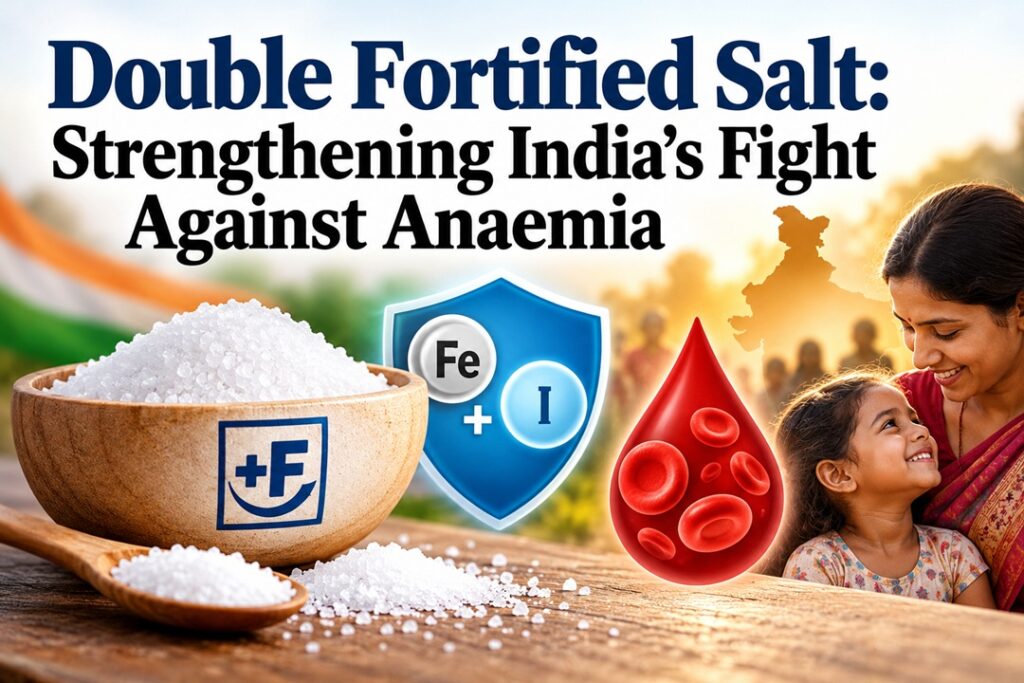
Double Fortified Salt: Strengthening India’s Fight Against Anaemia
Context
The Government of India’s renewed 7X7X7 Anaemia Mukt Bharat (AMB) strategy has renewed attention on preventive nutritional interventions. In this context, Double Fortified Salt (DFS), which combines iron and iodine in a commonly consumed food item, offers an opportunity to address widespread micronutrient deficiencies through existing food distribution networks.
Understanding Anaemia and Double Fortified Salt
What is Anaemia?
Anaemia is a condition in which the body has insufficient healthy red blood cells or haemoglobin to transport adequate oxygen to tissues. It remains a major public health concern in India, affecting over 50% of women and nearly three-fourths of children.
Its consequences include:
- Increased risk of maternal complications and mortality.
- Impaired cognitive development and learning outcomes among children.
- Reduced physical productivity and work capacity.
- Intergenerational transmission of undernutrition and poor health.
What is Double Fortified Salt (DFS)?
- DFS is ordinary edible salt fortified with two essential micronutrients: iron and iodine.
- Iron helps prevent iron-deficiency anaemia, while iodine supports thyroid function and prevents disorders such as goitre.
- Since salt is consumed regularly across different socioeconomic groups, DFS provides a convenient means of delivering micronutrients without depending entirely on individual compliance with supplements.
Existing Regulatory and Institutional Framework
India has developed several institutional mechanisms that can facilitate the expansion of DFS:
1. FSSAI Fortification Standards: The Food Safety and Standards Authority of India regulates the quality and composition of fortified salt. Specially processed iron compounds, such as encapsulated ferrous fumarate and ferric pyrophosphate, help maintain stability and minimise undesirable changes in colour and taste.
2. PM POSHAN Scheme: Double Fortified Salt is included in nutritional guidelines for school meals, helping improve children’s micronutrient intake.
3. Integrated Child Development Services (ICDS): The Anganwadi network provides an institutional channel for incorporating fortified food into supplementary nutrition programmes.
4. Anaemia Mukt Bharat (AMB): Its 7X7X7 framework targets seven beneficiary groups through seven interventions and seven institutional mechanisms. It combines supplementation, dietary improvement, testing and treatment.
5. Universal Salt Iodisation (USI): India’s established iodised salt production and distribution network, which reaches approximately 95% of households, provides an existing foundation for expanding dual fortification.
Major Challenges in Scaling Up Double Fortified Salt
1. Limited Integration with the Public Distribution System (PDS)
- Although DFS has found a place in selected nutrition programmes, its widespread distribution through fair-price shops remains uneven.
- State-level differences in funding, procurement and implementation have restricted access, particularly among economically vulnerable households.
- Consequently, a large population dependent on subsidised food distribution remains outside regular DFS coverage.
2. Problems Related to Taste, Colour and Stability
- Chemical interactions between iron compounds and iodine can cause discolouration, particularly when inappropriate fortification techniques are used.
- Changes in the appearance of salt or cooked food can discourage households from using it.
- Poor storage conditions and moisture exposure can further affect the stability of fortified nutrients.
3. Potential Risks for People with Genetic Blood Disorders
- Iron fortification requires careful consideration for individuals with certain haemoglobin disorders.
- People with conditions such as thalassemia major may experience iron accumulation, particularly when exposed to excessive iron supplementation.
- Therefore, DFS distribution should be aligned with screening and appropriate clinical guidance, especially in areas covered by the National Sickle Cell Anaemia Elimination Mission.
4. Limited Retail Availability and Higher Costs
- Quality-assured DFS is not consistently available through ordinary retail outlets.
- Higher production costs and limited commercial distribution can make branded variants more expensive than conventional iodised salt.
- This restricts access for households that do not receive fortified salt through government programmes.
5. Conflict Between Fortification and Sodium Reduction Goals
- Salt-based fortification creates a public health communication challenge because excessive sodium consumption increases the risk of hypertension and cardiovascular diseases.
- Promoting DFS must not inadvertently encourage higher salt consumption.
- This requires coordination between nutritional deficiency prevention and broader non-communicable disease prevention initiatives.
Way Forward
– Expand DFS through the PDS: Introduce a centrally supported distribution mechanism under the National Food Security Act (NFSA) to reduce dependence on individual state budgets and improve affordability.
– Strengthen Domestic Production Capacity: Utilise existing salt-processing infrastructure in major production centres such as Gujarat and Tamil Nadu to achieve economies of scale and maintain consistent quality.
– Improve Fortification Technology: Promote scientifically validated iron encapsulation techniques and moisture-resistant packaging to prevent nutrient degradation, discolouration and undesirable changes in food quality.
– Integrate with Haemoglobinopathy Screening: Coordinate DFS distribution with existing screening initiatives for sickle cell disease and thalassemia. Ensure appropriate counselling, labelling and access to suitable alternatives where medically required.
– Promote Community Awareness: Engage ASHA workers, Anganwadi workers and local health institutions in explaining the nutritional benefits of DFS and addressing concerns about its taste, colour and safety.
– Maintain Sodium Reduction Targets: Integrate DFS promotion with FSSAI’s Eat Right India initiative and encourage households to consume salt within recommended limits.
Conclusion
Double Fortified Salt offers India an opportunity to address iron and iodine deficiencies through an affordable and familiar food vehicle. However, its success depends not merely on technological innovation but also on reliable distribution, quality assurance, public awareness and appropriate health safeguards. Integrating DFS more effectively into existing food security and nutrition programmes can strengthen the 7X7X7 Anaemia Mukt Bharat strategy and contribute to healthier nutritional outcomes across the country.
Source : The Hindu