
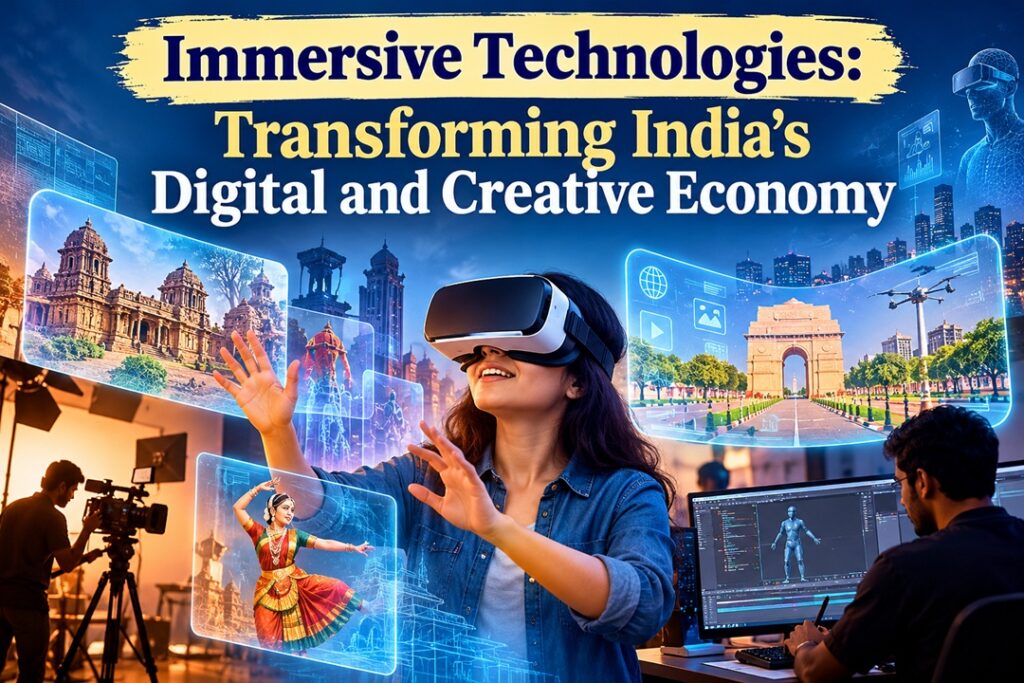
Immersive Technologies: Transforming India’s Digital and Creative Economy
Context
The Ministry of Information and Broadcasting is strengthening India’s Animation, Visual Effects, Gaming, Comics and Extended Reality (AVGC-XR) sector through a ₹250 crore allocation for Content Creator Labs across 15,500 educational institutions and the establishment of the Indian Institute of Creative Technologies (IICT), Mumbai. These initiatives aim to develop skilled talent and accelerate the adoption of immersive technologies in India.
What are Immersive Technologies?
Immersive technologies are digital tools that integrate the physical and virtual environments to create interactive experiences involving multiple human senses, particularly sight, sound and touch. They enable users to interact with digitally generated environments with a greater sense of realism and presence.
1. Major Types of Immersive Technologies
- Virtual Reality (VR): Creates a completely computer-generated environment that replaces the user’s physical surroundings, usually through specialised headsets.
- Augmented Reality (AR): Adds digital elements, such as images, information and 3D models, to the real-world environment through smartphones or smart glasses.
- Mixed Reality (MR): Combines physical and virtual environments, allowing digital objects to interact with real-world surroundings in real time.
- Haptic Technology: Uses vibrations, simulated textures and physical resistance to reproduce the sensation of touch.
- 360-Degree Video: Captures an entire surrounding environment, enabling viewers to explore recorded spaces from different directions.
Growth Potential of Immersive Technologies in India
- Expanding Market: India’s immersive technology market is expected to increase from $1.26 billion in 2023 to $7.82 billion by 2030, registering a projected CAGR of 29.8%.
- Gaming Industry: The Indian gaming market is projected to grow from $3.8 billion in 2024 to $9.2 billion by FY2029.
- Educational Infrastructure: The Union Budget 2026–27 earmarked ₹250 crore for establishing AVGC Content Creator Labs in 15,000 schools and 500 colleges.
- National Digital Twin: The Department of Telecommunications (DoT) aims to develop a National Digital Twin covering major urban centres by 2035.
Applications of Immersive Technologies in India
1. Education and Skill Development
- Converts complex subjects into interactive three-dimensional learning experiences.
- Improves practical understanding through virtual experiments and simulations.
- Example: IIT Madras researchers are introducing AR/VR-based educational modules in rural schools to help students explore human anatomy, historical archives and planetary systems.
2. Urban Planning and Infrastructure Development
- Digital Twins create virtual replicas of physical infrastructure using real-time data from IoT devices, 5G networks and mobility systems.
- Helps authorities simulate traffic patterns, assess infrastructure requirements and identify potential risks before implementing projects.
- Example: DoT’s Sangam: Digital Twin initiative and Varanasi’s Urban 3D Spatial Planning project support urban infrastructure and mobility planning.
3. Cultural Heritage Preservation and Tourism
- Enables digital documentation and preservation of historical monuments, artefacts and archaeological sites.
- Provides virtual access to heritage destinations and improves tourism experiences through AR-based interpretation.
- Example: The Ministry of Culture’s JATAN software supports the digitisation of museum collections, while AR-based tours can enhance visitor experiences at sites such as Hampi and Nalanda.
4. Entertainment and Creative Industries
- Facilitates virtual film production, motion capture, animation and interactive gaming.
- Creates opportunities for Indian studios to develop original intellectual property and compete in global creative markets.
- Example: Uttar Pradesh is developing an integrated AVGC-XR Park near the Noida International Airport at Jewar and the proposed International Film City.
5. Healthcare and Industrial Training
- Enables medical professionals to practise complex procedures through simulated environments.
- Supports equipment maintenance, workplace safety training and industrial skill development through virtual simulations.
Major Government Initiatives
– Indian Institute of Creative Technologies (IICT), Mumbai: Established in 2025 as a National Centre of Excellence for the AVGC-XR sector. It collaborates with global technology companies and offers specialised professional courses.
– GENESIS Scheme: Implemented by the Ministry of Electronics and Information Technology (MeitY), it supports deep-tech startups beyond major metropolitan centres. Its ecosystem includes 84 AR/VR startups and 106 technology incubators.
– WaveX Media-Tech Incubator: An initiative of the Ministry of Information and Broadcasting to encourage media-tech entrepreneurship and support startups developing emerging technologies.
– State-Level AVGC-XR Policies: States are developing specialised infrastructure and investment frameworks.
- Karnataka’s AVGC-XR Policy 3.0 includes support through the KITVEN Fund.
- Maharashtra has outlined a ₹3,268 crore policy roadmap extending to 2050.
- Tamil Nadu is promoting the sector through the ELCOT Viyan Centre of Excellence and its hub-and-spoke model.
– ESTIC-2026 Conclave: The Department of Science and Technology’s science and technology conference at Bharat Mandapam features discussions on Generative XR and Spatial Computing.
Challenges in Adopting Immersive Technologies
1. High Cost of Hardware and Import Dependence
- Advanced VR headsets, high-performance GPUs and motion-capture equipment are expensive.
- Dependence on imported components increases deployment costs and creates supply-chain vulnerabilities.
- High equipment costs can restrict adoption in government schools and smaller enterprises.
2. Digital Infrastructure Gaps
- Immersive applications require high bandwidth, reliable connectivity and low network latency.
- Uneven 5G availability and inadequate computing infrastructure in rural regions can affect performance.
- Real-time simulations may experience delays and interruptions in areas with weak connectivity.
3. Shortage of Skilled Professionals
- India faces a limited supply of specialised professionals in spatial computing, computer vision, 3D modelling and virtual production.
- Many educational institutions lack trained faculty and advanced practical learning infrastructure.
4. Health and Ergonomic Risks
- Extended use of VR headsets can cause eye strain, headaches, cybersickness and disorientation.
- Children and first-time users may be particularly vulnerable to discomfort during prolonged exposure.
- Clear usage guidelines and age-appropriate safeguards are therefore necessary.
5. Data Privacy and Cybersecurity
- XR devices can collect sensitive information, including eye movements, biometric identifiers and spatial details of physical surroundings.
- Unauthorised access or misuse of such information may create privacy and surveillance risks.
Way Forward
– Promote Indigenous Hardware Manufacturing: Introduce targeted incentives for domestic production of optical lenses, near-eye displays, spatial sensors and other critical XR components to reduce import dependence.
– Integrate XR into Education and Vocational Training: Incorporate 3D modelling, spatial design, game-engine programming and digital asset creation into STEM education, engineering curricula and National Skills Qualification Framework (NSQF) courses.
– Develop Open Digital Asset Repositories: Establish accessible repositories of Indian monuments, historical artefacts, traditional designs and architectural models to support indigenous content creation.
– Strengthen Digital Infrastructure: Expand reliable 5G connectivity, edge computing facilities and high-performance computing infrastructure, particularly in underserved regions.
– Establish Data Protection and Safety Standards: Develop appropriate safeguards under the Digital Personal Data Protection Act, 2023, for biometric and spatial data collected through immersive devices. Introduce guidelines addressing children’s safety, screen exposure and ergonomic risks.
– Encourage Industry-Academia Collaboration: Strengthen partnerships between universities, startups, research institutions and technology companies to facilitate innovation, skill development and commercialisation.
Conclusion
Immersive technologies represent an important transition from conventional screen-based digital interactions towards spatial computing and interactive virtual environments. Their applications extend beyond entertainment to education, healthcare, infrastructure planning and cultural preservation. By combining domestic manufacturing, skilled human resources, supportive policies and responsible data governance, India can develop a globally competitive AVGC-XR ecosystem and harness these technologies as a driver of innovation, employment generation and inclusive growth under the vision of Viksit Bharat 2047.
Source : PIB