
Cyclone Arnab: Rapid Intensification and the Role of El Niño in the North Indian Ocean
Context
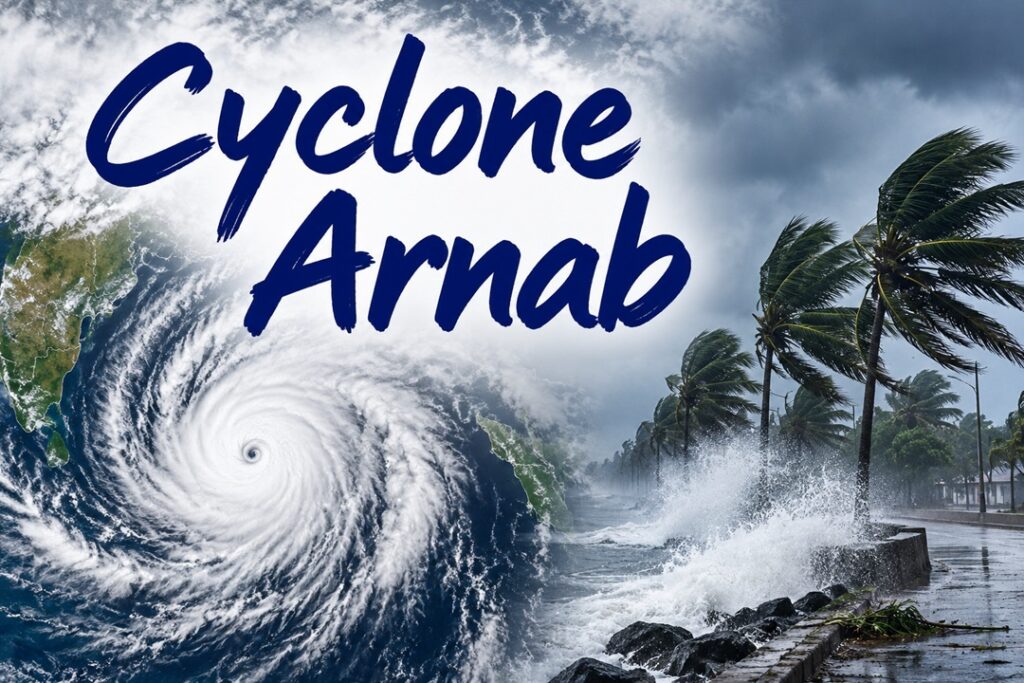
Cyclone Arnab, the first North Indian Ocean cyclone of 2026, made landfall between Bapatla and Visakhapatnam on October 28 after intensifying into a very severe cyclonic storm. Its rapid strengthening and unusual movement highlighted the influence of warmer ocean conditions and El Niño-related atmospheric changes on tropical cyclone behaviour.
What are Tropical Cyclones and Their Types?
Tropical cyclones are powerful, rotating low-pressure systems that develop over warm tropical oceans. They are associated with intense winds, thunderstorms and heavy rainfall, often causing widespread damage to coastal regions.
Conditions Favouring Their Formation:
- Warm ocean surface: Sea surface temperatures generally need to be around 26.5°C or higher.
- Coriolis force: Provides the rotation necessary for the development of a cyclonic system.
- Atmospheric moisture: Supports cloud formation and sustained thunderstorms.
- Low vertical wind shear: Prevents strong winds at different atmospheric levels from disrupting the cyclone.
- Pre-existing disturbance: Provides the initial low-pressure circulation around which the cyclone develops.
Energy Source: Tropical cyclones obtain energy from warm ocean waters through evaporation. The subsequent condensation of water vapour releases latent heat, which strengthens the storm.
Types Based on Ocean Basins:
- Hurricanes: Develop over the North Atlantic and northeastern Pacific Oceans.
- Typhoons: Occur over the northwestern Pacific Ocean.
- Cyclones: Form over the North Indian Ocean, including the Bay of Bengal and Arabian Sea, as well as the South Indian Ocean and South Pacific regions.
How Did Cyclone Arnab Develop and Intensify?
Cyclone Arnab originated as a low-pressure system over the southeast Bay of Bengal on October 23 and gradually strengthened into a cyclonic storm by October 26.
Its development involved several significant characteristics:
- Rapid strengthening: It intensified into a very severe cyclonic storm, recording sustained wind speeds of 125–135 kmph and gusts reaching 140 kmph.
- Unexpected movement: The system advanced towards the coastline faster than initially anticipated by the India Meteorological Department (IMD).
- Extended landfall phase: It remained almost stationary near Narsapur and Yanam, retaining considerable intensity for approximately six hours after landfall.
- Intense precipitation: Heavy rainfall affected coastal Andhra Pradesh and Odisha, with Visakhapatnam receiving 217 mm of rainfall.
How Does El Niño Affect Tropical Cyclone Activity?
El Niño is a climate phenomenon characterised by the abnormal warming of the central and eastern equatorial Pacific Ocean. It influences atmospheric circulation and can modify cyclone formation and movement across different ocean basins.
Its influence on tropical cyclones includes:
- Changes in atmospheric circulation: El Niño modifies global wind patterns and pressure distribution, influencing oceanic and atmospheric conditions over the North Indian Ocean.
- Equatorward formation: North Indian Ocean cyclones may develop closer to the equator during El Niño conditions.
- Altered cyclone trajectories: Cyclone tracks may shift towards the Andhra Pradesh and Tamil Nadu coasts rather than Odisha and West Bengal.
- Increased intensification potential: Favourable ocean temperatures and moisture conditions can support stronger convection and rapid cyclone development.
- Historical evidence: Cyclone Hudhud (2014), which caused significant damage along the Andhra Pradesh coast, also occurred during an El Niño year.
How Do Warmer Oceans Contribute to Cyclone Intensification?
Ocean temperature plays a critical role in determining the formation, strength and persistence of tropical cyclones.
- Sea surface temperature: Temperatures of approximately 26°C or above favour cyclone development, particularly when warm water extends to depths of around 50–100 metres.
- Oceanic heat content: Deeper layers of warm water provide sustained energy and reduce the cooling effect caused by cyclone-induced mixing.
- El Niño-related warming: During July–September 2026, temperatures in the equatorial Pacific’s Niño 3.4 region were reportedly 2–2.8°C above normal, indicating substantial warming.
- Accelerated development: Cyclone Arnab attained very severe cyclonic storm intensity within a single day, demonstrating the possibility of rapid intensification under favourable conditions.
However, ocean warming alone does not determine cyclone intensity. Other important factors include vertical wind shear, atmospheric convection, boundary-layer processes, upper-ocean circulation and air–sea interactions.
What are the Major Challenges in Cyclone Management?
- Unpredictable intensification: Rapid changes in wind speed make it difficult to estimate the potential severity of approaching cyclones.
- Forecasting uncertainties: Changes in cyclone movement and prolonged landfall complicate evacuation and disaster-response planning.
- Coastal vulnerability: Densely populated coastal settlements, fishing communities and critical infrastructure face significant exposure.
- Extreme rainfall: Slow-moving cyclones can trigger urban flooding, riverine floods, landslides and agricultural losses.
- Climate variability: Changing ocean temperatures and atmospheric circulation patterns add complexity to long-term cyclone risk assessment.
Way Forward
- Strengthen forecasting capabilities: Improve IMD’s satellite monitoring, Doppler weather radars, numerical prediction models and real-time ocean observation systems.
- Improve early-warning dissemination: Ensure timely, location-specific alerts reach coastal communities, particularly fishermen and vulnerable households.
- Build climate-resilient infrastructure: Strengthen cyclone shelters, coastal roads, power networks and communication facilities.
- Promote nature-based protection: Restore mangroves, coastal wetlands and other natural barriers to reduce storm surges and coastal erosion.
- Enhance regional cooperation: Strengthen data sharing and coordinated disaster preparedness among countries bordering the Indian Ocean.
- Develop scientific understanding: Improve research into the combined effects of El Niño, ocean heat content and atmospheric circulation on cyclone behaviour.
Conclusion
Cyclone Arnab highlights the growing importance of understanding interactions between ocean temperatures, atmospheric circulation and tropical cyclone dynamics. Although El Niño can influence cyclone behaviour, individual storm intensification depends on multiple environmental factors. Strengthening scientific forecasting, resilient coastal infrastructure and community-based preparedness is essential to minimise disaster-related losses in India’s vulnerable coastal regions.
Source : The Indian Express