
AI-Driven Traffic Management: Transforming Urban Mobility in Delhi
Context
The Cabinet Committee on Economic Affairs (CCEA) has approved the Intelligent Traffic Management System (ITMS) for Delhi with an outlay of ₹1,789.52 crore, aimed at improving traffic flow, strengthening enforcement and reducing congestion through artificial intelligence and real-time data.
A Shift Towards Intelligent Traffic Governance
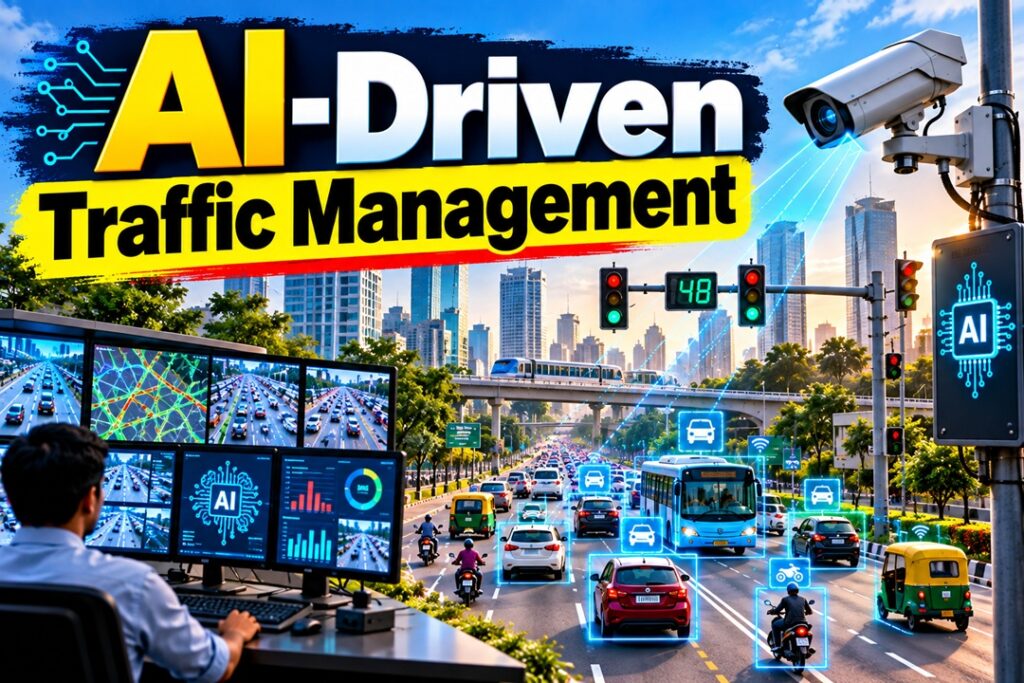
The ITMS is envisaged as a citywide, AI-enabled traffic management framework that moves beyond conventional fixed-time signals and manual traffic regulation. It will enable traffic signals and enforcement mechanisms to respond dynamically to changing road conditions.
The system will be implemented by the Delhi Police under the Ministry of Home Affairs.
How the System Will Function
Real-Time Traffic Monitoring
Roadside sensors and AI-enabled cameras will continuously capture information such as:
- Traffic density and vehicle speed
- Queue length at intersections
- Lane occupancy and traffic movement
This data will provide the technological foundation for real-time traffic management.
Adaptive Traffic Signals
Advanced Traffic Control System (ATCS) algorithms will process traffic information and modify signal timings automatically. Coordination between successive intersections can create “green waves”, allowing vehicles to move with fewer stops and reducing unnecessary delays.
Automated Traffic Enforcement
Computer-vision systems will identify violations such as:
- Red-light jumping
- Stop-line violations
- Triple riding
- Mobile-phone use while driving
Number-plate recognition can also be integrated with VAHAN databases to assist in identifying stolen, blacklisted or otherwise flagged vehicles.
Priority for Emergency Services
One significant feature is the creation of emergency green corridors. GPS-based tracking and traffic algorithms can coordinate signals to provide a clearer route for ambulances and fire tenders, potentially improving emergency response times.
Major Components of the ITMS
The proposed infrastructure will cover 42 major corridors, comprising 1,092 ATCS-controlled intersections and 1,029 automated enforcement locations across Delhi.
Centralised Traffic Command and Control Centres will aggregate traffic information and support operational decision-making. These facilities will be backed by Tier-III data centres and off-site disaster-recovery infrastructure, enhancing system continuity.
For commuters, congestion information will be communicated through Variable Message Signs (VMS) and navigation platforms. This can allow motorists to modify routes according to prevailing traffic conditions.
Significance
The ITMS can contribute to urban mobility in several ways:
Reducing congestion: Dynamic signal coordination can improve road capacity utilisation and reduce unnecessary waiting.
Lowering emissions: Smoother traffic movement and reduced idling can help decrease fuel consumption and vehicular emissions.
Improving road safety: Automated detection can make traffic enforcement more consistent and enable authorities to identify recurring violations.
Strengthening emergency response: Signal prioritisation can facilitate faster movement of emergency vehicles.
Data-driven governance: Continuous collection and analysis of traffic data can help authorities identify bottlenecks and plan future transport interventions.
Key Concerns
The expansion of AI-based surveillance also requires safeguards concerning data protection, cybersecurity, accuracy of automated detection and accountability for technology-driven enforcement.
AI systems may generate errors because of poor visibility, faulty sensors, number-plate recognition failures or unusual road conditions. Therefore, mechanisms for human review, grievance redressal and correction of erroneous enforcement actions will remain important.
The effectiveness of the system will also depend on interoperability between traffic infrastructure, databases, command centres and navigation platforms, along with regular maintenance of sensors and cameras.
Way Forward
Delhi should combine ITMS deployment with strong data-governance safeguards, transparent enforcement protocols and human oversight. Periodic independent audits can assess the accuracy of automated detection, while interoperable transport data can help integrate traffic management with public transport, pedestrian infrastructure and emergency services.
Technology should therefore complement, rather than replace, broader measures such as public transport expansion, parking management, road-safety improvements and better urban planning.
Conclusion
The ITMS represents a transition from reactive traffic policing to predictive and data-driven mobility management. Its long-term value will depend not only on technological deployment but also on responsible governance, system reliability and integration with Delhi’s wider urban transport strategy.
Source : PIB