
AI Proposed as India’s Next Digital Public Infrastructure (DPI)
Context
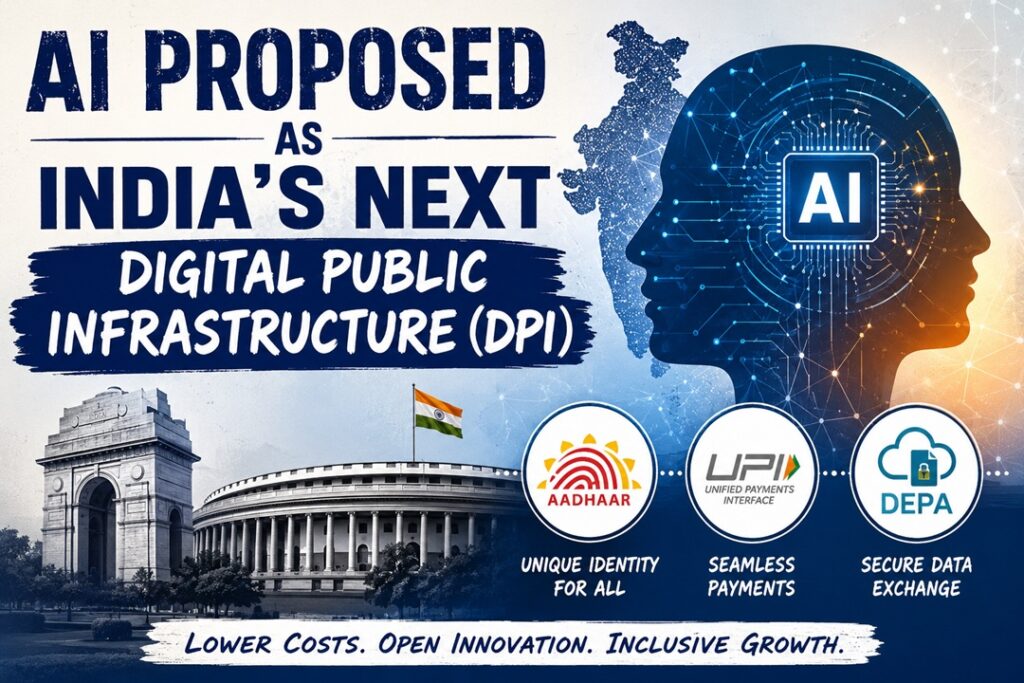
Public policy experts have proposed positioning Artificial Intelligence (AI) as India’s next Digital Public Infrastructure (DPI), advocating affordable AI inference, open-source foundation models, and interoperable digital ecosystems inspired by Aadhaar, UPI, and DEPA. The proposal seeks to transform AI into an accessible public utility, reduce dependence on foreign AI platforms, and promote inclusive digital innovation across governance, education, healthcare, agriculture, and industry.
AI as India’s Next Digital Public Infrastructure (DPI)
Overview
Artificial Intelligence (AI) as the next Digital Public Infrastructure (DPI) envisions AI computing, inference services, and foundational models becoming affordable, interoperable, and publicly accessible digital infrastructure. Similar to Aadhaar enabling digital identity and UPI revolutionizing digital payments, AI would become a common digital resource supporting innovation, economic growth, and public service delivery.
Why Should AI Become India’s Next DPI?
Expanding India’s Successful DPI Framework
India has already built globally acclaimed Digital Public Infrastructure through Aadhaar (digital identity), UPI (digital payments), and DEPA (consent-based data sharing). Adding AI as the next layer would strengthen India’s digital ecosystem and create a foundation for AI-powered public services and innovation.
Reducing Dependence on Foreign AI Platforms
Although India contributes significantly through software talent, data creation, and AI research support, most advanced AI models and cloud infrastructure remain controlled by foreign technology companies. Developing domestic AI infrastructure would enhance technological independence.
Making AI Affordable for Everyone
Commercial AI services often involve high inference costs, limiting access for startups, educational institutions, researchers, rural innovators, and small businesses. Affordable public AI infrastructure would democratize access to advanced AI capabilities.
Encouraging Indigenous Innovation
Lower AI infrastructure costs would allow Indian developers to concentrate on building innovative applications for agriculture, healthcare, education, governance, manufacturing, and financial services instead of spending heavily on proprietary AI services.
Strengthening Digital Sovereignty
Building India’s own AI ecosystem using open-source models and domestic computing infrastructure reduces strategic dependence on overseas technology providers while ensuring greater control over critical digital technologies.
Government Initiatives Supporting AI Development
IndiaAI Mission
The IndiaAI Mission, with an approved budget of ₹10,372 crore, aims to strengthen India’s AI ecosystem by expanding computing infrastructure, supporting startups, promoting AI research, and developing indigenous AI technologies.
Expansion of GPU Computing Infrastructure
India has aggregated more than 38,000 Graphics Processing Units (GPUs), with plans to expand computing capacity substantially. These resources are being made available at subsidized rates for startups, researchers, academic institutions, and innovators.
BHASHINI Initiative
BHASHINI is creating multilingual datasets, speech technologies, translation systems, and language models across Indian languages, enabling AI applications that serve India’s linguistic diversity.
Promotion of Open AI Ecosystems
Government-supported initiatives encourage collaborative AI research, open datasets, responsible AI development, and greater accessibility of AI technologies to academia and industry.
Major Challenges
Heavy Dependence on Imported AI Hardware
India currently lacks large-scale manufacturing of advanced AI semiconductor chips, making it dependent on imported GPUs and specialized computing hardware.
Growing Energy Requirements
AI data centres consume enormous amounts of electricity. Existing energy planning frameworks do not fully account for the rapidly increasing demand created by AI computing infrastructure.
Limited Availability of Open AI Models
Most cutting-edge foundation models are proprietary products owned by a handful of global technology companies, creating long-term affordability and accessibility concerns.
Insufficient Indian Language Training Data
Large-scale, high-quality datasets in regional Indian languages remain limited, reducing AI performance for many local-language applications.
High Cost of Proprietary AI APIs
Indian startups frequently rely on foreign AI platforms that charge usage fees in US dollars, increasing operational costs and reducing opportunities for experimentation and innovation.
Suggested Roadmap
Integrate AI Infrastructure into National Energy Planning
Future electricity planning should specifically include AI data centres, renewable energy generation, and dedicated transmission infrastructure to support expanding AI computing needs.
Encourage Open-Weight AI Models
AI models developed using government-funded computing resources or publicly supported datasets should be released under open-weight licensing to promote wider research, innovation, and transparency.
Create a Unified Intelligence Interface (UII)
India can establish an interoperable AI platform similar to UPI that enables applications to seamlessly connect with multiple AI models through standardized APIs.
Introduce AI Compute Credits
Students, researchers, startups, educational institutions, and innovators could receive government-supported AI computing credits or subsidized inference tokens to encourage experimentation and learning.
Invest in AI Capacity Building
Greater investment should be directed toward AI education, research institutions, innovation centres, digital skilling programmes, and workforce development to build long-term national AI capabilities.
Benefits of AI as Digital Public Infrastructure
- Expands affordable access to AI technologies across society.
- Supports innovation by Indian startups and developers.
- Strengthens digital sovereignty and technological self-reliance.
- Promotes AI adoption in education, healthcare, agriculture, governance, and MSMEs.
- Encourages multilingual AI solutions tailored to India’s diverse population.
- Creates new employment and economic opportunities through AI-driven industries.
Conclusion
Making Artificial Intelligence the next Digital Public Infrastructure can transform India from primarily a provider of digital talent and data into a global leader in AI-powered innovation. By expanding affordable computing infrastructure, promoting open-source AI models, strengthening domestic capabilities, and ensuring equitable access, India can build an inclusive AI ecosystem that supports sustainable economic growth, technological independence, and public welfare.
Source : The Hindu