
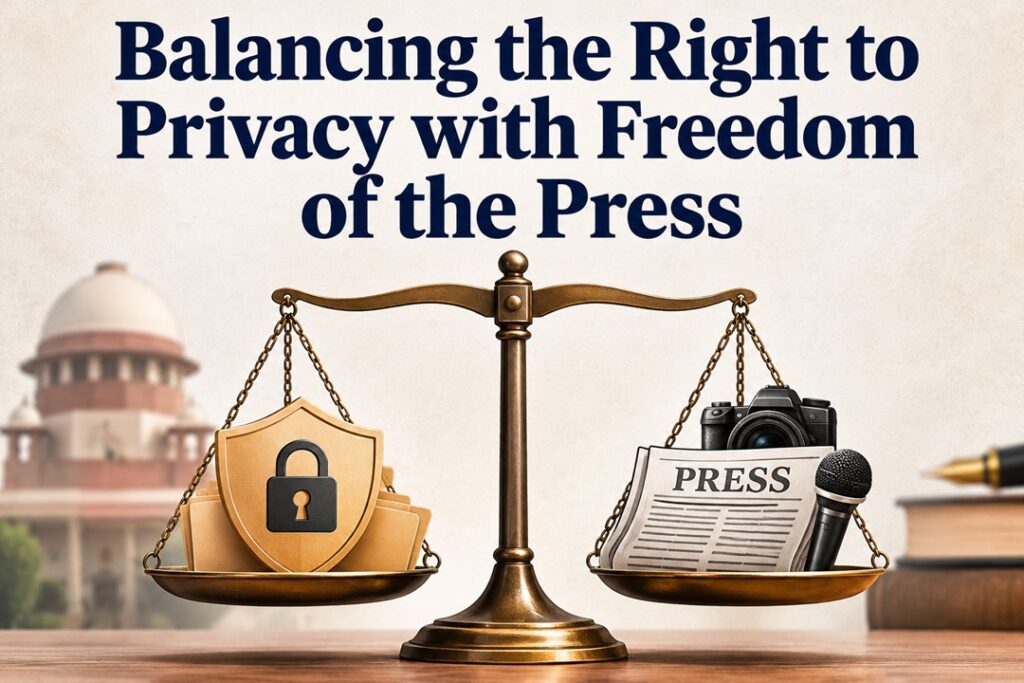
Balancing the Right to Privacy with Freedom of the Press
Context
The Digital Personal Data Protection (DPDP) Act, 2023, has triggered concerns over its potential impact on investigative journalism and freedom of the press, bringing the balance between individual privacy and the public’s right to information into focus.
Background of the Case
- Challenge by News Publishers: On October 27, 2026, the Digital News Publishers Association (DNPA), representing 21 news organisations, approached the Supreme Court seeking an interim stay on certain provisions of the DPDP Act, 2023.
- Concerns over Journalistic Freedom: In its petition filed on October 6, the DNPA argued that the legislation could restrict investigative reporting, compromise confidential sources, compel the removal of published material and discourage whistleblowers.
- Absence of Journalistic Exemption: The association highlighted that the Act does not provide a specific exemption for journalistic activities, potentially exposing news organisations to restrictions while processing personal data.
- Risk of Pre-censorship: Senior advocate Madhavi Divan argued that requiring journalists to obtain consent from individuals before publishing reports could effectively allow those being investigated to influence or prevent publication.
- Constitutional Debate: The Supreme Court hearing raises an important question about reconciling the fundamental right to privacy with press freedom and the public interest in accessing information.
Can the Media Invade Individual Privacy in the Name of Public Interest?
The Constitution protects both freedom of expression and personal privacy. Neither right is absolute, requiring a careful balance between public accountability and individual dignity.
- Constitutional Protection of Press Freedom: Article 19(1)(a) guarantees freedom of speech and expression, which includes the freedom to investigate, publish and disseminate information. However, this freedom must coexist with the Right to Privacy under Article 21.
- Privacy as a Fundamental Right: In K.S. Puttaswamy v. Union of India (2017), the Supreme Court recognised privacy as an intrinsic part of the right to life and personal liberty.
- Distinction Between Public and Private Life: In R. Rajagopal v. State of Tamil Nadu (1994), popularly known as the Auto Shankar case, the Court held that public officials cannot invoke privacy to prevent the publication of information relating to their official conduct.
- However, occupying public office does not mean that every aspect of an individual’s personal life becomes a legitimate subject of media scrutiny.
- Protection Against Prior Restraint: The Court recognised that the State cannot ordinarily impose prior restrictions on publication merely on the ground that the material concerns an individual’s private life.
- Investigative Reporting and Fair Trial: Journalism must not turn into an unofficial judicial process in which allegations are presented as established guilt.
- Temporary Restrictions on Reporting: In Sahara India Real Estate Corp. v. SEBI (2012), the Supreme Court recognised that courts may issue temporary postponement orders when media reporting creates a real and substantial risk of prejudicing an ongoing trial.
- Avoiding Media Trials: In Manu Sharma v. State (NCT of Delhi) (2010), the Court cautioned against media narratives that portray accused persons as guilty before the judicial process is completed.
Can Journalists Use Hidden Cameras and Sting Operations to Expose Wrongdoing?
Investigative journalism sometimes employs concealed recording devices and undercover methods to uncover corruption and abuse of authority. However, the legitimacy of these techniques depends on their purpose, methods and compliance with the law.
A sting operation involves covert or deceptive methods used to expose suspected wrongdoing or catch individuals engaging in unlawful activities.
- Public Interest in Sting Operations: In R.K. Anand v. Registrar, Delhi High Court (2009), the Supreme Court upheld the importance of a sting operation that exposed an attempt to influence a witness in the BMW hit-and-run case.
- Public Interest Does Not Guarantee Immunity: In Rajat Prasad v. CBI (2014), the Supreme Court clarified that investigative journalism does not provide blanket protection against criminal liability for unlawful conduct undertaken during a sting operation.
- Distinguishing Investigation from Entrapment: Journalists must distinguish between documenting existing misconduct and actively inducing an individual to commit an offence.
- Individual Assessment of Liability: Criminal responsibility must be determined by examining the intention, conduct and specific role of each person involved, based on the available evidence.
Thus, exposing wrongdoing may serve a legitimate democratic purpose, but the methods employed must remain within the boundaries of law.
How Do International Frameworks Balance Privacy and Press Freedom?
International human rights instruments recognise privacy and freedom of expression as complementary rights that may sometimes come into conflict.
- International Covenant on Civil and Political Rights (ICCPR):
- Article 17 protects individuals against arbitrary or unlawful interference with their privacy.
- Article 19 safeguards freedom of opinion and expression, including the freedom to seek, receive and impart information.
- European Convention on Human Rights (ECHR):
- Article 8 protects the right to respect for private and family life.
- Article 10 guarantees freedom of expression, including press freedom.
Axel Springer AG v. Germany (2012)
- The European Court of Human Rights examined restrictions imposed on a newspaper that reported the arrest of a television actor on suspicion of possessing cocaine.
- By a 12–5 majority, the Grand Chamber found that the restrictions violated the newspaper’s freedom of expression under Article 10.
- The Court emphasised the media’s role as a public watchdog and recognised the importance of reporting matters of legitimate public interest.
Approaches Adopted by Different Countries
- United States: The First Amendment protects freedom of the press. The Privacy Protection Act, 1980, also provides safeguards against certain law-enforcement searches and seizures of journalists’ unpublished materials, subject to specified exceptions.
- United Kingdom: The Data Protection Act, 2018, provides a journalistic exemption from certain data-protection obligations where publishers reasonably believe that publication is in the public interest and the relevant legal conditions are satisfied.
- Brazil: The General Data Protection Law (LGPD) excludes personal data processing undertaken exclusively for journalistic and artistic purposes from its general scope.
- Kenya: Section 52 of the Data Protection Act, 2019, provides conditional exemptions from certain data-protection requirements for journalistic activities, subject to public-interest considerations and safeguards.
Global Approach: Many jurisdictions recognise that journalism requires certain freedoms in handling personal information. Consequently, they provide conditional exemptions rather than treating journalistic activities in the same manner as ordinary commercial data processing.
Way Forward
- Introduce a Clear Journalistic Exemption: India’s data-protection framework should provide a carefully defined exemption for genuine journalistic activities, particularly investigations undertaken in the public interest.
- Establish Public-Interest Criteria: Exemptions should consider the relevance of information to public accountability, the seriousness of wrongdoing and the necessity of disclosure.
- Protect Confidential Sources: Appropriate legal safeguards should prevent unnecessary disclosure of whistleblower identities and confidential journalistic sources.
- Strengthen Media Accountability: Journalists should follow professional ethics, verify facts, distinguish allegations from proven facts and respect the privacy of individuals where disclosure serves no legitimate public purpose.
- Prevent Arbitrary Restrictions: Any restriction on publication should satisfy constitutional requirements of legality, necessity and proportionality.
- Promote Judicial Oversight: Independent judicial scrutiny can help prevent misuse of data-protection provisions to suppress legitimate criticism or investigative reporting.
- Encourage Responsible Digital Journalism: News organisations should adopt transparent data-handling practices while ensuring that compliance requirements do not undermine editorial independence.
Conclusion
Privacy and press freedom are both essential pillars of a constitutional democracy. While the DPDP Act seeks to strengthen individual control over personal information, its implementation must not weaken the media’s ability to expose corruption, hold public authorities accountable and inform citizens. India needs a proportionate legal framework that protects individual dignity without allowing privacy laws to become instruments of censorship.
Source : The Hindu