
Can India Safeguard Merit Against the Menace of Corruption?
Context
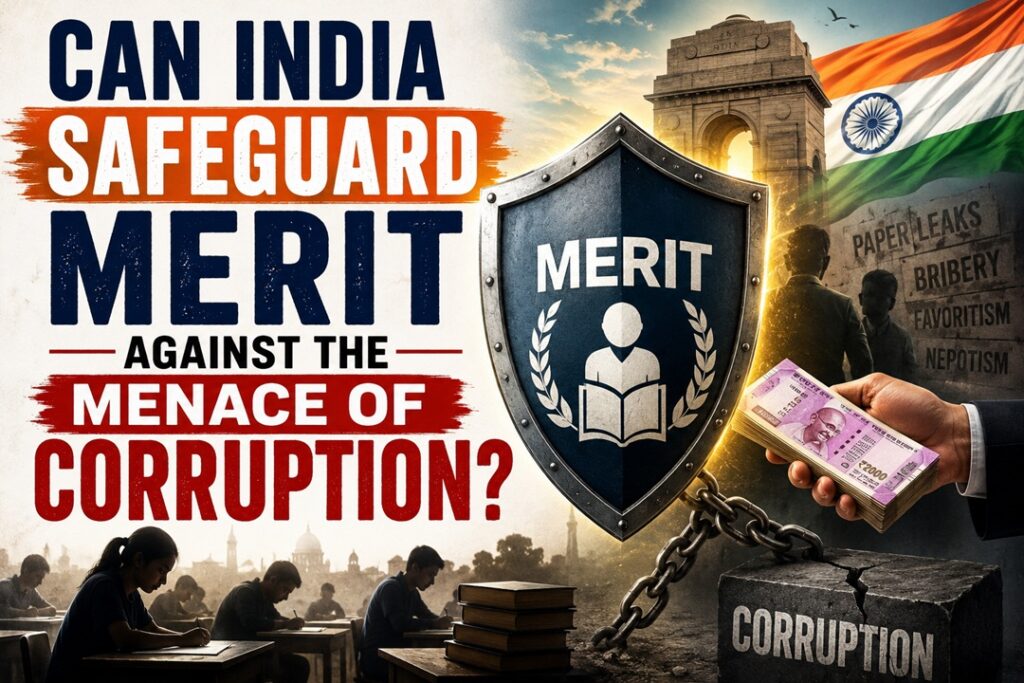
Nationwide student protests erupted across Delhi (Jantar Mantar), Amritsar, Mumbai, and several other cities following recurring paper-leak incidents in major national entrance examinations, particularly NEET-UG. Students demanded greater transparency, institutional accountability, and strict action against organized examination fraud. The protests reignited concerns over the growing impact of corruption on meritocracy, fair recruitment, institutional credibility, and public trust, raising a broader debate on whether corruption has become one of the greatest threats to India’s future.
What is Corruption?
Corruption is the misuse of entrusted public or private authority for personal, political, or financial gain. It undermines the principles of accountability, transparency, fairness, and the rule of law, replacing public interest with self-interest and weakening institutional credibility.
Broadly, corruption can be classified into Collaborative (Collusive) Corruption and Forced (Coercive) Corruption, besides common forms such as bribery, embezzlement, nepotism, favoritism, abuse of office, and fraud.
Major Types of Corruption
1. Collaborative (Collusive) Corruption
Meaning:
Occurs when both the bribe-giver and bribe-taker willingly cooperate to secure an illegal benefit.
Characteristics:
- Both parties gain mutual benefits.
- Public resources and taxpayers become the ultimate victims.
- Highly secretive and difficult to detect.
Example:
A private company bribes government officials to obtain public infrastructure contracts or bypass environmental regulations.
2. Forced (Coercive) Corruption
Meaning:
Occurs when public officials force citizens or businesses to pay bribes for services that are legally their right.
Characteristics:
- Victims pay under coercion or administrative harassment.
- Mostly affects ordinary citizens and vulnerable groups.
- Victims are more likely to report if adequate legal protection exists.
Example:
Demanding illegal payments for pensions, land records, driving licences, or filing police complaints.
Key Facts on Corruption in Competitive Examinations
Repeated Paper Leaks
- More than 152 recruitment and entrance examinations reportedly experienced paper leaks between 2016–2026.
- Around 7.5 crore aspirants were affected nationwide.
Poor Conviction Rate
- Despite numerous investigations, organized paper-leak syndicates continue to operate due to extremely low conviction rates.
NEET-UG 2026 Controversy
- The cancellation and re-examination affected nearly 22.7 lakh medical aspirants.
- Investigation reports alleged papers were sold through organized interstate networks for as much as ₹40 lakh.
Demand-Supply Gap
- Around 23 lakh students compete for nearly one lakh MBBS seats, creating opportunities for illegal examination rackets.
Major Causes of Corruption
Weak Institutional Accountability
Anti-corruption bodies often suffer from delayed appointments, inadequate independence, and weak enforcement capacity.
Example:
Institutions such as the Lokpal have faced criticism regarding delays in high-profile investigations and limited effectiveness.
Declining Transparency
Restrictions on access to government information reduce public oversight and weaken transparency mechanisms.
Legal Protection for Officials
Certain legal provisions requiring prior government approval before investigating public servants may delay inquiries and reduce accountability.
Judicial Delays
Corruption trials often continue for several years, reducing deterrence and allowing offenders to evade timely punishment.
Impact on India’s Future
Undermining Meritocracy
Paper leaks and recruitment scams replace merit with financial influence, denying deserving candidates equal opportunities.
Mental Health Consequences
Repeated examination cancellations, uncertainty, and prolonged litigation create stress, anxiety, and emotional trauma among students.
Declining Professional Standards
Entry of unqualified candidates into professions such as medicine, engineering, education, and civil services weakens service quality and public safety.
Loss of Public Trust
Persistent corruption reduces confidence in democratic institutions, governance, and the rule of law.
Moral and Ethical Decline
When corruption goes unpunished, unethical practices become normalized, encouraging institutional cynicism.
Way Forward
Fast-Track Courts
Establish dedicated courts under the Public Examinations (Prevention of Unfair Means) Act, 2024 to ensure corruption and paper-leak cases are disposed of within a fixed timeframe.
Strengthen Transparency
Improve access to public information while balancing privacy concerns to enhance accountability.
Reform Examination Agencies
Transform bodies such as the National Testing Agency (NTA) into stronger statutory institutions with secure digital examination systems and specialized professional cadres.
Independent Institutional Appointments
Ensure transparent, merit-based appointments to constitutional watchdogs and investigative agencies to strengthen institutional independence.
Technology-Based Security
Adopt advanced cybersecurity measures, AI-based monitoring, encrypted digital systems, and secure computer-based testing to minimize examination fraud.
Conclusion
Corruption is not merely a legal or administrative issue but a serious threat to India’s democracy, economic development, social justice, and youth aspirations. Examination paper leaks demonstrate how corruption directly undermines meritocracy and public confidence in institutions. Restoring trust requires strong institutions, transparent governance, swift justice, robust technological safeguards, and ethical public administration. Only by ensuring accountability and protecting merit can India build a fair, inclusive, and developed society.
Source : The Hindu