
Carbon Border Adjustment Mechanism (CBAM): Implications for India and Global Trade
Introduction
The Carbon Border Adjustment Mechanism (CBAM) has emerged as a major climate policy instrument in global trade governance. Introduced by the European Union (EU), CBAM seeks to integrate climate objectives with international trade by imposing carbon-linked charges on imports of carbon-intensive products. While the mechanism aims to reduce global emissions and prevent carbon leakage, it also poses significant economic and trade challenges for developing countries such as India, particularly in sectors dependent on energy-intensive production.
What is Carbon Border Adjustment Mechanism (CBAM)?
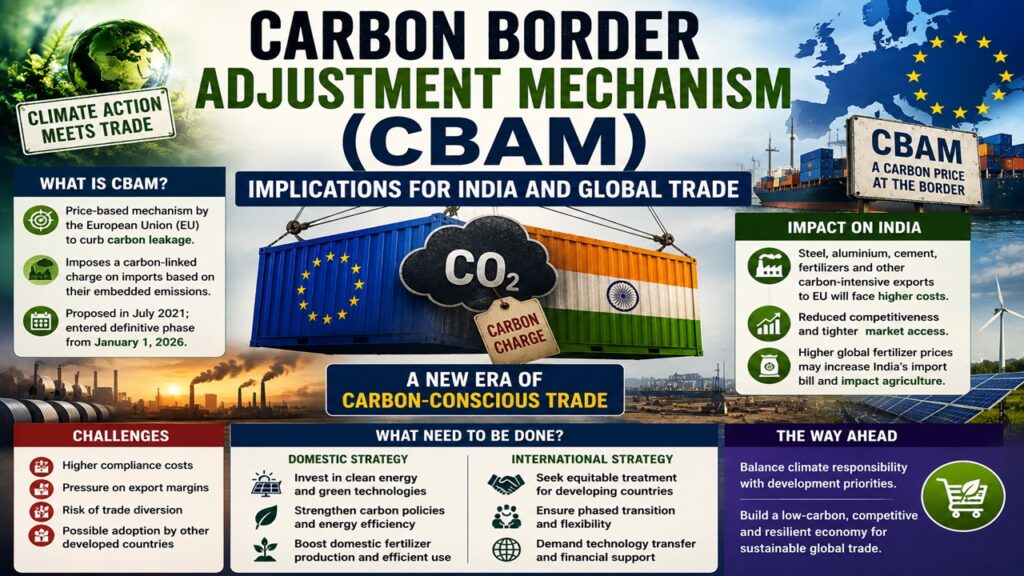
Meaning of CBAM: CBAM is a price-based and quantifiable climate policy tool that directly links market access for carbon-intensive goods with the amount of carbon emissions embedded in their production.
Primary Objective: The main goal of CBAM is to prevent carbon leakage by imposing a carbon-linked charge on imports entering the European Union.
Meaning of Carbon Leakage: Carbon leakage occurs when industries shift the production of carbon-intensive goods to countries with weaker climate regulations to avoid strict emission norms and higher compliance costs.
Timeline and Implementation: CBAM was proposed by the European Union in July 2021 and entered its definitive phase from January 1, 2026.
Distinction Between CBAM and Traditional Non-Tariff Measures
Nature of Traditional NTMs: Traditional non-tariff measures (NTMs), such as product quality standards and technical regulations, mainly affect trade through compliance requirements that are often qualitative in nature.
Unique Nature of CBAM: Unlike conventional NTMs, CBAM directly imposes costs based on the carbon intensity of production, making climate compliance a critical determinant of market access.
Higher Compliance Costs: Transitioning to cleaner and carbon-neutral production systems is significantly more expensive in the short term compared to meeting ordinary product quality standards.
Shift in Global Trade Rules
Carbon Efficiency as a Trade Determinant: Global trade is increasingly being shaped not only by tariffs and price competitiveness but also by the carbon efficiency of production processes.
Transformation in Market Access: Countries with carbon-intensive industries may face reduced export competitiveness unless they adopt cleaner technologies and sustainable production methods.
Emergence of Climate-Linked Trade Governance: CBAM represents a structural transformation where climate policy becomes closely integrated with international trade regulations.
Impact of CBAM on India’s Trade
Applicability Despite Trade Agreements: Even if India concludes bilateral trade agreements with the EU, CBAM will continue to apply to carbon-intensive exports entering European markets.
Carbon Standards and Market Access: Access to international markets is increasingly determined by compliance with carbon-emission standards alongside traditional tariff reductions.
Sector-Wise Impact on India
Impact on Steel and Aluminium Sectors: India’s steel and aluminium industries are expected to face the most immediate impact because of their dependence on European markets and relatively carbon-intensive production systems.
Burden on Exporters: Although the carbon levy will formally be paid by EU importers, a significant part of the cost burden is likely to shift to Indian exporters through:
Tighter supplier contracts
Stricter sourcing requirements
Pressure to reduce emissions
Pressure for Green Transition: European buyers are increasingly likely to prefer low-emission suppliers, compelling Indian exporters to invest in greener production technologies.
Short-Term Competitiveness Concerns: Rising compliance costs may reduce profit margins and weaken export competitiveness despite ongoing free trade agreement negotiations.
Indirect Impact on India’s Fertilizer Sector
India’s Import Dependence: India is a major importer of fertilizers and may face indirect economic pressures due to rising global carbon-compliance costs.
Key Fertilizer Exporters: Countries such as Egypt, Russia, Morocco, and China, which are important fertilizer suppliers to India, are also major exporters to the EU.
Transmission of Higher Costs: As these countries face increased carbon-compliance expenses under CBAM, part of the additional cost is likely to be transferred through higher fertilizer prices globally.
Impact on Agriculture: Rising fertilizer import costs may:
Increase India’s fertilizer import bill
Reduce farm profitability
Increase agricultural input costs
Contribute to food inflation
Structural Implications for Developing Countries
Global Expansion of Carbon Tariffs: CBAM signals a broader structural shift, as several developed countries are considering similar climate-linked trade measures.
Challenges for Developing Economies: Developing countries such as India may face restricted market access unless they improve carbon efficiency and transition towards sustainable industrial production.
Risk of Trade Inequality: Without adequate support mechanisms, carbon-linked trade rules may widen economic disparities between developed and developing economies.
Domestic Strategies for India
Investment in Clean Energy: India must increase investments in:
Renewable energy
Green hydrogen
Energy-efficient technologies
Low-carbon manufacturing systems
Strengthening Carbon Policies: Effective implementation of domestic carbon policies and emission reduction frameworks is necessary to improve industrial competitiveness.
Domestic Measures for Fertilizer Security
Reducing Import Dependence: India should reduce reliance on imported fertilizers through:
Higher domestic production
Promotion of alternative fertilizers
Improved nutrient management practices
Role of Soil Health Cards: Better implementation of the Soil Health Card Scheme can encourage balanced and need-based fertilizer usage.
Sustainable Agricultural Practices: Efficient fertilizer use can reduce both environmental pressure and import dependence.
International Strategy for India
Demand for Equitable Treatment: India must negotiate for fair treatment of developing countries in climate-linked trade mechanisms.
Phased Transition Mechanism: India should advocate a gradual and phased implementation of carbon compliance obligations to reduce short-term economic disruption.
Need for Technology Transfer: Access to affordable green technologies and climate finance is essential for enabling developing countries to transition towards low-carbon production systems.
Importance of Transitional Support: India should seek financial and technological support mechanisms in trade negotiations with developed economies.
Conclusion
The emergence of CBAM reflects a significant transformation in the global trade regime where climate considerations are increasingly shaping market access and competitiveness. For India, the challenge lies not only in adapting to carbon-constrained trade systems but also in ensuring that the transition does not undermine economic growth, industrial competitiveness, and developmental priorities. A balanced strategy combining domestic reforms, green industrial transformation, and effective international negotiation will be essential for safeguarding India’s long-term economic and environmental interests.
Source :The Hindu