
Census 2027: Strengthening Digital Enumeration, Data Accuracy and Public Trust
Context
The introduction of 13 new questions in Census 2027 highlights India’s evolving approach to demographic data collection. As the country’s first digital Census, the exercise places greater emphasis on accurate enumeration, comprehensive demographic information, data security and public confidence.
What Are the Major Changes in Census 2027?
Census 2027 introduces additional questions to capture a wider range of personal, social and economic information compared with the 2011 Census. The new questionnaire seeks to improve the understanding of India’s changing demographic and socio-economic profile.
Key areas of information include:
- Personal and Family Information: Details relating to caste, religion, nationality, spouse’s name and parents’ particulars, including their place and date of birth.
- Identity and Documentation: Information concerning Aadhaar, mobile numbers, voter ID, driving licence, passport availability and bank accounts.
- Residential Information: Details regarding permanent residential addresses.
- Digital and Social Indicators: Information on digital literacy, disability, migration, fertility and economic activities.
- Health-related Information: The questionnaire also includes details regarding the place of COVID-19 vaccination.
What Are the Key Features of Census 2027?
- Two-Phase Exercise: The Census is organised into House Listing Operations (HLO) and Population Enumeration (PE).
- House Listing Operations: The first phase was conducted between April 1 and September 30, 2026, except in Manipur.
- Large Enumeration Workforce: Approximately 34 lakh enumerators and supervisors, predominantly government school teachers, will participate in the second phase.
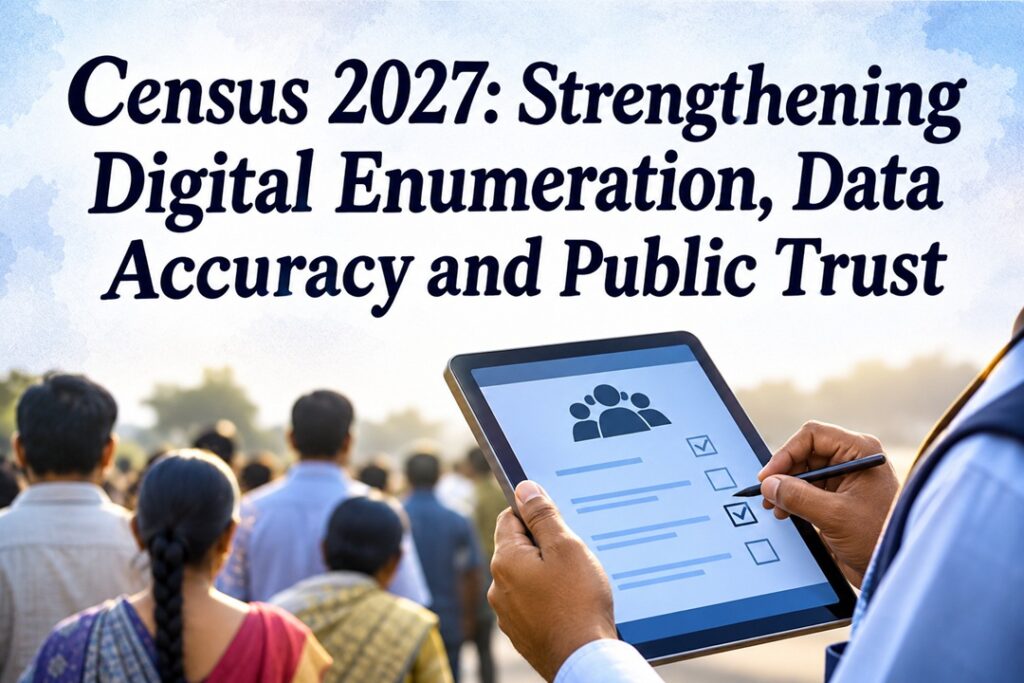
- Digital Data Collection: Enumerators will use mobile applications to record information, marking India’s transition towards a fully digital Census.
- Enumeration Blocks: Each block generally covers around 750–800 people, with approximately 20–25 minutes allocated for each household interview.
Why Is Enumerator Training Essential?
The reliability of Census information depends considerably on the competence and conduct of field personnel. Since the questionnaire includes sensitive personal information, enumerators must combine technical knowledge with professional sensitivity.
- Accuracy in Data Collection: Proper understanding of questions, coding procedures and interviewing techniques is necessary to minimise errors.
- Sensitivity towards Respondents: Questions concerning caste, religion, disability, fertility and migration must be handled without prejudice or discrimination.
- Protection of Privacy: Enumerators must explain the purpose of information collection and ensure that respondents do not feel pressured to disclose information.
- Building Public Confidence: Courteous behaviour, transparency and confidentiality are essential to encourage voluntary cooperation.
What Are the Major Concerns Associated with Census 2027?
1. Challenges in Caste Enumeration
- Census 2027 will undertake caste enumeration beyond Scheduled Castes and Scheduled Tribes for the first time in independent India.
- Respondents outside SC/ST categories will have to enter their caste names manually.
- The absence of a separate OBC category and reliance on open-ended responses may create difficulties in standardisation, classification and data comparability.
- Differences in caste nomenclature across regions could further complicate the preparation of reliable statistics.
2. Aadhaar and Data Privacy
- The inclusion of Aadhaar-related questions has raised concerns about the protection and possible misuse of personal information.
- Questions have also emerged regarding whether identity-related information could be associated with citizenship verification.
- However, Census officials have clarified that Aadhaar disclosure is optional and that the Census is not a citizenship verification exercise.
3. Concerns Regarding NPR and NRC
- The National Population Register (NPR), last updated in 2015, has attracted public opposition because of apprehensions about its possible relationship with the National Register of Citizens (NRC).
- Questions relating to identity, nationality, caste and religion may generate distrust if their purpose is not adequately explained.
- Clear institutional communication is therefore necessary to distinguish demographic enumeration from citizenship-related processes.
4. Digital and Administrative Limitations
- Dependence on mobile applications and digital infrastructure creates challenges relating to connectivity, technical failures and data security.
- Inadequate training or inconsistent interpretation of questions could affect data quality.
- Managing a workforce of approximately 34 lakh personnel across diverse geographical and socio-economic conditions will require strong coordination.
How Is Enumerator Training Organised?
Census training follows a four-tier hierarchical model to ensure standardised procedures and consistent implementation throughout the country.
- Subject Matter Experts: Train National Trainers.
- National Trainers: Prepare Master Trainers.
- Master Trainers: Train Field Trainers.
- Field Trainers: Conduct training for enumerators and supervisors in batches of 35–50 participants.
- Practical training in the Population Enumeration mobile application is compulsory for enumerators and supervisors.
- This approach aims to familiarise field personnel with digital tools, questionnaire procedures and accurate data recording.
What Is the PRAMAN Framework?
The government has introduced the PRAMAN framework to improve the quality of interaction between enumerators and households.
| Component | Meaning |
|---|---|
| Pehchaan | Establishing identity |
| Rishta | Building rapport |
| Anurodh | Making a request |
| Madad | Providing assistance |
| Aankada Shuddhata | Ensuring data accuracy |
| Nishtha | Demonstrating commitment |
- The framework encourages respectful communication and cooperation during household visits.
- A Seva Bhav pledge further reinforces the values of public service, responsibility and sensitivity among Census personnel.
What Is the Way Forward?
- Comprehensive Capacity Building: Strengthen practical training on sensitive questions, digital applications, standardised coding and unbiased interviewing.
- Safeguard Personal Information: Establish robust data protection mechanisms and clearly communicate the confidentiality of Census responses.
- Improve Transparency: Explain the purpose of new questions, particularly those concerning caste, Aadhaar and nationality, to address public apprehensions.
- Ensure Standardised Classification: Develop clear guidelines for recording and categorising caste names to minimise inconsistencies.
- Strengthen Digital Infrastructure: Provide technical support, secure data systems and backup mechanisms to address connectivity and application-related problems.
- Encourage Public Participation: Undertake awareness campaigns to improve cooperation and strengthen confidence in the Census process.
Conclusion
Census 2027 represents an important transformation in India’s demographic data collection, combining digital technology with expanded social and economic indicators. Its success will depend not merely on technological advancement but also on accurate enumeration, institutional transparency, data confidentiality and public cooperation. A credible Census can provide the foundation for inclusive policymaking, effective welfare delivery and evidence-based governance.
Source : The Hindu