
Climate Change and Cooperative Federalism: Who Should Bear the Cost of Climate Disasters?
Context
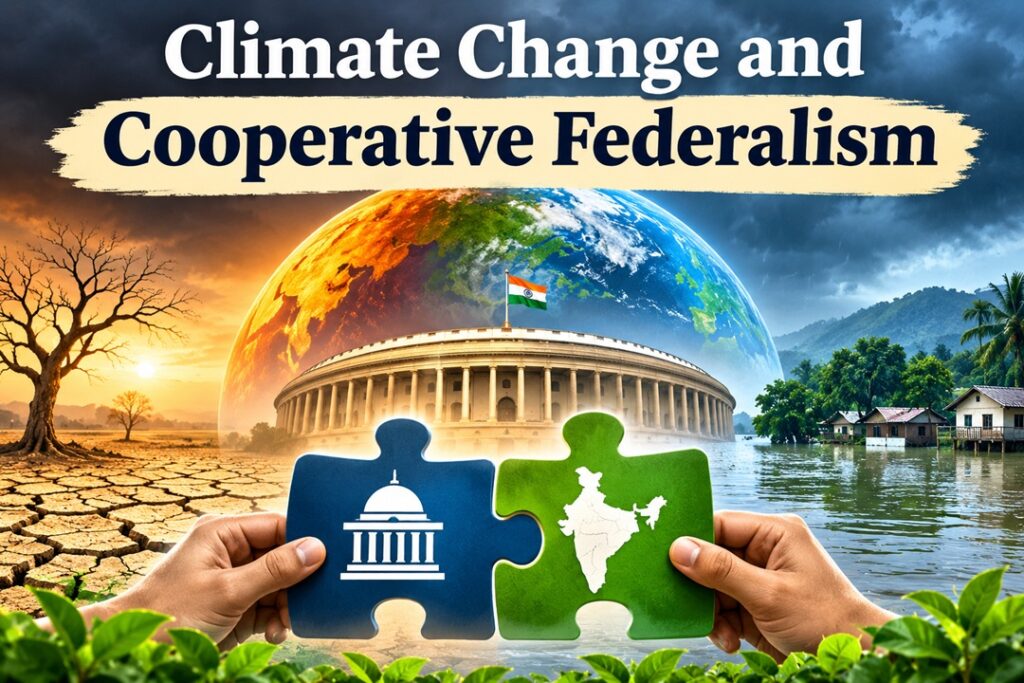
Recent climate-liability proceedings in the United States and the Sikkim High Court’s suo motu intervention have brought attention to the question of who should finance climate-induced disasters. In India, the debate highlights a growing mismatch between the Centre’s control over environmental regulation and financial resources and the States’ responsibility for disaster response and rehabilitation.
Climate Change and Federal Fiscal Responsibility
Understanding the Issue
Climate disaster financing is a constitutional, legal and fiscal issue concerning the distribution of responsibilities between the Union and State governments. It involves determining who should bear the costs of climate-related losses, how polluting industries should be held accountable, and whether disaster-affected States receive adequate financial assistance.
Evidence of the Growing Financial Burden on States
- Wayanad Landslides (2024): The disaster claimed 298 lives, with 32 people reported missing. The Centre took nearly five months to classify it as a disaster of severe nature and subsequently provided ₹529.50 crore as a 50-year interest-free loan instead of a grant.
- Himachal Pradesh Floods (2023): Against estimated damages of ₹9,042 crore, the State received ₹633.73 crore as immediate assistance through the National Disaster Response Fund (NDRF). A further ₹2,006.40 crore was sanctioned for recovery nearly two years later.
- Punjab Floods (2025): The State sought ₹20,000 crore for immediate relief following the August–September floods, whereas the Centre announced ₹1,600 crore.
- Coal Cess: The Clean Environment Cess on coal was increased to ₹400 per tonne in 2016. However, its proceeds remain with the Union government rather than being shared with States through the divisible tax pool.
Why Does India’s Climate Governance Face Federal Imbalances?
1. Centralised Legislative Authority
- Article 253 empowers Parliament to legislate on subjects in the State List for implementing international treaties and agreements.
- This provision has enabled the Union government to exercise considerable influence over environmental policymaking.
- For instance, the Air (Prevention and Control of Pollution) Act, 1981 and the Environment (Protection) Act, 1986 were enacted following the 1972 Stockholm Conference.
2. Centralised Disaster Management Framework
- Disaster management is not explicitly mentioned in the Union, State or Concurrent Lists of the Seventh Schedule.
- Parliament relied on relevant Concurrent List provisions to enact the Disaster Management Act, 2005, creating a largely centrally coordinated institutional framework.
- However, States undertake much of the actual disaster response, rescue, relief and rehabilitation.
- Delays in central assessments and the classification of disasters often restrict States’ access to additional financial assistance.
3. Unequal Distribution of Environmental Revenues
- Article 270 excludes cesses and surcharges from the divisible pool of central taxes.
- Consequently, revenues collected through environmental levies, including the coal cess, remain outside the regular tax-sharing mechanism.
- This creates a fiscal imbalance because States bear substantial ecological and disaster-management costs without receiving a corresponding share of these revenues.
4. Delayed and Inadequate Financial Assistance
- Central assistance frequently falls short of the actual economic losses suffered by disaster-affected States.
- The increasing reliance on loans instead of grants adds to the financial burden of States already facing reconstruction and rehabilitation expenses.
- Such arrangements can weaken their capacity to invest in long-term climate adaptation.
5. Limited Accountability of Corporate Polluters
- Industries contributing significantly to greenhouse gas emissions and environmental degradation rarely face direct financial liability for climate-related damages.
- Although environmental laws provide mechanisms for compensation and restitution, their effective implementation remains a challenge.
- This shifts a disproportionate share of disaster-related costs to governments and affected communities.
Judicial Interventions Strengthening Climate Accountability
Indian courts have gradually developed environmental principles that can support a stronger framework for climate responsibility.
- M.C. Mehta v. Union of India (1987): Established the principle of Absolute Liability, making enterprises engaged in hazardous activities responsible for harm caused by their operations without exceptions.
- Vellore Citizens Welfare Forum v. Union of India (1996): Recognised the Precautionary Principle and Polluter Pays Principle as essential components of Indian environmental jurisprudence.
- National Green Tribunal Act, 2010: Established a specialised tribunal with powers to adjudicate environmental disputes and provide compensation and restitution for environmental damage.
- M.K. Ranjitsinh v. Union of India (2024): Recognised the right to be free from the adverse effects of climate change as part of the fundamental rights protected under Articles 14 and 21.
- Sikkim High Court Intervention (September 2026): Following regional flash floods and the 2023 Teesta Glacial Lake Outburst Flood (GLOF), the High Court initiated suo motu proceedings. It emphasised district-level climate-risk assessments and participatory approaches to disaster preparedness.
Way Forward
- Integrate Climate Vulnerability into Fiscal Devolution: The Finance Commission should consider ecological sensitivity, disaster frequency, geographical vulnerability and adaptation requirements while determining the distribution of tax revenues among States.
- Ensure Equitable Sharing of Green Revenues: Environmental cesses and fossil-fuel-related levies should be incorporated into an appropriate revenue-sharing framework to provide States with resources for climate resilience.
- Move Towards Grant-Based Disaster Assistance: Replace excessive dependence on loans with time-bound, non-repayable rehabilitation grants based on transparent damage assessments and objective eligibility criteria.
- Strengthen Cooperative Climate Federalism: States should receive greater institutional flexibility to formulate region-specific adaptation policies, enforce environmental standards and undertake local climate-risk assessments.
- Improve Corporate Climate Liability: Strengthen the enforcement capacity of the NGT and other legal mechanisms to ensure that industries responsible for environmental damage contribute financially to restoration and compensation.
- Promote Anticipatory Disaster Governance: Develop district-level vulnerability mapping, early-warning systems, resilient infrastructure and community participation to reduce future disaster losses.
Conclusion
Climate change is not merely an environmental challenge but also a question of fiscal justice and constitutional federalism. India’s States cannot be expected to shoulder the consequences of climate disasters while remaining dependent on centrally controlled financial resources and regulatory mechanisms. A more equitable framework based on climate-sensitive fiscal devolution, polluter accountability, timely grants and decentralised decision-making is essential. Such an approach would strengthen cooperative federalism and move India from reactive disaster relief towards anticipatory climate resilience.
Source : The Hindu