
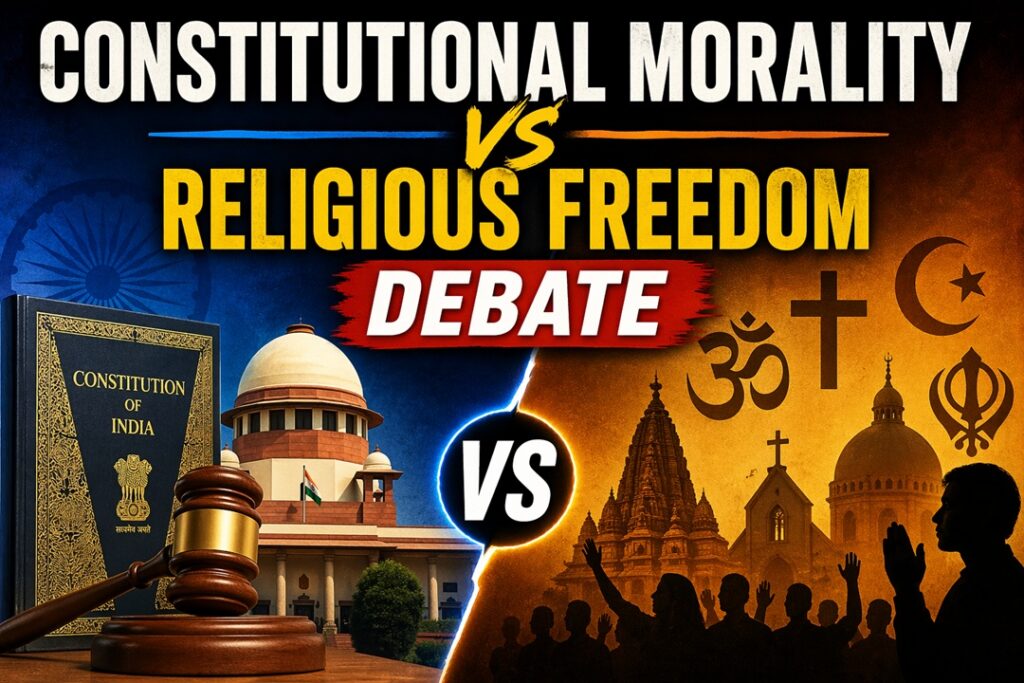
Constitutional Morality vs Religious Freedom Debate
Context
The Supreme Court of India is examining whether the State can rely on constitutional morality and the Directive Principles of State Policy (DPSP) to justify reform laws that impact religious practices.
Understanding Constitutional Ethics in Governance
Meaning – Constitutional morality refers to adherence to the foundational ideals of the Constitution—justice, liberty, equality, and fraternity—over entrenched societal or religious conventions.
Purpose – It ensures that legal reasoning is anchored in constitutional values rather than majoritarian beliefs or traditional authority.
Core Idea – The Constitution becomes the ultimate moral compass guiding governance and judicial interpretation.
Key Constitutional Provisions Involved
Equality Framework (Article 14) – Guarantees equal protection of laws, ensuring reforms address systemic discrimination.
Anti-Discrimination Clause (Article 15) – Prohibits exclusion based on religion, caste, gender, etc., forming the basis of progressive legislation.
Reform-Oriented Religious Freedom (Article 25(2)(b)) – Empowers the State to enact laws for social welfare, even within religious domains.
Welfare Mandate (Article 38) – Directs the State to promote social justice, linking DPSPs with transformative reforms.
Role in Driving Progressive Change
Breaking Social Hierarchies – Enables courts to invalidate discriminatory practices rooted in tradition.
Primacy of Individual Rights – Shifts focus from community dominance to individual dignity and freedoms.
Reforming Traditions – Facilitates alignment of religious practices with democratic and egalitarian norms.
Safeguarding Marginalized Sections – Protects minorities and vulnerable groups from oppressive customs.
Evolving Interpretation – Keeps constitutional values dynamic and responsive to changing societal needs.
Concerns and Social Tensions
Perceived Intrusion into Religion – Judicial intervention may be viewed as interference in faith-based practices.
Ideological Divisions – Creates friction between reformists and traditionalists.
Cultural Alienation – Communities may fear erosion of their distinct identity.
Public Resistance – Sudden reforms can trigger protests and instability.
Judicial Overreach Debate – Courts risk being seen as imposing moral standards beyond their mandate.
Ensuring a Balanced Approach
Essential Religious Practices Test – Distinguishes core religious tenets from reformable customs.
Measured Judicial Approach – Courts must rely on constitutional text, avoiding subjective interpretations.
Gradual Transformation – Incremental reforms ensure social acceptance and stability.
Dialogue with Communities – Encouraging internal reform reduces resistance.
Proportionality Principle – Restrictions on religious freedom must be reasonable and justified.
Conclusion
The debate on constitutional morality underscores the tension between individual rights and collective religious autonomy. While the Constitution authorizes social transformation, reforms must be carefully calibrated to avoid societal backlash. A nuanced, balanced path is essential to harmonize progressive ideals with India’s diverse cultural fabric.
Source : B&B