
Coral Reefs at Risk: IUCN Warns of Widespread Ecosystem Collapse by 2075
Context
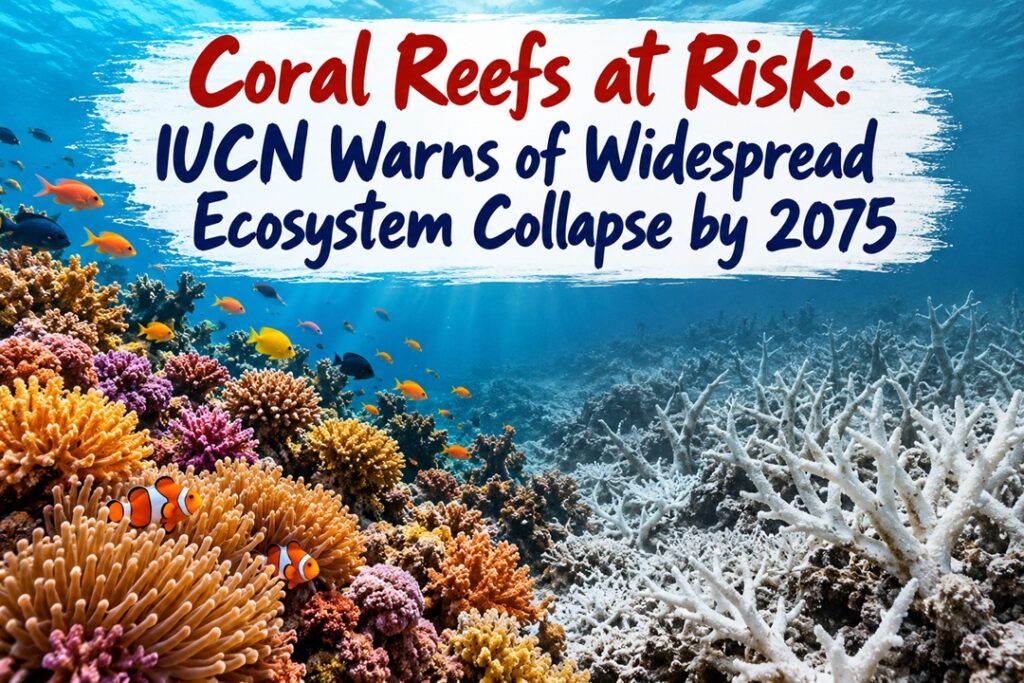
The International Union for Conservation of Nature (IUCN) released its first global assessment of coral reef ecosystems under the IUCN Red List of Ecosystems at a UN biodiversity conference in Yerevan, Armenia. The assessment highlights the growing threat of climate change and other human pressures, warning that 96% of the world’s shallow-water coral reef ecoregions could face a critical risk of collapse by 2075.
What Are Coral Reefs?
Coral reefs are underwater ecosystems formed by colonies of tiny marine organisms called coral polyps, which secrete calcium carbonate to build hard structures. Most reef-building corals maintain a symbiotic relationship with microscopic algae called zooxanthellae, which provide food through photosynthesis and contribute to their colour.
When ocean temperatures rise beyond tolerable limits, corals expel these algae, causing coral bleaching. Prolonged heat stress can lead to coral death and the degradation of entire reef ecosystems.
Key Findings of the IUCN Assessment
- Critical endangerment: 122 out of 127 assessed reef ecoregions (96%) are classified as Critically Endangered, while the Western Galápagos reef ecosystem is identified as collapsed.
- Climate-driven deterioration: Based on observed changes, around 24% of reef ecoregions are critically endangered; this proportion rises sharply when projected climate warming is considered.
- Marine heat stress: Rising ocean temperatures threaten approximately 77% of assessed reef ecoregions.
- Overfishing: Fish depletion and unsustainable fishing practices affect nearly 63% of reef ecoregions, weakening their ability to recover from disturbances.
- Exceptional biodiversity: Despite occupying less than 0.2% of the ocean floor, coral reefs support more than 25% of known marine species.
Importance of Coral Reef Ecosystems
1. Biodiversity conservation
Coral reefs provide breeding grounds, feeding areas and nursery habitats for numerous marine organisms, including fish, molluscs, crustaceans, sea turtles and sharks.
Example: The Great Barrier Reef and the Coral Triangle support exceptionally diverse marine communities.
2. Coastal protection
Reefs function as natural barriers that absorb wave energy, reducing coastal erosion, flooding and damage caused by storms. Healthy coral structures can dissipate up to 97% of incoming wave energy under suitable conditions.
Example: Island communities and low-lying atoll nations depend on surrounding reefs for protection against coastal hazards.
3. Food security and livelihoods
Coral reef fisheries provide food, employment and income to millions of people. Reef-based tourism also supports local economies through diving, recreation and hospitality services.
4. Medical and scientific value
Marine organisms associated with coral reefs produce compounds that can contribute to pharmaceutical research, including investigations into anticancer and antiviral agents. Coral-derived materials also have applications in bone grafting and biomedical research.
5. Carbon and nutrient cycling
Reef ecosystems contribute to marine nutrient cycling, support complex food webs and help sustain the ecological productivity of surrounding coastal waters.
Major Threats to Coral Reefs
1. Ocean warming and coral bleaching
Marine heatwaves disrupt the relationship between corals and their symbiotic algae. Repeated or prolonged bleaching reduces coral growth, reproduction and survival.
Example: Repeated mass bleaching events on the Great Barrier Reef have placed substantial pressure on living coral populations.
2. Overfishing and ecological imbalance
Excessive fishing reduces populations of herbivorous fish that control algae. Without sufficient grazing, algae can spread over coral surfaces and prevent young corals from establishing themselves.
3. Pollution and sedimentation
Agricultural runoff, untreated sewage, industrial waste and coastal construction introduce pollutants and excess nutrients into marine waters. Sediments reduce sunlight penetration and can smother coral colonies.
Example: Poorly managed coastal development can damage nearshore reef habitats in the Andaman and Nicobar Islands and Palk Bay.
4. Coral diseases and biological disturbances
Environmental stress increases coral susceptibility to disease. Outbreaks of coral predators, particularly the crown-of-thorns starfish, can also destroy large areas of living coral.
5. Ocean acidification
The absorption of atmospheric carbon dioxide by seawater lowers ocean pH and reduces carbonate ion availability. This makes it more difficult for corals to build and maintain their calcium carbonate skeletons.
Initiatives for Coral Reef Conservation
- Kunming–Montreal Global Biodiversity Framework: Promotes the conservation of 30% of land and sea areas by 2030, alongside ecosystem restoration and biodiversity monitoring.
- International Coral Reef Initiative (ICRI): Facilitates international cooperation, policy coordination and coral reef conservation efforts.
- Global Coral Reef Monitoring Network (GCRMN): Collects and analyses information on reef conditions to improve conservation planning and track ecological changes.
- Marine Protected Areas (MPAs): Restrict damaging activities in ecologically sensitive marine regions. In India, coral habitats in the Gulf of Mannar, Gulf of Kutch and island territories receive varying levels of protection.
- Restoration technologies: Methods such as coral micro-fragmentation, larval seeding and Biorock technology support the recovery of degraded reef habitats.
Way Forward
1. Strengthen global climate action
Countries must accelerate greenhouse gas emission reductions through stronger climate commitments, renewable energy deployment and reduced dependence on fossil fuels. Local reef protection cannot compensate for continued global ocean warming.
2. Protect climate-resilient reef habitats
Identify and conserve thermal refugia—areas where local environmental conditions provide corals with a better chance of surviving warming. Such areas can act as potential sources for future reef recovery.
3. Improve fisheries management
Enforce science-based fishing limits, prevent destructive fishing practices and protect herbivorous fish populations that maintain ecological balance. Expand community-led fisheries management and marine protected areas.
4. Control land-based pollution
Strengthen wastewater treatment, regulate industrial discharges, reduce agricultural runoff and improve sediment management in coastal development projects.
5. Scale up coral restoration and research
Invest in heat-tolerant coral breeding, assisted evolution, coral nurseries, larval propagation and cryobanking of coral reproductive material. Restoration should complement, rather than replace, protection of existing reefs.
6. Strengthen monitoring and international cooperation
Expand satellite-based observation, underwater surveys and early-warning systems. Countries should share scientific data, finance conservation programmes and involve coastal communities in reef management.
Conclusion
The IUCN assessment underscores the vulnerability of coral reefs to the combined effects of climate change, overfishing and pollution. Their degradation threatens marine biodiversity, coastal protection, food security and the livelihoods of millions of people. Protecting coral reefs requires a dual strategy: rapid global emissions reduction and effective local ecosystem management. Coordinated action today is essential to prevent further reef collapse and preserve these irreplaceable marine ecosystems for future generations.
Source : Down To Earth