
Deep-Sea Mining in India: Balancing Critical Mineral Security with Ocean Conservation
Context
India’s Deep Ocean Mission and exploration contracts with the International Seabed Authority (ISA) are expanding the country’s scientific and technological capabilities in the deep ocean. At the same time, concerns are growing over the ecological consequences of extracting minerals from poorly understood and extremely fragile seabed ecosystems.
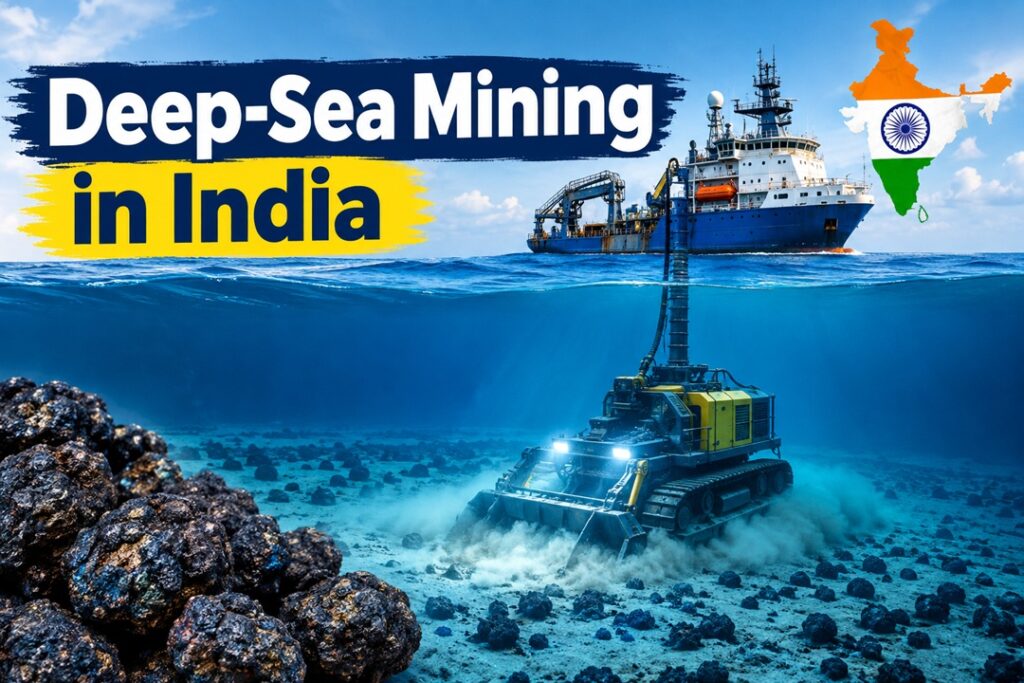
Deep-sea mining involves recovering polymetallic nodules, polymetallic sulphides and cobalt-rich ferromanganese crusts, generally from depths of about 3,000–6,000 metres. These deposits contain minerals such as nickel, cobalt, copper and manganese, which are important for clean-energy technologies.
India’s Deep-Sea Mining Potential
Under UNCLOS Part XI, the international seabed beyond national jurisdiction and its mineral resources are treated as the Common Heritage of Mankind, with the ISA responsible for regulating related activities.
The ISA has developed rules for exploration, but a comprehensive exploitation framework is still unresolved. Issues concerning environmental safeguards, liability, monitoring and benefit-sharing therefore remain important.
India currently has three ISA exploration contracts, covering around 95,000 sq km in areas including the Central Indian Ocean Basin, Central Indian Ridge and Carlsberg Ridge. Exploration has indicated nearly 366 million tonnes of polymetallic nodules containing strategically important minerals.
The Deep Ocean Mission is supporting the development of technologies required for deep-sea exploration. These include underwater robotic systems and the MATSYA-6000 human-occupied submersible. The National Institute of Ocean Technology has also tested a crawler-based seabed mining system at depths of around 5,270 metres.
At the same time, scientific surveys of 19 seamounts have identified around 1,300 deep-sea organisms, including 23 species previously unknown to science. This highlights both the scientific value of these ecosystems and the limited understanding of their ecological functioning.
Why Deep-Sea Mining Raises Environmental Concerns
- Permanent destruction of seabed habitats:
Polymetallic nodules take millions of years to form and provide hard surfaces for specialised organisms. Removing them can therefore eliminate habitats that cannot realistically regenerate within human timescales. - Sediment plumes:
Mining machinery can disturb seabed sediments and release plumes that may spread considerable distances. These can affect filter-feeding organisms, alter water quality and potentially disturb marine food webs. - Noise, vibration and artificial light:
Industrial equipment would introduce significant acoustic, physical and light disturbances into environments that have evolved under conditions of extreme darkness and low background noise. - Limited scientific knowledge:
Large portions of the deep ocean remain inadequately mapped and studied. Industrial activity could therefore affect species and ecological relationships before scientists have even identified them. - Regulatory uncertainty:
Although the ISA regulates exploration, the absence of a fully operational exploitation regime creates questions about environmental thresholds, inspection, liability and enforcement if commercial-scale mining expands.
The Central Policy Dilemma
The debate is not simply about whether India possesses the technological capability to mine the seabed. The larger question is whether technological feasibility should automatically translate into commercial exploitation.
Critical minerals are essential for the energy transition, but their demand can also be addressed through recycling, mineral substitution, resource efficiency and a circular economy. Deep-sea extraction could otherwise shift environmental pressures from terrestrial mining to ecosystems that are even less understood.
This makes the distinction between scientific exploration and commercial exploitation particularly important. Exploration can improve knowledge of ocean geology and biodiversity without necessarily creating an immediate commitment to large-scale extraction.
Way Forward
- Keep exploration and exploitation separate: Use the Deep Ocean Mission primarily to strengthen scientific knowledge, technological capacity and biodiversity assessment before considering commercial extraction.
- Adopt a precautionary approach: Establish stringent ecological thresholds and identify sensitive habitats, seamounts and hydrothermal-vent systems where mining should not be permitted.
- Strengthen marine biodiversity baselines: Expand long-term monitoring to understand species distribution, ecosystem interactions and recovery capacity before industrial intervention.
- Promote circularity in critical minerals: Increase battery recycling, material recovery, substitution and efficient mineral use so that seabed resources are not treated as the first response to mineral scarcity.
- Push stronger international governance: India can advocate within the ISA for transparent environmental standards, independent monitoring, effective liability mechanisms and enforceable safeguards.
- Invest in low-impact technologies: Encourage autonomous underwater vehicles, remote sensing and non-destructive observation systems that improve ocean knowledge without disturbing the seabed.
Conclusion
Deep-sea resources may contribute to India’s critical-mineral security, but the ecological consequences of their extraction remain uncertain and potentially long-lasting. India can therefore combine technological advancement with a precautionary approach, ensuring that scientific knowledge and marine conservation remain central to its deep-ocean strategy.
Source : The Hindu