
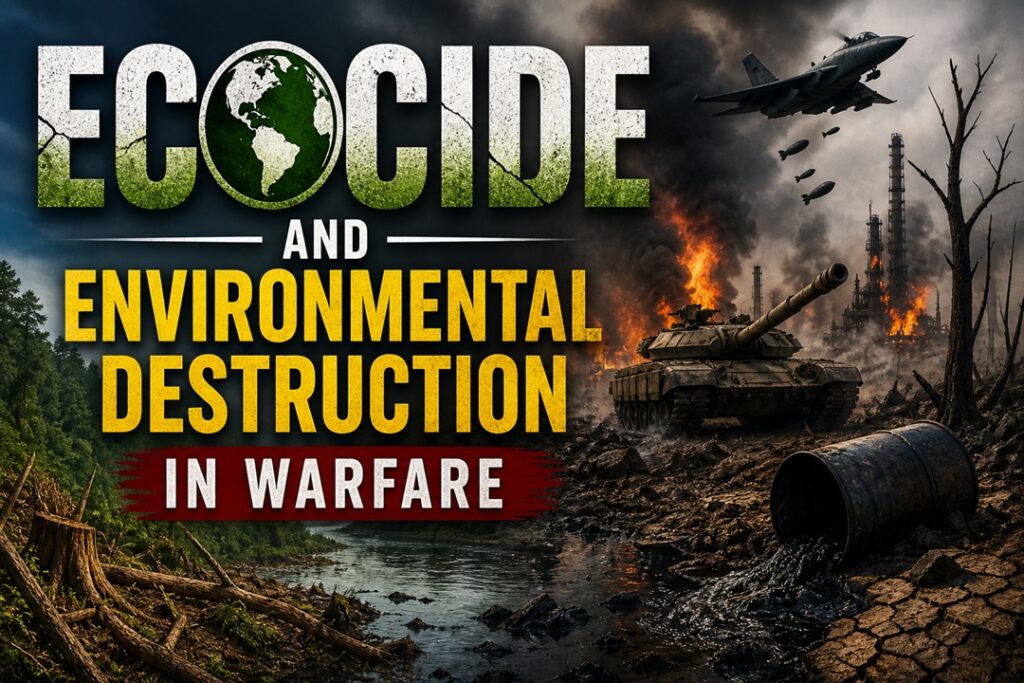
Ecocide and Environmental Destruction in Warfare
Context
Countries such as Lebanon and Iran have recently alleged that Israel has caused large-scale environmental destruction during military actions, bringing renewed attention to the concept of ecocide in global discourse.
Ecocide and Armed Conflict
Meaning and Scope
Ecocide denotes severe environmental harm resulting from deliberate or reckless human activities, where there is awareness that such acts can lead to widespread, long-term ecological damage.
Evolution and Global Recognition
Origin of Term: Coined in 1970 by Arthur W. Galston in the context of chemical warfare during the Vietnam War.
Legal Adoption: Vietnam became the first to criminalize ecocide domestically in 1990.
International Spread: Nations like France, Belgium, Russia, Ukraine, and Chile have incorporated similar provisions.
Standard Definition Efforts: In 2021, experts associated with Stop Ecocide International proposed a uniform legal definition to support its inclusion in the Rome Statute.
How It Differs from Existing Legal Frameworks
Ecocentric Approach: Unlike traditional anthropocentric laws, ecocide centers the environment as an independent entity deserving protection.
Recognition of Environmental Harm: Moves beyond viewing ecological damage as collateral, recognizing nature itself as a victim.
Nature of Liability: Focuses on reckless or wanton acts with foreseeable environmental consequences, not just intentional attacks.
Criminal Dimension: Seeks to elevate environmental destruction from civil liability to an international crime.
Applicability Beyond War: Proposed to apply in both wartime and peacetime, unlike current frameworks limited largely to armed conflict.
Limitations of Current International Law
Restricted Coverage: Under the Rome Statute, environmental damage is punishable only if linked to war crimes and proven disproportionate.
Jurisdiction Constraints: The International Criminal Court can act only on member states or via UN referrals, limiting cases like those involving Iran or Lebanon.
Absence of Binding Criminal Norms: Bodies such as the International Union for Conservation of Nature recognize ecocide conceptually but lack enforcement authority.
Human-Centric Proof Requirement: Legal action often depends on demonstrating direct human suffering due to environmental harm.
High Burden of Proof: Establishing intent or knowledge of large-scale ecological damage remains difficult.
Challenges in Enforcement
Amendment Difficulty: Adding ecocide to the Rome Statute requires a two-thirds majority of member states.
No Precedent: No standalone international prosecution for wartime environmental destruction exists yet.
Jurisdictional Complexities: Expansion of universal jurisdiction remains uneven across regions.
Political Constraints: Major powers often resist legal frameworks that could expose their military or industrial actions.
Normative vs Practical Impact: Without broad compliance, such norms risk remaining symbolic rather than enforceable.
Future Pathways
Regional Legal Models: Instruments like the European environmental protection convention can guide global frameworks.
Domestic Legislation: Wider national adoption can gradually build customary international law.
Reform of ICC Framework: Continued diplomatic engagement to include ecocide as a fifth core international crime.
Clarity in Definitions: Better articulation of “severe” and “long-term” damage to ensure enforceability.
Shift in Jurisprudence: Encouraging institutions like the International Court of Justice to recognize environmental rights independently.
Conclusion
The growing debate on ecocide reflects an important transition from human-centric legal systems to a more holistic environmental accountability framework. While present laws remain limited in scope and enforcement, increasing domestic legislation and global advocacy indicate a gradual shift toward recognizing ecological destruction as a serious international crime.
Source : The Indian Express