
El Niño and the Indian Monsoon: Why Strong Warming Does Not Always Mean Drought
Context
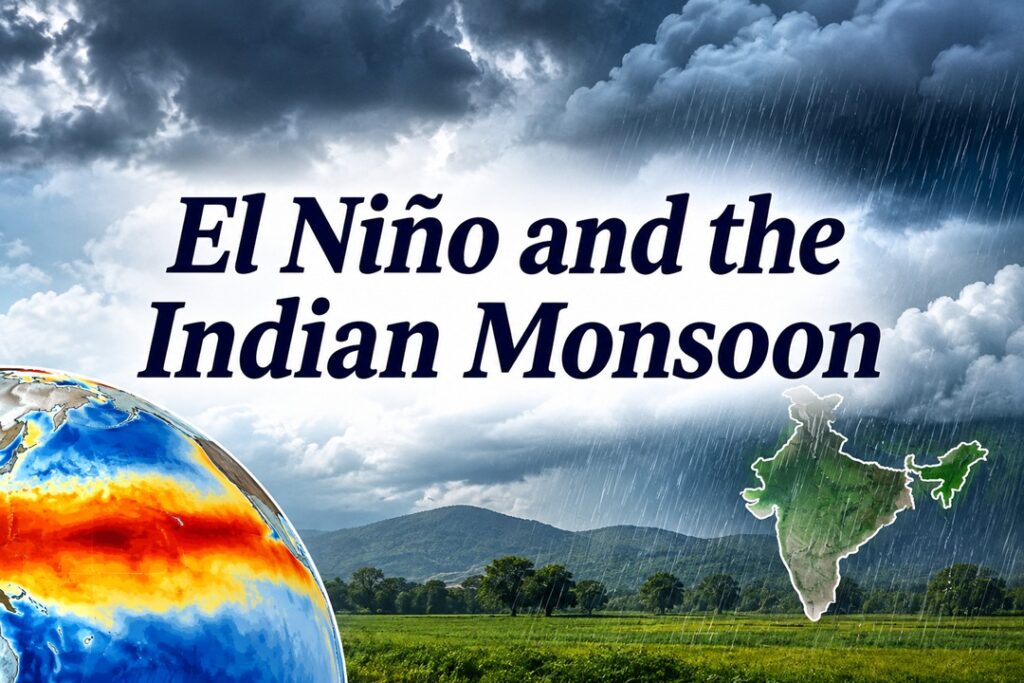
Despite the development of a strong El Niño in the Pacific Ocean, historical climate records indicate that intense El Niño conditions do not necessarily lead to monsoon failure in India. The contrasting rainfall outcomes during different El Niño years highlight the influence of other oceanic and atmospheric factors in determining the strength and distribution of the Indian southwest monsoon.
Understanding El Niño and Its Impact on the Indian Monsoon
1. Normal Conditions: Walker Circulation
- Under normal conditions, easterly trade winds push warm surface waters towards the western Pacific, particularly near Indonesia.
- This creates favourable conditions for cloud formation and heavy rainfall over the western Pacific.
- Meanwhile, cold, nutrient-rich water rises near the western coast of South America through oceanic upwelling.
- This east-west atmospheric circulation is known as the Walker Circulation.
2. Changes During El Niño
- El Niño is a periodic warming of the central and eastern equatorial Pacific Ocean, generally occurring every 2–7 years.
- During this phenomenon, trade winds weaken or occasionally reverse, allowing warm waters to shift eastwards.
- Rainfall-producing convection also moves towards the central and eastern Pacific, disturbing the normal Walker Circulation.
3. How Does El Niño Suppress the Indian Monsoon?
- Increased convection over the Pacific changes the distribution of rising and descending air across the tropics.
- The altered circulation can strengthen descending, dry air over the Indian subcontinent.
- This reduces atmospheric moisture, suppresses cloud formation and weakens monsoon circulation.
- Consequently, India becomes more vulnerable to prolonged dry spells and below-normal rainfall.
El Niño and Indian Monsoon: Important Observations
- Historical association: Since 1950, five out of seven moderate or strong El Niño years reportedly experienced deficient Indian monsoon rainfall.
- The 1997 exception: Despite a strong El Niño, with sea surface temperature anomalies of approximately +1.64°C, India received normal monsoon rainfall.
- Contrasting years: The 2015 El Niño was associated with significant rainfall deficiency, demonstrating that similar Pacific warming conditions can produce different outcomes.
- 2026 rainfall scenario: The southwest monsoon reportedly received only 87.4% of its Long Period Average (LPA), with particularly severe deficits in East and Northeast India.
- Agricultural vulnerability: Nearly 40% of India’s net cultivated area is rain-fed, making agricultural production highly sensitive to monsoon fluctuations.
Why Does a Strong El Niño Not Always Cause Drought in India?
1. Indian Ocean Dipole (IOD) as a Counterbalancing Factor
- The IOD refers to differences in sea surface temperatures between the western Indian Ocean, near Africa, and the eastern Indian Ocean, near Indonesia.
- A positive IOD develops when the western Indian Ocean becomes relatively warmer than its eastern counterpart.
- This encourages convection and rainfall over the western Indian Ocean, potentially increasing moisture transport towards India.
- It can therefore partially counter the rainfall-suppressing influence of El Niño.
Example: The strong positive IOD during 1997 helped offset the adverse influence of El Niño and supported normal Indian monsoon rainfall.
2. Location of Pacific Ocean Warming
- The geographical distribution of warming across the Pacific influences the intensity and location of atmospheric circulation changes.
- During conventional or eastern-Pacific El Niño events, maximum warming occurs closer to South America.
- In contrast, during El Niño Modoki, warming is concentrated in the central Pacific.
- The latter can produce atmospheric circulation patterns that are more unfavourable for the Indian monsoon.
Thus, the location of maximum warming is as important as its intensity.
3. Madden–Julian Oscillation (MJO)
- The MJO is a large-scale tropical atmospheric disturbance involving alternating phases of enhanced and suppressed rainfall.
- It moves eastwards across the tropics over a period of approximately 30–60 days.
- Its position and intensity influence the timing, distribution and active or break phases of the Indian monsoon.
Example: In August 2023, unfavourable MJO conditions contributed to prolonged rainfall suppression, making it one of India’s driest Augusts in 122 years.
4. Influence of Mid-Latitude Weather Systems
- Weather disturbances outside the Pacific region can also modify Indian rainfall patterns.
- High-pressure systems over the Iranian plateau and low-pressure formations over the Arabian Sea can influence moisture transport towards the subcontinent.
- Such systems may generate rainfall even when broader Pacific conditions are unfavourable.
Historical rainfall patterns during 1983 and 1997 illustrate the importance of these independent atmospheric influences.
Implications of Monsoon Deficiency for India
1. Agricultural Production and Rural Livelihoods
- Delayed monsoon onset and prolonged dry spells can disrupt Kharif sowing and reduce crop yields.
- Paddy, pulses and oilseeds are particularly vulnerable to rainfall irregularities.
- Reduced agricultural output directly affects farm incomes and rural employment.
2. Groundwater Depletion and Water Insecurity
- Poor rainfall reduces replenishment of reservoirs, rivers and groundwater aquifers.
- This creates water shortages for drinking, irrigation and industrial requirements.
- Reduced water availability can also affect Rabi cultivation.
3. Food Inflation and Economic Instability
- Lower agricultural production can increase food prices and contribute to food inflation.
- Rural consumption and agricultural demand may weaken due to declining farm incomes.
- Governments may resort to export restrictions and other supply-management measures to stabilise domestic prices.
4. Challenges in Monsoon Forecasting
- The combined influence of ENSO, IOD, MJO and regional weather systems makes monsoon behaviour complex.
- Models relying heavily on Pacific Ocean indicators may fail to capture important regional variations.
- This creates uncertainty for farmers, policymakers and water-resource managers.
Way Forward
1. Strengthen Multi-Ocean Climate Forecasting
- Improve the Indian Meteorological Department’s dynamic forecasting systems by integrating Pacific and Indian Ocean conditions.
- Give greater importance to IOD variations, MJO activity and regional atmospheric circulation.
- Strengthen real-time ocean monitoring and seasonal rainfall prediction.
2. Promote Climate-Resilient Agriculture
- Encourage drought-tolerant seeds and short-duration crop varieties.
- Expand cultivation of millets, pulses and other less water-intensive crops in rain-fed regions.
- Improve agricultural advisories to help farmers adjust sowing schedules according to rainfall forecasts.
3. Improve Decentralised Water Management
- Expand watershed development, farm ponds, check dams and groundwater recharge structures.
- Promote drip and sprinkler irrigation to improve water-use efficiency.
- Strengthen community participation in local water conservation and management.
4. Strengthen Agricultural Risk Protection
- Improve the implementation of the Pradhan Mantri Fasal Bima Yojana (PMFBY).
- Use satellite imagery, drones and digital technologies for faster crop-loss assessment.
- Ensure timely insurance compensation and strengthen financial support for vulnerable farmers.
5. Develop Integrated Drought Preparedness
- Establish early-warning systems linking meteorological forecasts with agricultural and water-resource planning.
- Prepare contingency crop plans for vulnerable districts.
- Improve coordination between the Centre, States and local institutions to manage drought-related risks.
Conclusion
El Niño is an important indicator of monsoon vulnerability, but it is not a standalone predictor of drought in India. The interaction of the Indian Ocean Dipole, Pacific warming patterns, Madden–Julian Oscillation and regional weather systems determines the eventual rainfall outcome. With climate change increasing the complexity of ocean-atmosphere interactions, India must move beyond El Niño-based predictions towards integrated climate forecasting, resilient agriculture and decentralised water management to strengthen its preparedness against monsoon uncertainties.
Source : The Hindu