
El Niño: Early Intensification and Rising Extreme-Weather Risks
Context
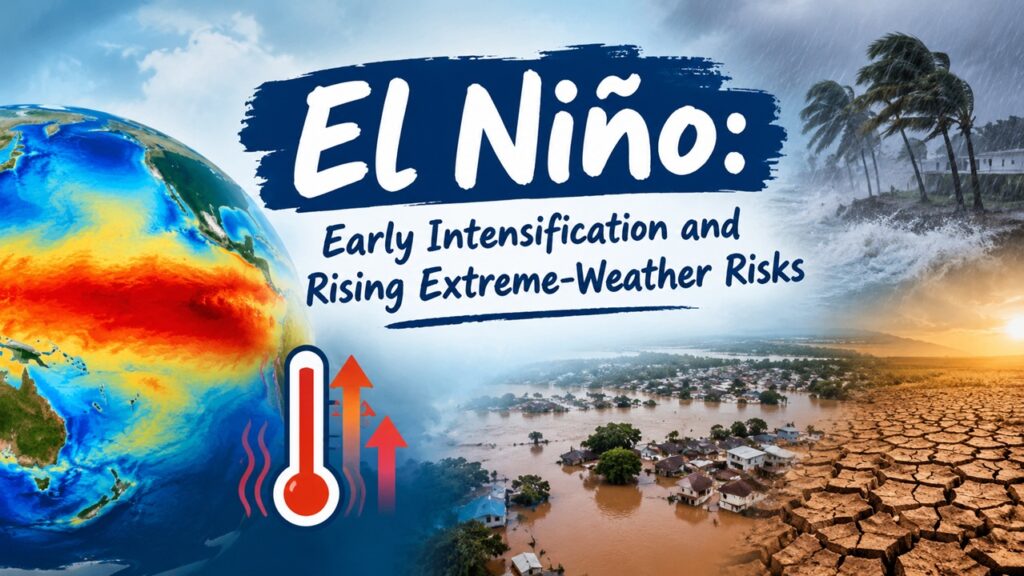
An unusually early and intense El Niño episode is raising concerns about amplified climate extremes. Its interaction with human-induced warming could increase the likelihood of heatwaves, droughts, floods, wildfires and ecosystem stress across vulnerable regions.
What is El Niño?
- El Niño is the warm phase of the El Niño–Southern Oscillation (ENSO), originating in the tropical Pacific Ocean.
- It develops when Pacific trade winds weaken or reverse, allowing warm surface waters to shift eastward towards the central and eastern Pacific.
- An El Niño is generally identified when sea-surface temperatures in the central tropical Pacific remain at least 0.5°C above the long-term average.
- It occurs irregularly, usually every 2–7 years, and commonly persists for around 9–12 months.
- Its opposite phase, La Niña, is associated with unusually cooler Pacific surface waters.
- The altered ocean-atmosphere circulation can influence rainfall, temperature and tropical cyclone behaviour far beyond the Pacific.
Why is the Current El Niño Significant?
- Unusually early warming: Unlike typical events that peak around November–January, the present episode has intensified considerably ahead of the usual peak period.
- Exceptional temperature anomaly: August relative-index readings reportedly reached around 2.3°C above average, indicating an exceptionally strong warming signal.
- Greater climate sensitivity: Background global warming means that an El Niño-driven temperature increase is occurring on top of an already warmer climate system.
- Potential global temperature records: The combination of El Niño and anthropogenic warming could push global temperatures to exceptional levels in the coming period.
- Regional variability: El Niño does not produce identical outcomes everywhere; one region may face drought while another experiences excessive rainfall.
Major Impacts
1. Agriculture and Food Security
- Shifts in rainfall can result in droughts, floods and crop losses.
- Small farmers dependent on rainfall are particularly vulnerable.
- Repeated climate shocks can increase food prices and livelihood insecurity.
2. Water Stress
- Prolonged dry conditions can reduce water availability for irrigation, drinking water and ecosystems.
- Regions already facing water scarcity may experience heightened stress.
3. Extreme Weather
- Warmer and drier conditions can increase heatwave and wildfire risks in susceptible regions.
- Changes in atmospheric circulation can also produce intense rainfall and flooding elsewhere.
- Tropical cyclone activity may be redistributed, particularly across parts of the Pacific.
4. Ecosystem Damage
- Elevated ocean temperatures increase the likelihood of coral bleaching, including stress on the Great Barrier Reef.
- Forests, wetlands and other ecosystems can suffer from prolonged heat and moisture deficits.
- Biodiversity may be affected as species struggle to adapt to rapidly changing conditions.
5. Global Humanitarian Risks
- Food shortages, water stress and extreme weather can disproportionately affect low-income and climate-vulnerable communities.
- Simultaneous disasters across regions can place additional pressure on humanitarian and disaster-response systems.
Challenges
- Regional uncertainty: Predicting the exact consequences of an exceptionally strong El Niño remains difficult.
- Complex climate interactions: Natural ENSO variability is increasingly interacting with human-induced climate change.
- Unequal vulnerability: Countries and communities differ substantially in their capacity to prepare for and recover from climate shocks.
- Compound extremes: Heatwaves may coincide with drought, wildfire or water shortages, creating cascading impacts.
- Pressure on food systems: Agricultural losses in multiple regions can disrupt global supply chains and food security.
Way Forward
- Strengthen ENSO observation networks, climate modelling and seasonal forecasting.
- Establish region-specific early-warning systems for droughts, floods, cyclones, heatwaves and wildfires.
- Promote climate-resilient agriculture, including drought-tolerant varieties, crop diversification and efficient irrigation.
- Build stronger disaster preparedness and social-protection systems for vulnerable households.
- Improve strategic management of water resources in drought-prone regions.
- Protect coral reefs, forests, wetlands and other ecosystems that provide natural resilience against climate shocks.
- Integrate ENSO forecasts into agricultural planning, disaster management and public-health preparedness.
- Continue reducing greenhouse-gas emissions, since limiting long-term warming can reduce the additional intensity of climate extremes.
Conclusion
El Niño is a natural climate phenomenon and cannot be prevented, but its consequences need not become disasters by default. The emerging pattern demonstrates the importance of combining better climate forecasting with resilient agriculture, water security, ecosystem conservation and effective social protection. As natural variability increasingly operates within a warmer climate system, preparedness and adaptation will be crucial for reducing its economic, ecological and humanitarian costs.
Source : Down To Earth