
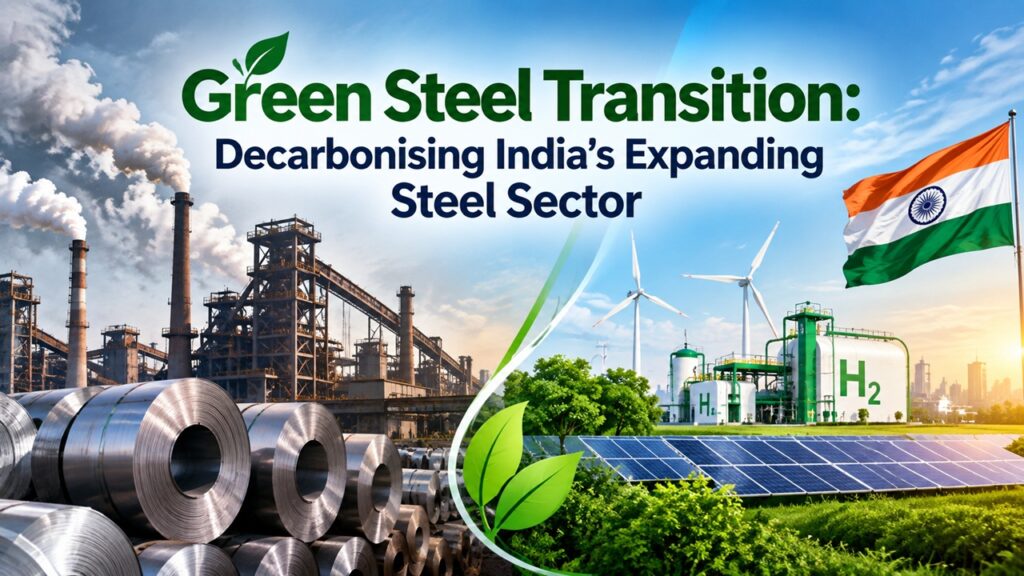
Green Steel Transition: Decarbonising India’s Expanding Steel Sector
Context
India’s rapidly growing steel industry is critical for infrastructure and economic development but is also a major source of greenhouse-gas emissions. With steel demand expected to rise sharply, the country is promoting green steel, green hydrogen, recycling and cleaner production technologies to align industrial growth with its Net Zero 2070 target.
Why Steel is Difficult to Decarbonise
Steelmaking is considered a hard-to-abate sector because conventional production requires extremely high temperatures and relies heavily on coal.
The Blast Furnace–Basic Oxygen Furnace (BF-BOF) route uses coking coal to reduce iron ore and produces substantial carbon emissions. In India, approximately 43% of crude steel is produced through BF-BOF, while 22% comes from Electric Arc Furnaces (EAFs) and 35% from Electric Induction Furnaces.
A major concern is that the BF-BOF share could increase to nearly 56% of capacity by 2030, potentially locking India into carbon-intensive infrastructure for decades.
Cleaner Technologies for Steelmaking
Electric Arc Furnaces
EAFs melt steel scrap using electricity and can have less than half the emissions intensity of BF-BOF production globally. Their wider adoption, however, depends on adequate supplies of quality scrap and affordable low-carbon electricity.
DRI-EAF Route
The Direct Reduced Iron (DRI)–EAF pathway offers particular potential for India. DRI reduces iron ore without using a conventional blast furnace. Natural gas can initially serve as a reducing agent, with green hydrogen eventually replacing fossil fuels.
This pathway is important because India does not currently possess enough domestic high-quality scrap to depend entirely on scrap-based EAF production.
Green Hydrogen
Hydrogen produced using renewable electricity can replace fossil fuels in iron-ore reduction. When combined with renewable power and suitable DRI technology, it offers a pathway towards near-zero-carbon steel.
Recycling and Scrap
Expanding steel recycling can reduce dependence on virgin iron ore, lower energy consumption and emissions, and strengthen the circular economy. Building an efficient scrap-collection and processing network will therefore be crucial.
Government Push for Green Steel
The National Mission on Green Steel seeks to reduce India’s steel emission intensity from approximately 2.55–2.65 tCO₂e per tonne to 2.2 tCO₂e per tonne by 2029–30.
The Green Steel Certification Scheme provides a framework for identifying and certifying steel according to its emissions performance.
The government is also supporting green-hydrogen pilot projects for low-carbon steelmaking. The Ministry of New and Renewable Energy has backed three pilot projects, while industrial players are testing hydrogen in DRI-based production.
Major Roadblocks
1. Insufficient Scrap
India’s limited availability of high-quality scrap constrains a rapid transition to scrap-based EAF production.
2. High Cost of Green Hydrogen
Green hydrogen remains relatively expensive, and uncertainty over its future large-scale availability makes investment decisions difficult.
3. Clean Power Requirement
Electrifying steelmaking at scale will require abundant, reliable and affordable renewable or otherwise low-carbon electricity.
4. Carbon Lock-in
Fresh investments in BF-BOF facilities and the prolonged operation or relining of existing blast furnaces could create carbon-intensive assets with long operating lives.
5. Weak Green-Steel Demand
Low-carbon steel currently carries a price premium, while consumers and industries have limited incentives to pay more for it.
6. Risks from Natural Gas
Natural gas may provide a transitional alternative to coal, but excessive dependence could increase import exposure, price volatility and geopolitical risks.
7. Global Carbon Regulations
The EU Carbon Border Adjustment Mechanism (CBAM) is increasing pressure on Indian steel exporters to lower their carbon footprint. Decarbonisation is therefore becoming not only an environmental necessity but also a trade and competitiveness issue.
Way Forward
India should steer future steel investments towards DRI-EAF and eventually hydrogen-based production, particularly where new BF-BOF capacity can be avoided.
A stronger domestic ecosystem for scrap collection, sorting and recycling should be developed alongside rapid expansion of renewable electricity and green-hydrogen production.
Government procurement can create an initial market for low-carbon steel by incorporating green-steel standards into infrastructure and public projects. At the same time, blast-furnace investments should be assessed carefully to prevent avoidable long-term carbon lock-in.
The transition must also include worker reskilling and regional support for communities dependent on coal-intensive steelmaking.
Conclusion
India’s growing steel demand does not have to translate into a proportional rise in emissions. Early movement towards EAFs, DRI, recycling, renewable electricity and green hydrogen can help India meet its infrastructure needs while protecting long-term industrial competitiveness. The key challenge is to ensure that today’s steel investments do not become tomorrow’s carbon liabilities.
Source : The Hindu