
Humane Education Reform: Rethinking India’s Admission System
Context
Following student-led demonstrations demanding reforms in the education sector, policy commentators have renewed the call for replacing India’s high-pressure entrance examination framework with a more inclusive and student-friendly admission model that values holistic development alongside academic performance.
Building a Student-Centric Education System
Overview
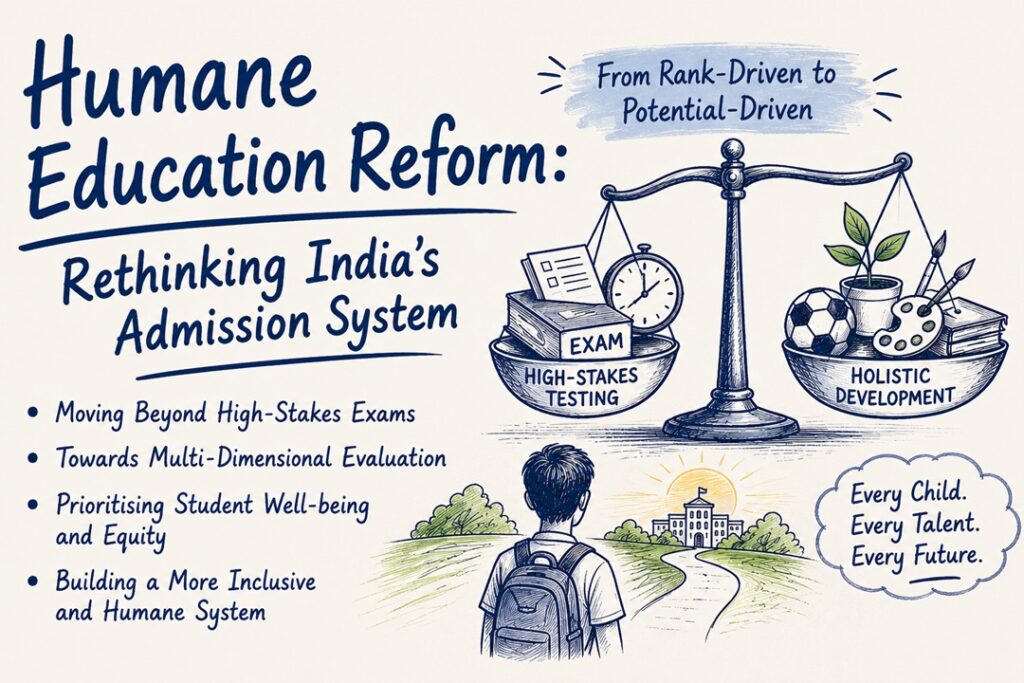
A student-centric education framework seeks to transform India’s admission process by moving away from excessive dependence on single competitive examinations. Instead, it promotes a balanced evaluation system that considers academic consistency, analytical ability, creativity, practical skills, extracurricular participation, emotional well-being, and informed career guidance. Such a model aims to nurture learning rather than merely rewarding exam performance.
Major Challenges in the Existing Admission Framework
Dependence on Uniform National Examinations
National-level entrance examinations attempt to assess students from vastly different educational, linguistic, geographical, and socio-economic backgrounds using a common testing pattern, raising concerns about fairness and inclusivity.
Expansion of the Coaching Industry
The growing influence of commercial coaching institutions has shifted attention away from school education. Escalating coaching expenses place a heavy financial burden on families while widening educational disparities.
Growing Stress Among Students
An examination culture that treats one entrance test as the defining measure of future success contributes to anxiety, depression, burnout, and increasing concerns over student mental health.
Risks Associated with Centralized Testing
Large-scale centralized examinations remain vulnerable to operational failures, technical glitches, and question paper leaks, affecting millions of candidates simultaneously.
Consequences of an Unbalanced Admission System
Increasing Mental Health Concerns
Extreme academic competition and societal pressure create emotional distress among students, reducing confidence and negatively affecting psychological well-being.
Limited Understanding of Merit
The current admission process often prioritizes memorization and speed over creativity, innovation, ethical thinking, collaboration, communication skills, and real-world problem-solving abilities.
Economic Burden on Families
Heavy expenditure on private coaching, study materials, and accommodation creates financial hardship, particularly for economically weaker households.
Unequal Opportunities
Students from rural regions, government schools, regional-language backgrounds, and disadvantaged communities often face structural barriers in a centralized examination system.
Restricted Career Choices
The excessive focus on a few prestigious professional courses discourages exploration of emerging disciplines, vocational education, entrepreneurship, research, and interdisciplinary careers.
Suggested Policy Reforms
Adopt Holistic Student Assessment
- Combine school academic records with subject aptitude tests.
- Include project work, research assignments, innovation challenges, community service, and extracurricular achievements.
- Introduce analytical writing, interviews, and practical skill evaluations wherever appropriate.
Promote Institutional Autonomy in Admissions
- Permit universities to conduct admission processes within broad regulatory standards prescribed by the University Grants Commission (UGC).
- Spread admission schedules throughout the academic year to reduce dependence on a single nationwide examination.
Strengthen Examination Integrity
- Deploy encrypted digital transmission of question papers.
- Use randomized question banks, biometric verification, secure printing systems, AI-based monitoring, and comprehensive post-examination audits to prevent malpractice.
Regulate the Coaching Sector
- Establish transparent norms governing coaching fees, advertisements, hostel facilities, and student welfare.
- Encourage stronger integration between schools and higher education institutions to reduce excessive coaching dependence.
Expand Career Guidance and Counseling
- Provide professional career counseling in regional languages for students and parents.
- Promote aptitude-based career planning, scholarship awareness, vocational pathways, internships, and mentorship programmes to support informed career decisions.
Way Forward
A modern education system should encourage learning, innovation, and personal growth rather than rewarding only examination performance. Building a fair admission framework through diversified assessments, stronger examination governance, effective counseling, and institutional flexibility can improve educational equity while reducing stress on students. Such reforms would better prepare young learners for higher education, employment, and lifelong learning in a rapidly changing world.
Source : The Hindu