
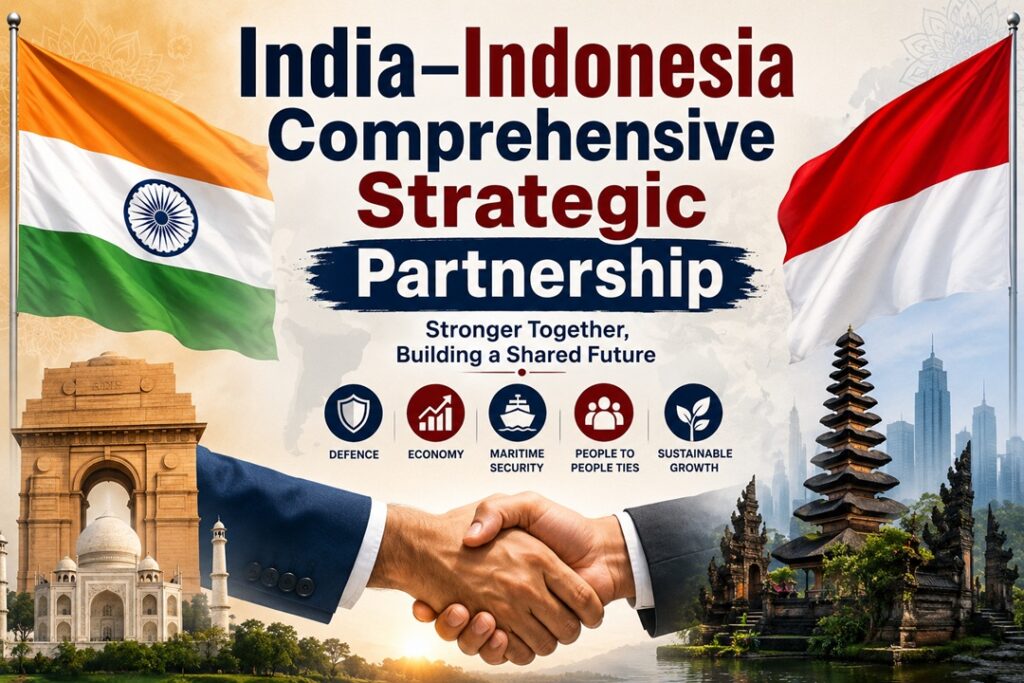
India–Indonesia Comprehensive Strategic Partnership
Context
Prime Minister of India undertook a State Visit to Indonesia, where both nations adopted a Joint Vision Statement to further strengthen their Comprehensive Strategic Partnership (CSP) with greater cooperation in defence, maritime affairs, trade, technology, connectivity and regional governance.
India–Indonesia Strategic Partnership
Overview
What is it?
- India and Indonesia maintain a Comprehensive Strategic Partnership (CSP), elevated in 2018, founded on deep civilisational ties, shared maritime history and growing strategic convergence.
- The partnership spans political engagement, defence cooperation, maritime collaboration, commerce, digital transformation, energy security, space research, education, cultural exchanges, connectivity and multilateral engagement.
Major Highlights of the India–Indonesia Summit (2026)
Political & Diplomatic Engagement
- Both countries agreed to hold regular leadership summits and strengthen institutional dialogue through the Joint Commission, Foreign Office Consultations and Parliamentary exchanges.
- Greater collaboration among universities, research institutes and policy think tanks will enhance strategic policy coordination.
Defence & Indo-Pacific Cooperation
- Defence cooperation was expanded in BrahMos missile collaboration, Astra air-to-air missiles, joint military drills, defence manufacturing, hydrographic surveys, Maritime Domain Awareness (MDA) and capacity building.
- Indonesia deployed an International Liaison Officer (ILO) to India’s IFC-IOR at Gurugram, while both countries renewed their Maritime Safety and Security MoU.
Security & Digital Resilience
- Both nations reaffirmed a zero-tolerance policy against terrorism, enhancing cooperation against terror financing, violent extremism and online radicalisation.
- Cooperation will deepen in cyber security, CERT coordination, digital forensics and protection of critical digital infrastructure.
Economic & Commercial Partnership
- India and Indonesia committed to an early completion of the ASEAN–India Trade in Goods Agreement (AITIGA) Review to improve bilateral trade.
- A new Joint Economic and Financial Dialogue was launched, alongside promotion of Local Currency Settlement (LCS) between RBI and Bank Indonesia.
Critical Minerals & Manufacturing
- Agreements were signed to strengthen cooperation in critical minerals, rare earth elements and strategic steel supply chains.
- A joint initiative between SAIL and PT Krakatau Steel will explore stainless steel production, technology transfer and industrial cooperation.
Health, Agriculture & Clean Energy
- Both countries signed agreements covering healthcare workforce development, pharmaceutical regulation, agriculture, food security and fertilizer cooperation.
- Cooperation will expand in green hydrogen, LNG, solar power, biofuels and renewable energy technologies.
Connectivity & Digital Innovation
- India will participate in the development of Sabang Port, while both countries advanced Andaman–Aceh maritime connectivity.
- Indonesia launched the Indonesia Open Network (ION) inspired by India’s ONDC framework, alongside work on cross-border QR payments and telecom cooperation.
Space, Science & Emerging Technologies
- Cooperation between ISRO and BRIN was extended, including support for India’s Gaganyaan Mission through Biak tracking facilities.
- Both countries also agreed to collaborate in Artificial Intelligence, nuclear energy, scientific research and innovation ecosystems.
Cultural & Educational Partnership
- India will assist in the restoration of the UNESCO-listed Prambanan Temple Complex.
- The years 2026–27 will be celebrated as the Tagore–Dewantara Commemorative Year, alongside expansion of tourism, student mobility, visa facilitation and higher education cooperation, including the proposed IIM Bangalore campus in Indonesia.
Regional & Global Cooperation
- Indonesia expressed support for India’s BRICS Chairship (2026).
- Both countries reiterated support for UN Security Council reforms, Global South representation, ASEAN centrality, UNCLOS, freedom of navigation and a free, open Indo-Pacific.
Significance for India
Maritime Advantage
- Development of Sabang Port strengthens India’s strategic presence near the Strait of Malacca, enhancing maritime monitoring in the eastern Indian Ocean.
Defence Exports
- Expansion of BrahMos and Astra missile cooperation supports India’s defence export ambitions and strengthens indigenous defence manufacturing.
Critical Mineral Security
- Indonesia’s abundant nickel reserves can support India’s electric vehicle and battery manufacturing ecosystem, reducing import vulnerabilities.
Digital Leadership
- Expansion of UPI, ONDC and digital public infrastructure abroad strengthens India’s position as a global fintech and digital governance leader.
Key Challenges
Strategic Balancing
- Indonesia continues to pursue an independent foreign policy, maintaining balanced relations with major powers, including China.
Trade Constraints
- Despite growing trade, Indian exporters continue to face market access limitations, while imports of palm oil and coal remain significant.
Project Implementation
- Infrastructure initiatives such as Sabang Port face delays due to regulatory approvals, administrative procedures and environmental clearances.
Defence Integration
- Integrating advanced Indian missile systems with Indonesia’s diverse defence platforms requires complex software integration, interoperability and protection of sensitive technologies.
Conclusion
Strengthening the India–Indonesia Comprehensive Strategic Partnership enhances India’s maritime reach, defence exports, digital diplomacy and economic resilience in Southeast Asia. Aligning Viksit Bharat 2047 with Indonesia Emas 2045 can contribute to a secure, prosperous and rules-based Indo-Pacific while reinforcing both nations’ roles as leading partners in the Global South.
Source : PIB