
India Launches Asia’s First UNESCO Chair on Gender-Inclusive Skilling
Context
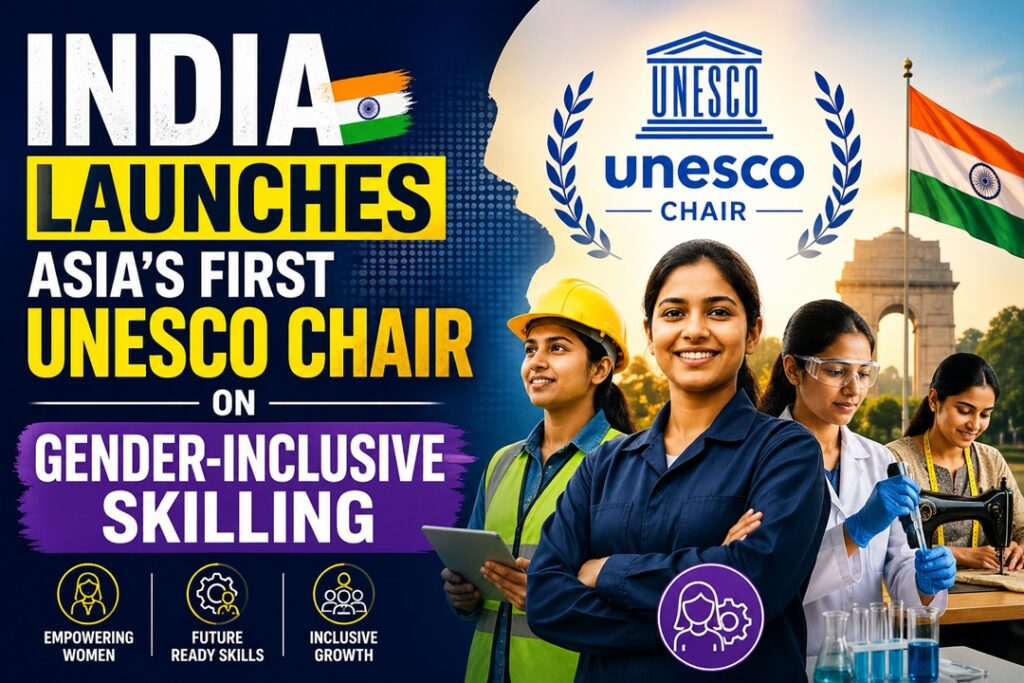
In a significant push towards gender-equitable workforce development, India has operationalised Asia’s first UNESCO Chair dedicated to gender inclusion in skill development at Symbiosis Skills and Professional University (SSPU), Pune. The initiative aligns with India’s broader vision of enhancing female labour force participation and promoting women’s leadership in emerging sectors.
UNESCO Chair on Gender Equity & Future Skills
Overview: What is it?
The UNESCO Chair on Gender Inclusion and Skill Development is a globally recognised platform aimed at bridging gender disparities in technical and vocational education.
Inauguration: April 24, 2026 | Pune, Maharashtra
Institutional Framework
- Nodal Ministry: Ministry of Skill Development & Entrepreneurship (MSDE)
- Global Partner: UNESCO
- Host University: Symbiosis Skills and Professional University
Core Objective
To integrate women into high-growth economic sectors through inclusive skilling frameworks that combine social equity with economic advancement.
Salient Dimensions
- Emerging Sector Focus: Targets training of women in cutting-edge domains like semiconductors, AI, robotics, advanced manufacturing, and defence technologies.
- Global Partnerships: Launched during the “Women Leading the Future of Work” conference with participation from International Labour Organization, UNESCO-UNEVOC (Germany), and UNESCO Global Skills Academy (Paris).
- Inclusive Access: Prioritises women from underserved communities, ensuring equitable access to job-oriented and industry-relevant skills.
- Industry Alignment: Integrates insights from over 40 industry experts and policymakers to match skilling with labour market demands.
- Inter-Ministerial Support: Joint backing from Skill Development and Education ministries to embed gender inclusion into national education policies.
Significance
- Global First in Asia: Establishes India as a frontrunner in institutionalising gender-inclusive skilling at a global level.
- Economic Empowerment: Enhances women’s participation in future-ready sectors, strengthening financial independence and long-term empowerment.
Conclusion
The establishment of this UNESCO Chair marks a strategic shift from traditional skilling approaches to a more inclusive and future-oriented framework. By embedding gender equity into emerging sectors, India is not only addressing structural disparities but also unlocking the full potential of its workforce, thereby reinforcing sustainable and inclusive economic growth.
Source : PIB