
India–Netherlands Ties Elevated to Strategic Partnership
Context
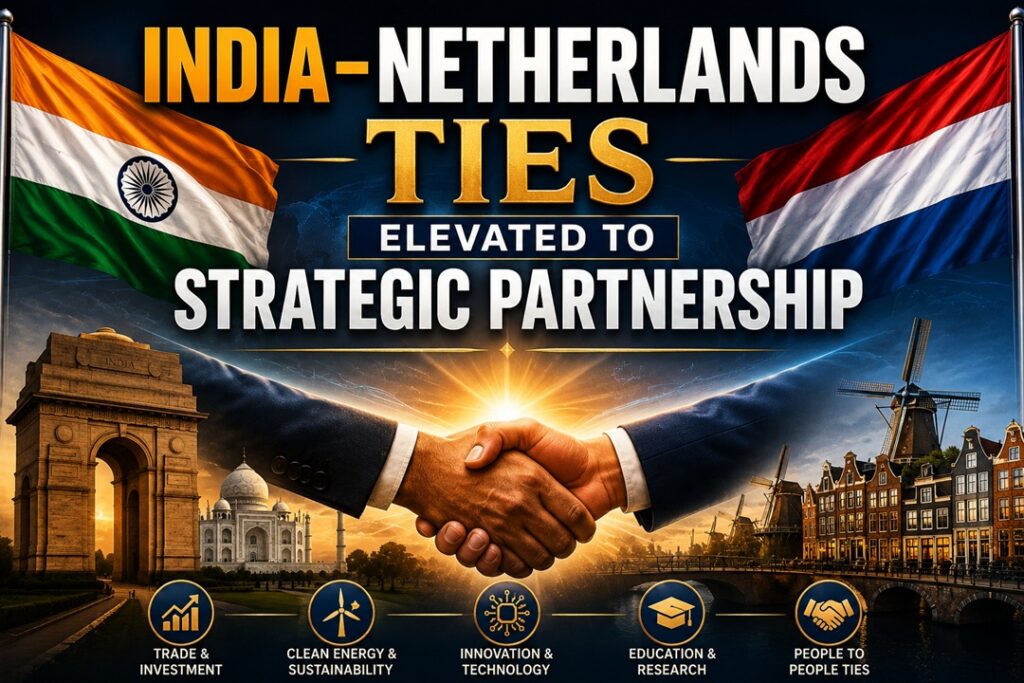
During high-level bilateral discussions at The Hague, Prime Minister Narendra Modi and Dutch Prime Minister Rob Jetten agreed to upgrade India–Netherlands relations into a comprehensive Strategic Partnership.
To operationalize this vision, both countries jointly unveiled the India–Netherlands Strategic Partnership Roadmap (2026–2030), a structured five-year action framework aimed at expanding cooperation in advanced technology, green energy, maritime connectivity, security, and innovation-driven economic growth.
India–Netherlands Strategic Partnership Roadmap (2026–2030)
What is the Roadmap?
The roadmap is a long-term bilateral framework intended to transform India and the Netherlands into close strategic and technology-driven partners over the next five years. It seeks to deepen institutional collaboration, build resilient industrial supply chains, and strengthen cooperation in emerging sectors such as semiconductors, clean energy, maritime logistics, digital innovation, and Indo-Pacific security.
Major Components of the Roadmap
Strategic Consultations & Institutional Coordination
- Annual Strategic Dialogue: Establishes yearly meetings between the Foreign Ministers of both nations to assess implementation progress and identify future priorities.
- Leadership-Level Engagement: Encourages regular interactions among Prime Ministers, Ministers, and senior officials during bilateral visits and multilateral summits.
Trade Expansion & Resilient Supply Networks
- Trade and Investment Facilitation Platform: Strengthens the Joint Trade & Investment Committee to enhance bilateral investment in electronics, telecom, logistics, and smart urban infrastructure.
- Critical Minerals Collaboration: Promotes joint cooperation in strategic minerals, sustainable mining, recycling systems, and ESG-compliant value chains to reduce overdependence on limited global suppliers.
- Business Fast-Track System: Introduces periodic institutional review mechanisms to resolve investment bottlenecks and support MSMEs and foreign investors.
Water Governance, Agriculture & Health Cooperation
- River and Water Partnership: Extends bilateral cooperation on water management, flood control, urban river restoration, and Ganga Basin sustainability initiatives.
- Climate-Smart Agriculture: Expands Centres of Excellence for biotechnology, precision farming, seed technology, and climate-resilient crop systems.
- Public Health & One Health Initiative: Enhances collaboration in disease surveillance, antimicrobial resistance research, and digital healthcare security through partnerships between leading health institutions.
Technology, Innovation & Semiconductor Cooperation
- Semiconductor Innovation Network: Connects premier Indian institutes with Dutch universities and semiconductor companies to create a joint research and talent ecosystem.
- Advanced Technology Collaboration: Encourages cooperation in artificial intelligence, photonics, quantum technologies, cybersecurity, and semiconductor manufacturing capabilities.
- Space-Based Cooperation: Facilitates satellite-data sharing for climate monitoring, food security assessment, and pollution tracking.
Green Energy Transition & Sustainable Maritime Connectivity
- Green Maritime Corridor: Develops a clean shipping route linking Indian green hydrogen production hubs with European markets through Dutch ports.
- Circular Economy Partnership: Supports joint projects in renewable energy, waste-to-energy systems, battery storage, and sustainable biofuels.
Defence & Security Cooperation
- Defence Industry Partnership: Enhances collaboration between defence industries of both countries for co-development and advanced manufacturing of military systems.
- Indo-Pacific Maritime Cooperation: Promotes naval coordination, maritime exercises, and logistics cooperation in the Indo-Pacific region.
- Cybersecurity & Counter-Terrorism: Expands intelligence-sharing mechanisms to combat cybercrime, digital threats, and international terrorism.
Mobility, Education & Cultural Cooperation
- Skilled Talent Mobility: Facilitates legal migration pathways for students, researchers, professionals, and technology experts.
- Cultural Heritage Cooperation: Creates an institutional mechanism for restitution and return of historical and cultural artifacts.
Key Concerns Linked to the Partnership
Regulatory Divergence
- Strict European environmental and food-safety standards continue to create compliance challenges for Indian exports, particularly agricultural and marine products.
Geopolitical Sensitivities
- Differences in strategic positioning on global conflicts and sanctions may occasionally complicate diplomatic coordination.
Technology Access Constraints
- Restrictions on sharing advanced semiconductor and lithography technologies could slow India’s ambitions in high-end chip manufacturing.
Trade Imbalance Issues
- India’s exports remain concentrated in petroleum products and low-value goods, whereas imports from the Netherlands are dominated by high-value technology products and machinery.
Cybersecurity & Data Governance Risks
- Expanding cooperation in digital infrastructure, health systems, and supercomputing raises concerns related to cyber espionage, privacy standards, and data protection frameworks.
Future Priorities
Accelerating the Green Shipping Corridor
- Rapid implementation of green maritime infrastructure can help establish India as a major exporter of green hydrogen to Europe.
Digitizing Trade Certification Systems
- Full adoption of electronic food-safety certification can reduce customs delays and improve trade efficiency.
Strengthening Defence Logistics Cooperation
- Finalizing the Mutual Logistic Support Agreement (MLSA) can improve naval interoperability and strategic reach in the Indo-Pacific.
Expanding Semiconductor R&D
- The semiconductor partnership should evolve from academic collaboration into joint fabrication research and industrial design centres within India.
Boosting Biofuel Collaboration
- Dutch expertise in circular economy systems can support waste-to-energy and biofuel projects across Indian urban centres.
Conclusion
The India–Netherlands Strategic Partnership Roadmap (2026–2030) represents a major advancement in bilateral relations by combining India’s manufacturing scale with Dutch expertise in semiconductors, logistics, clean energy, and maritime innovation. The partnership aims to create resilient supply chains, deepen technological cooperation, and strengthen strategic coordination in an increasingly uncertain global environment.
Source : PIB