
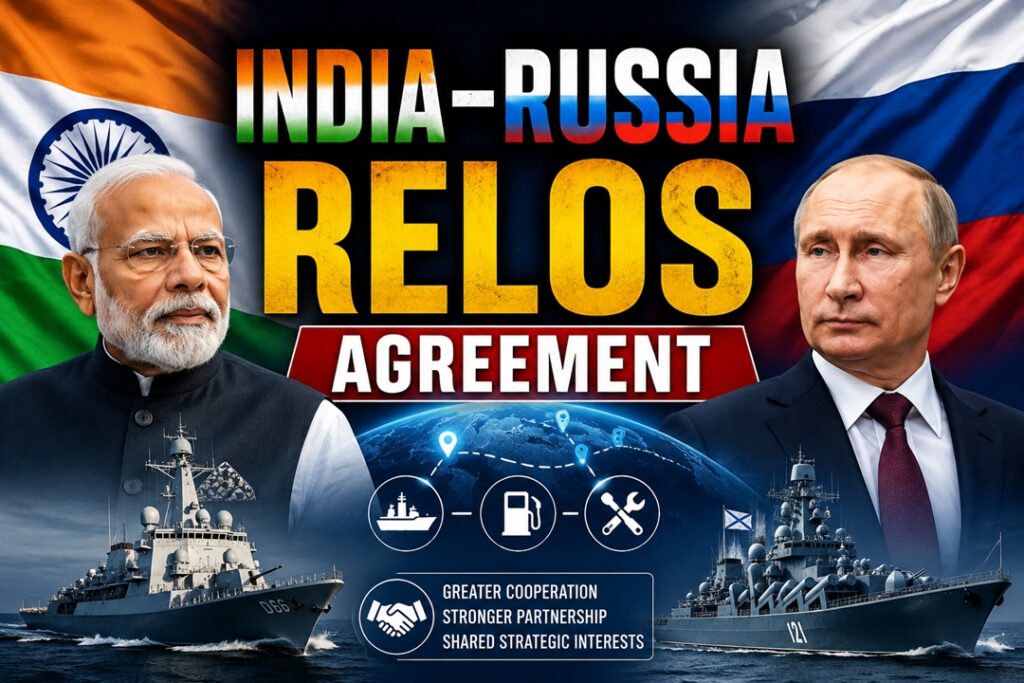
India–Russia RELOS Agreement: Facts, Features and Strategic Significance
Context
Recently, misinformation circulated on social media claiming that the India–Russia Reciprocal Exchange of Logistics Agreement (RELOS) permits the permanent deployment of 3,000 Russian troops in India or Indian troops in Russia. The agreement has therefore attracted attention regarding its implications for India’s strategic autonomy and defence cooperation. However, RELOS is a standard logistics support arrangement that facilitates reciprocal military logistical assistance during approved activities and does not allow permanent troop stationing or military bases.
What are Logistics Support Agreements (LSAs)?
Meaning
Logistics Support Agreements (LSAs) are defence cooperation arrangements that enable the armed forces of partner countries to access each other’s designated military facilities for logistical support during approved military activities.
Objective
The primary objective of LSAs is to improve operational efficiency, reduce bureaucratic delays and establish pre-approved mechanisms for logistical support and reimbursement.
Services Covered
LSAs generally provide:
- Fuel and lubricants
- Food and water supplies
- Accommodation facilities
- Transportation support
- Medical assistance
- Repair and maintenance services
- Spare parts support
- Storage facilities
- Communication services
- Port and airfield services
Common Applications
These agreements are typically used during:
- Joint military exercises
- Defence training programmes
- Naval port visits
- Humanitarian Assistance and Disaster Relief (HADR) operations
- Peacekeeping missions
- Transit and operational deployments
What LSAs Do Not Allow
LSAs do not:
- Establish military bases
- Permit permanent troop deployments
- Transfer territorial control
- Create military alliance obligations
India’s Logistics Cooperation Framework
India signed its first major logistics agreement, the Logistics Exchange Memorandum of Agreement (LEMOA), with the United States in 2016.
Subsequently, India concluded similar arrangements with:
- United States
- United Kingdom
- France
- Australia
- Japan
- Singapore
- Vietnam
- Russia
Additionally, Oman provides logistical access through broader defence cooperation mechanisms.
These agreements facilitate reciprocal logistical support while preserving India’s strategic autonomy.
India–Russia RELOS Agreement
Background
The Reciprocal Exchange of Logistics Agreement (RELOS) was signed in Moscow on 18 February 2025.
The Russian Federation ratified the agreement in December 2025, and it became operational in January 2026.
Key Features of RELOS
Reciprocal Access to Military Facilities
The agreement enables both countries to utilise designated military infrastructure such as:
- Naval ports
- Airbases
- Airfield facilities
- Logistics depots
This access supports visiting military personnel, aircraft and naval vessels during approved activities.
Logistics and Technical Support
RELOS facilitates logistical assistance for:
- Military aircraft
- Naval warships
- Defence formations
- Military equipment and platforms
Support includes:
- Refuelling
- Maintenance
- Repairs
- Replenishment of supplies
Joint Exercises and Training
The agreement facilitates smoother conduct of bilateral and multilateral military exercises by reducing administrative procedures and ensuring logistical availability.
Humanitarian Assistance and Disaster Relief
RELOS allows rapid logistical cooperation during:
- Natural disasters
- Humanitarian emergencies
- Evacuation missions
- Relief operations
Medical and Technical Assistance
The agreement provides:
- Medical facilities for military personnel
- Technical maintenance support
- Equipment repair and servicing
- Food and essential supplies
Does RELOS Allow Permanent Troop Stationing?
Source of the Misconception
A provision within the agreement mentions an upper limit of 3,000 personnel.
This was incorrectly interpreted as allowing permanent deployment of Russian troops in India or Indian troops in Russia.
Actual Meaning
The provision merely specifies the maximum number of personnel that may participate in mutually agreed activities such as:
- Joint military exercises
- Naval visits
- Training programmes
- Temporary operational deployments
The figure includes military personnel accompanying ships, aircraft and defence formations during official engagements.
Why Permanent Deployment is Not Allowed
Under RELOS:
- No military bases are established.
- No permanent deployment rights are granted.
- Every activity requires mutual consent.
- National laws remain fully applicable.
- Sovereignty of both countries is preserved.
Therefore, RELOS does not create a military alliance and does not permit permanent stationing of troops.
Strategic Significance of RELOS
Enhanced Operational Reach
The agreement expands the operational reach of both armed forces by providing access to logistical facilities beyond their national territories.
For India, it increases flexibility in regions where Russian infrastructure can support military operations.
Strengthened Defence Cooperation
RELOS complements existing India–Russia defence cooperation through:
- Joint military exercises
- Defence technology collaboration
- Arms procurement and maintenance
- Maritime security cooperation
Faster Operational Turnaround
Warships and aircraft can obtain fuel, supplies and repairs without returning to home bases, thereby improving:
- Mission endurance
- Operational readiness
- Cost efficiency
Emergency Response Capability
The agreement enhances both countries’ ability to respond rapidly during:
- Humanitarian crises
- Disaster relief operations
- Evacuation missions
- Emergency deployments
Arctic Cooperation
One of the most significant strategic benefits of RELOS is its potential role in supporting India’s access to Russian logistical infrastructure in the Arctic region.
As climate change opens Arctic sea routes, the region is gaining strategic and economic importance.
The agreement may support India’s interests in:
- Arctic scientific research
- Maritime connectivity
- Resource exploration
- Polar governance
- Emerging shipping routes
RELOS and India’s Defence Diplomacy
Strategic Autonomy
India’s logistics agreements reflect its policy of:
- Strategic autonomy
- Multi-alignment
- Issue-based partnerships
Rather than joining military blocs, India seeks practical arrangements that strengthen military capabilities while preserving independent decision-making.
Evidence of a Balanced Foreign Policy
India maintains logistics agreements with countries that may have differing geopolitical interests, including both the United States and Russia.
This demonstrates that logistics agreements are functional military arrangements rather than alliance commitments.
Challenges and Concerns
Strategic Perceptions
Some countries may perceive logistics agreements as signs of deeper military alignment, even when no alliance exists.
Dependence on External Infrastructure
Excessive reliance on foreign logistical networks could create vulnerabilities during periods of geopolitical uncertainty.
Managing Multiple Partnerships
India must continue balancing relations with diverse strategic partners while safeguarding its strategic autonomy.
Conclusion
The India–Russia Reciprocal Exchange of Logistics Agreement (RELOS) is a conventional military logistics arrangement that facilitates reciprocal access to military facilities, logistical support and operational assistance during mutually agreed activities.
It does not permit permanent military bases or troop stationing. Instead, it strengthens defence cooperation, improves operational flexibility, supports humanitarian missions and enhances strategic opportunities, particularly in the Arctic region.
In line with India’s policy of strategic autonomy and multi-alignment, RELOS serves as a practical instrument for improving military readiness and international defence cooperation while fully preserving national sovereignty.
Source: The Hindu