
India Strengthens the Fight Against Sickle Cell Disease
Context
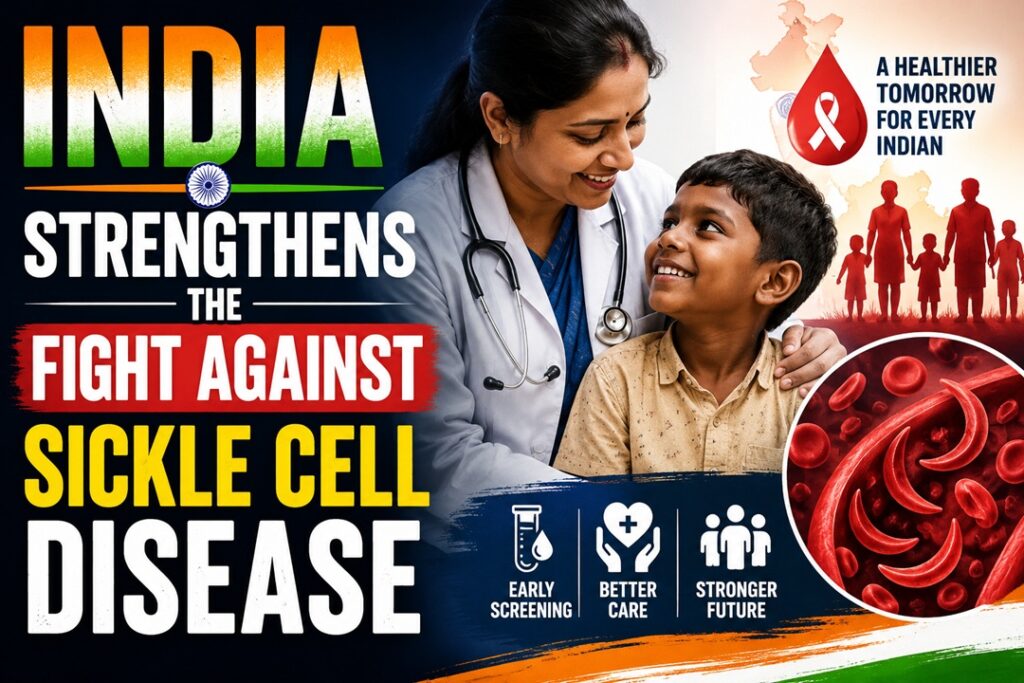
The President of India attended the International Sickle Cell Awareness Day commemoration at Omkareshwar, Madhya Pradesh, reaffirming India’s commitment to eliminating Sickle Cell Disease through nationwide screening, improved treatment, community participation, and strengthened healthcare interventions under the National Sickle Cell Anaemia Elimination Mission (NSCAEM).
Understanding Sickle Cell Disease (SCD)
Overview
Sickle Cell Disease (SCD) is a hereditary blood disorder characterized by abnormal red blood cells that become rigid and sickle-shaped, resulting in chronic illness, repeated pain episodes, and multiple organ complications.
Genetic Origin
Gene Defect:
SCD develops due to a mutation in the HBB (beta-globin) gene located on Chromosome 11, which controls the formation of hemoglobin responsible for oxygen transport.
Formation of Abnormal Hemoglobin:
The mutation produces Hemoglobin S (HbS) instead of normal hemoglobin. Under low oxygen conditions, HbS molecules stick together, forming long rigid fibers.
Red Blood Cell Deformation:
These fibers distort healthy disc-shaped red blood cells into crescent or sickle-shaped cells that lose flexibility and obstruct blood circulation.
Inheritance Pattern:
- SCD follows an autosomal recessive inheritance.
- Individuals inheriting two defective genes develop the disease.
- Those carrying only one defective gene remain healthy carriers (Sickle Cell Trait).
Major Health Complications
Painful Vascular Blockages
Sickle-shaped cells block small blood vessels, interrupting blood supply and causing severe recurring pain known as vaso-occlusive crises.
Persistent Anaemia
Unlike normal red blood cells that survive around 120 days, sickle cells survive only 10–20 days, leading to continuous destruction of blood cells and chronic anaemia.
Increased Infection Risk and Organ Injury
Repeated damage to the spleen weakens immunity, increasing susceptibility to bacterial infections. Long-term blockage of blood vessels may also result in stroke, lung complications, kidney damage, and acute chest syndrome.
Available Treatment Options
Supportive Medical Care
- Pain relief through analgesics and hydration
- Preventive antibiotics and pneumococcal vaccination
- Periodic blood transfusions to reduce HbS concentration
Medicines that Slow Disease Progression
- Hydroxyurea, which boosts fetal hemoglobin production
- Targeted therapies such as Crizanlizumab to reduce painful crises
Curative Therapies
- Allogeneic Bone Marrow (Stem Cell) Transplantation
- Advanced CRISPR-Cas9 gene-editing therapies (e.g., Casgevy), which correct the defective gene using the patient’s own stem cells.
India’s Sickle Cell Control Programme
National Sickle Cell Anaemia Elimination Mission (NSCAEM)
Mission Goal
To eliminate Sickle Cell Disease as a major public health problem by 2047, supporting the vision of Viksit Bharat.
Collaborative Governance
The programme is jointly implemented by:
- Ministry of Health and Family Welfare
- Ministry of Tribal Affairs
ensuring coordinated healthcare delivery in affected regions.
Integrated Government Measures
Health Screening Network
SCD diagnosis and management have been incorporated into:
- National Health Mission (NHM)
- Rashtriya Bal Swasthya Karyakram (RBSK)
- PM Surakshit Matritva Abhiyan (PMSMA)
to enable early detection and prenatal screening.
Digital Health Integration
Individuals receive digital genetic status records linked with their Ayushman Bharat Health Account (ABHA) for lifelong health tracking.
Legal and Welfare Support
Under the Rights of Persons with Disabilities (RPwD) Act, 2016, eligible SCD patients receive disability-related benefits and institutional assistance.
Community Participation
States like Madhya Pradesh have introduced “Sickle Mitra” volunteers, while treatment for severe episodes is covered under PM-JAY.
Progress Achieved So Far
| Indicator | Achievement (Mid-2026) |
|---|---|
| Population Screened | Over 7.19 crore |
| Confirmed Patients | Around 2.46 lakh |
| Identified Carriers | More than 20 lakh |
| Digital Genetic Cards Issued | Over 4 crore |
Challenges in Eliminating SCD
Social Barriers
Fear of discrimination, marriage-related concerns, and lack of awareness discourage many tribal communities from participating in screening programmes.
Difficult Geographic Access
Remote villages and tribal settlements remain difficult to reach, affecting regular screening, medicine supply, and healthcare delivery.
Health System Constraints
Maintaining uninterrupted availability of Hydroxyurea, blood transfusion services, and long-term follow-up places significant pressure on rural healthcare systems.
World Sickle Cell Awareness Day
Background
Observed every year on 19 June, the day was designated by the United Nations General Assembly (2008) to promote awareness and improve access to diagnosis and treatment worldwide.
Theme for 2026
“Closing the Survival Gap: Equity in Sickle Cell Disease.”
The emphasis is on reducing disparities in access to advanced diagnostics, treatment, and gene therapies.
India’s Approach
India uses the occasion to strengthen community participation, expand screening programmes, and accelerate progress under the National Sickle Cell Anaemia Elimination Mission.
Ethical Issues Involved
Promoting Health Equity
Since SCD primarily affects Scheduled Tribes and economically weaker populations, prioritizing free diagnosis and treatment promotes equitable healthcare access.
Privacy versus Social Stigma
Genetic screening and status cards improve preventive healthcare but also raise concerns regarding confidentiality, discrimination, and marriage-related stigma, making ethical counselling essential.
Unequal Access to Advanced Therapies
Although gene-editing therapies offer permanent cures, their extremely high cost limits accessibility, highlighting global inequities in healthcare technology.
Way Forward
India should now shift beyond mass screening towards community-driven behavioural change, encouraging tribal participation through local leaders and trained volunteers.
Expanding genetic counselling, ensuring uninterrupted medicine availability, strengthening village-level healthcare infrastructure, and increasing access to prenatal diagnosis will be essential to achieving the goal of a Sickle Cell-free India by 2047.
Source : PIB