
India–Uzbekistan Ties: Advancing a Comprehensive Strategic Partnership
Context
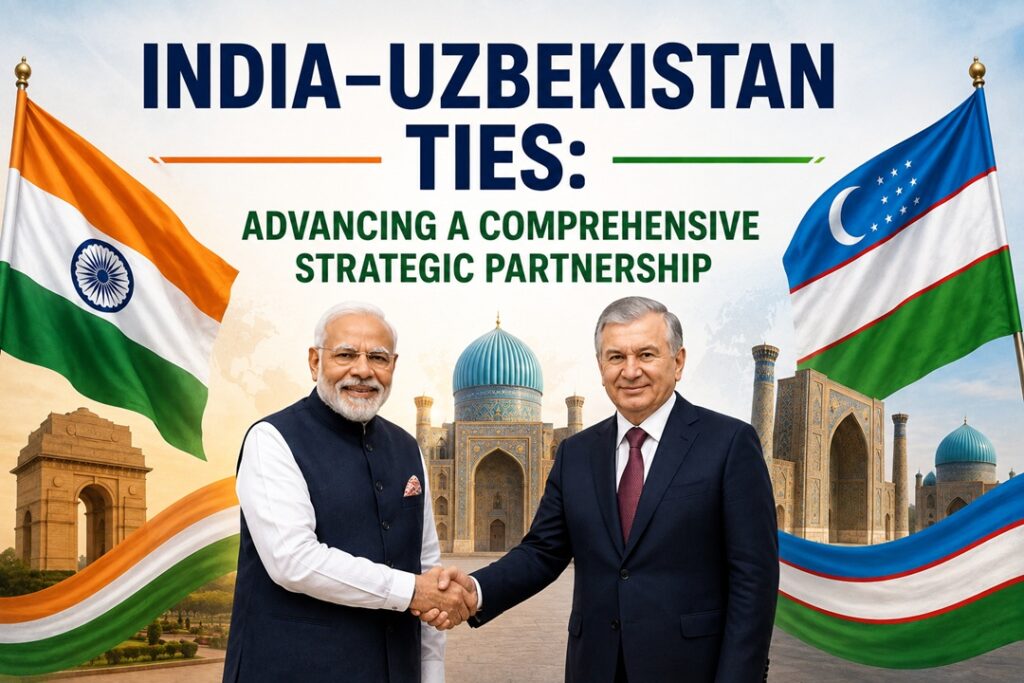
India and Uzbekistan have upgraded their bilateral relationship to a Comprehensive Strategic Partnership (CSP) during a State Visit. The two countries signed 11 agreements and set an ambitious $5 billion bilateral trade target by 2030, giving fresh momentum to cooperation in trade, energy, defence, technology and connectivity.
Why Uzbekistan Matters to India
Strategic Significance:
- Gateway to Central Asia: Uzbekistan’s central location makes it an important partner for India’s engagement with Central Asia and its wider Eurasian neighbourhood.
- The new Comprehensive Strategic Partnership broadens cooperation across economic diversification, civil nuclear energy, critical minerals, defence manufacturing and digital connectivity.
- Deeper engagement with Tashkent can help India strengthen its continental outreach and build greater resilience against regional geopolitical disruptions.
Trade, Energy and Technology: Major Areas of Progress
- $5 Billion Commerce Goal: India and Uzbekistan aim to raise bilateral trade from around $1 billion currently to $5 billion by 2030, supported by negotiations towards a Preferential Trade Agreement (PTA).
- Assured Uranium Cooperation: The two sides established a framework for long-term uranium supplies from Uzbekistan to support India’s expanding civil nuclear energy programme.
- Aral Sea Ecological Support: India announced a $1 million Grant-in-Aid, along with technical assistance, for environmental restoration and afforestation initiatives in the Aral Sea region.
- Digital Payment Connectivity: An agreement between NPCI International Payments Ltd. (NIPL) and Uzbekistan’s National Interbank Processing Centre (HUMO) will facilitate interoperability between India’s UPI ecosystem and Uzbekistan’s UZQR platform.
- Defence Exercises: Both countries reaffirmed their commitment to conducting Exercise Dustlik regularly, strengthening operational coordination between their armed forces.
Key Deliverables from the High-Level Visit
- Stronger Coordination Mechanism: The existing Joint Commission has been upgraded from the Secretary level to a Ministerial-level Coordination Council, co-chaired by the two Foreign Ministers.
- Critical Minerals Partnership: India and Uzbekistan agreed to explore joint investments in geological surveys, mining and mineral processing, particularly for strategic resources such as lithium, copper and rare earth elements.
- Defence Manufacturing Cooperation: Bilateral defence relations are moving beyond conventional procurement towards joint development, research and co-production of defence equipment.
- Pharmaceutical Manufacturing: Indian companies will receive greater opportunities to invest in manufacturing and research activities within the Tashkent Pharma Park.
- Buddhist Heritage Conservation: The countries signed a Letter of Intent covering the restoration, digital documentation and preservation of Buddhist sites such as Fayaz Tepa and Karatepa in Termez.
- Backing at Global Institutions: Uzbekistan reiterated its support for India’s permanent membership of a reformed UNSC, while India welcomed Uzbekistan’s potential participation in the International Solar Alliance (ISA) and International Big Cat Alliance (IBCA).
Persistent Roadblocks to Deeper Engagement
- Connectivity Deficit: The lack of direct overland access through Pakistan forces India-Uzbekistan trade to depend on complex multimodal routes involving Iran and Chabahar, increasing logistics costs.
- Trade Facilitation Issues: Different customs systems, regulatory requirements and phytosanitary standards continue to create non-tariff barriers for businesses.
- Afghanistan-Related Security Risks: Instability in Afghanistan presents common concerns involving terrorism, radicalisation, narcotics trafficking and cross-border security.
- Geopolitical Competition: China’s substantial infrastructure presence through the Belt and Road Initiative, along with Russia’s established economic and defence networks, creates a challenging environment for expanding India’s footprint.
Policy Priorities for the Next Phase
- Complete the PTA Negotiations: Accelerate the Preferential Trade Agreement with focused tariff concessions covering pharmaceuticals, engineering products, automobiles and agricultural commodities.
- Build Integrated Eurasian Connectivity: Improve the integration of Chabahar Port with INSTC and Central Asian transport corridors, including rail and multimodal links.
- Secure Strategic Mineral Supplies: Establish a dedicated India–Uzbekistan Critical Minerals Taskforce involving KABIL and Uzbek geological institutions to identify exploration and mining opportunities.
- Improve Air-Based Logistics: Develop dedicated air-cargo linkages between major Indian cities and Tashkent for high-value pharmaceuticals, perishables and other time-sensitive goods.
- Deepen Counter-Terrorism Cooperation: Make greater use of the SCO Regional Anti-Terrorist Structure (RATS), headquartered in Tashkent, for intelligence sharing, cyber-security exercises and combating terror financing.
Conclusion
The India–Uzbekistan Comprehensive Strategic Partnership can serve as an important pillar of India’s Central Asian outreach. Cooperation in uranium, critical minerals, pharmaceuticals, digital payments, defence production and cultural heritage offers substantial opportunities for both countries.
However, connectivity constraints, regulatory barriers and regional instability remain significant obstacles. Greater integration of Chabahar, INSTC and Central Asian transport networks, combined with stronger trade facilitation and security cooperation, will be crucial for converting the $5 billion trade ambition into a sustainable economic partnership.
Source : The Hindu