
India’s Agricultural Exports: The Growing Dominance of Livestock and Fisheries
Context
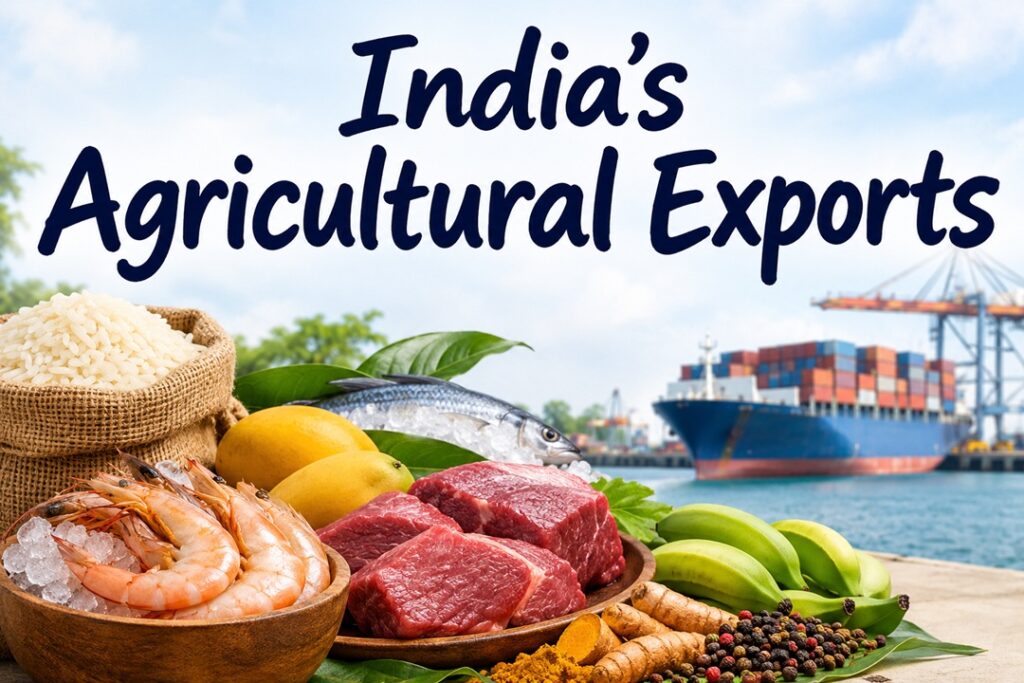
Recent Department of Commerce data for the first half of FY 2026–27 indicates a significant shift in India’s agricultural export composition. Marine products ($4.5 billion) and buffalo meat ($3.4 billion) have emerged as leading agricultural export commodities, surpassing traditional products such as basmati rice. This reflects the growing importance of livestock and fisheries in India’s agricultural economy.
Changing Composition of India’s Agricultural Exports
- Growing Contribution to Agricultural GDP: Livestock and fisheries now account for nearly 40% of India’s agricultural GDP, compared to around 30% a decade ago, indicating a shift towards high-value agricultural activities.
- Reduced Dependence on Traditional Crops: Animal-based exports are increasingly strengthening India’s export basket, offering an alternative to crops that are frequently affected by weather fluctuations and government-imposed export restrictions.
Key Export Trends (H1 FY 2026–27)
- Overall Agricultural Exports: India’s agricultural exports increased by 4.7% to $27.1 billion during April–September 2026.
- Marine Products: Exports registered 13.2% growth, reaching $4.5 billion.
- Buffalo Meat: Exports recorded an impressive 53.8% increase to $3.4 billion.
- Record Seafood Performance: Marine exports touched a record $8.4 billion in FY 2025–26, supported by growing international demand.
- Improved Meat Export Realisation: Average buffalo meat export value increased from $2,716.8 per tonne in FY23 to $4,368.2 per tonne in H1 FY27.
Factors Driving the Growth of Animal Product Exports
1. Expansion into New International Markets: Indian exporters are reducing dependence on individual importing countries by accessing markets across West Asia, Southeast Asia and Central Asia.
Example: Major buffalo meat destinations include Vietnam, Egypt, Malaysia, Indonesia and Saudi Arabia.
2. Improved Quality and Global Acceptance: Better sanitary practices, modern processing facilities and compliance with international food safety standards have enhanced the reputation and value of Indian buffalo meat.
3. Expansion of Commercial Aquaculture: The growth of vannamei shrimp cultivation, particularly in Andhra Pradesh, Odisha and Gujarat, has strengthened India’s seafood export capacity. Pathogen-free hatcheries have further supported production quality.
4. Better Export Policy Stability: Unlike certain agricultural commodities such as wheat, sugar and non-basmati rice, marine products and buffalo meat have generally experienced fewer sudden export restrictions arising from domestic inflation management.
5. Growing International Demand: Rising consumption of seafood and affordable animal protein in international markets has created additional opportunities for Indian exporters.
Changing Patterns in India’s Agricultural Trade: Emerging Import Dependence
While livestock and fisheries exports are expanding, India is increasingly facing import pressures in several traditional agricultural commodities.
- Cotton: Declining productivity growth and pest-related challenges have contributed to India becoming a net cotton importer, with imports crossing $2 billion in FY27.
- Edible Oils: India reduced import duties on palm, soybean and sunflower oils to manage domestic food inflation and ensure adequate supplies.
- Pulses: Duty-free imports have been permitted to address domestic shortages and stabilise prices.
- Sugar: Reduced water availability in Maharashtra and Karnataka affected sugarcane production, leading to export restrictions and provisions for duty-free raw sugar imports.
- Climate Vulnerability: Irregular monsoon patterns and extreme weather events continue to affect the productivity and export potential of rain-fed agricultural crops.
This changing trade pattern highlights the growing contrast between the export competitiveness of animal-based products and India’s import requirements for several conventional agricultural commodities.
Challenges Associated with Animal Product Exports
1. Stringent Sanitary and Phytosanitary Standards: International markets impose rigorous food safety requirements, including antibiotic residue limits, chemical testing and health certification. Non-compliance can result in rejection of consignments.
2. Animal Disease Risks: Persistent Foot-and-Mouth Disease (FMD) outbreaks restrict India’s access to premium meat markets in Europe and North America, where disease-free certification is essential.
3. Environmental Degradation: Intensive shrimp farming and large slaughterhouse operations can generate saline wastewater, solid waste and pollution, affecting coastal ecosystems, groundwater and mangroves.
4. Dependence on Limited Export Markets: Despite geographical diversification, access to high-value markets remains constrained by regulatory restrictions and disease-related concerns.
5. Geopolitical and Logistical Disruptions: Conflicts and instability along major maritime routes increase freight costs, insurance premiums and transportation delays, particularly for temperature-sensitive products requiring refrigerated containers.
Way Forward
- Strengthen Animal Disease Management: Accelerate the National Animal Disease Control Programme (NADCP) and establish internationally recognised FMD-free zones to improve access to premium export destinations.
- Promote Value Addition: Encourage exports of processed seafood, ready-to-eat products, finfish, seaweed and other high-value marine products under the Pradhan Mantri Matsya Sampada Yojana (PMMSY).
- Upgrade Export Infrastructure: Develop integrated cold-chain networks, modern slaughterhouses and accredited testing laboratories to ensure compliance with international quality standards.
- Improve Digital Traceability: Introduce technology-enabled tracking systems to monitor the origin, processing, transportation and safety of animal products.
- Ensure Sustainable Production: Promote environmentally responsible aquaculture, effective wastewater treatment, scientific waste management and protection of coastal ecosystems.
- Diversify Export Destinations: Expand trade partnerships across Europe, East Asia, Africa and other emerging markets to reduce geographical concentration and external trade risks.
Conclusion
The increasing prominence of marine products and buffalo meat signals an important transformation in India’s agricultural trade, moving beyond its traditional dependence on crop-based exports. Livestock and fisheries offer significant opportunities for export diversification, rural employment and higher agricultural incomes. However, long-term competitiveness will depend on stronger disease surveillance, international quality compliance, sustainable production practices and modern export infrastructure. India must therefore pursue a balanced agricultural strategy that strengthens both traditional crop production and emerging animal-based value chains.
Source : The Indian Express