
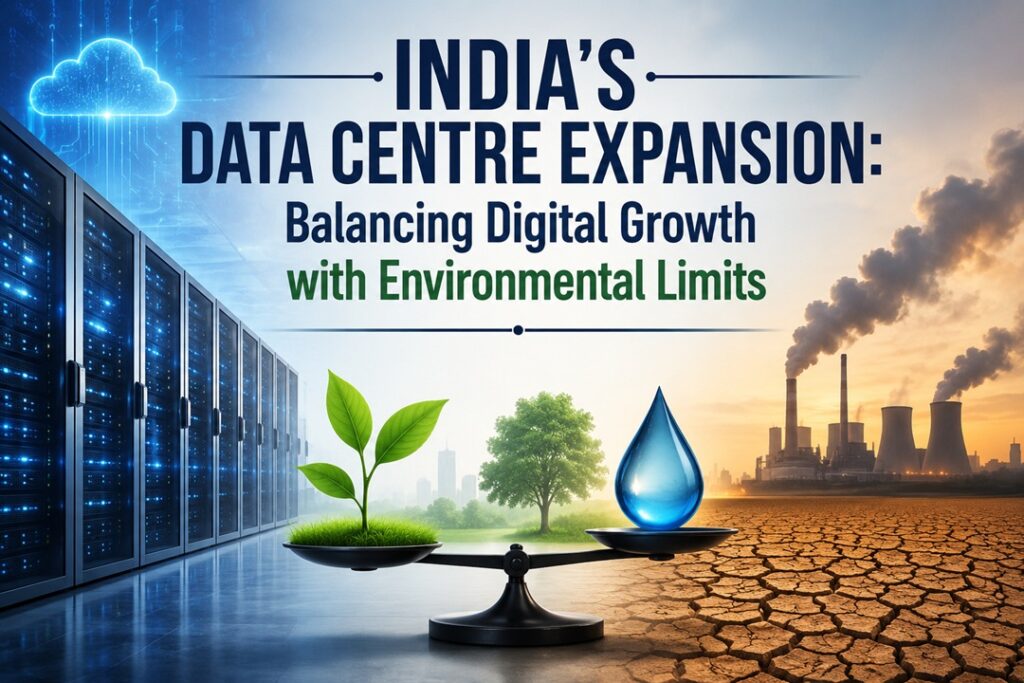
India’s Data Centre Expansion: Balancing Digital Growth with Environmental Limits
Context
India’s data centre industry is expanding rapidly, with capacity projected to reach 6.5 GW by 2030. However, rising electricity and freshwater demand, along with grid constraints and urban heat, are creating new sustainability challenges.
Understanding the Digital Infrastructure–Climate Tension
- Data centres require uninterrupted electricity and substantial cooling, making them highly resource-intensive.
- Concentration in metropolitan regions can increase pressure on already-stressed water and power systems.
- Dependence on conventional grid electricity during renewable-energy shortages can increase emissions.
- Heat released by cooling systems can contribute to localised warming and further increase cooling demand.
India’s Data Centre Growth Trajectory
- Installed capacity increased from around 520 MW in 2020 to approximately 1.5 GW in 2026.
- Capacity is projected to reach nearly 6.5 GW by 2030.
- Electricity consumption is expected to rise from around 13 TWh in 2024 to 57 TWh by 2030.
- Generative AI could add 26.3 GW of new baseload demand by 2031–32, according to the Ministry of Power.
Water Demand: An Emerging Constraint
- Cooling constitutes a major component of data centre water consumption.
- A 100 MW facility can consume approximately 2 million litres of water daily, equivalent to the usage of around 6,500 urban households.
- Aggregate water consumption could increase from about 150 billion litres in 2024–25 to 358 billion litres annually by 2030.
- Establishing water-intensive facilities in groundwater-stressed areas could intensify competition between industrial and domestic requirements.
Renewable Energy Meets Grid Bottlenecks
- Corporate commitments to renewable energy do not necessarily guarantee continuous clean power.
- Transmission and evacuation constraints can prevent renewable electricity from reaching major data centre clusters.
- Around 300 GWh of renewable electricity was curtailed in Q1 2026.
- India achieved only about 80% of its annual transmission targets over the previous five years.
- Delays affecting nearly 20 GW of renewable capacity can encourage data centres to rely on coal-dominated grid electricity for reliable baseload supply.
Geographic Concentration and Resource Stress
- Major data centre clusters are emerging around Mumbai, Hyderabad, Bengaluru and the National Capital Region.
- Such concentration increases pressure on land, electricity and freshwater resources.
- Rajasthan is extracting around 147.11% of its annual groundwater recharge.
- Hyderabad experienced a decline in surface-water availability in 2024, while several Telangana districts face severe groundwater stress.
- This highlights the need to align data centre location decisions with local ecological carrying capacity.
The Urban Heat Feedback Mechanism
- Data centre cooling systems release considerable waste heat into their surroundings.
- University of Cambridge satellite analysis found an average 2°C increase in land-surface temperatures within a 10-km radius of data centres, with extreme localised increases reaching 9.1°C.
- This can create a reinforcing cycle:
- Rising temperatures increase cooling requirements.
- Higher cooling demand increases electricity consumption.
- Greater energy use can increase emissions where grids remain fossil-fuel dependent.
- Additional heat and emissions can further intensify urban warming.
Policy and Governance Challenges
- Competition among States to attract data centre investments can sometimes dilute environmental requirements.
- Maharashtra reportedly reduced its renewable-energy sourcing requirement from 100% to 51% in June 2026.
- Public investment in transmission, water supply and other infrastructure may disproportionately support private data centre development.
- Without suitable cost-recovery mechanisms, infrastructure costs could eventually be transferred to electricity and water consumers.
Way Forward
Establish a National Sustainability Framework
India should introduce enforceable national standards covering water consumption, renewable-energy procurement, cooling efficiency, waste-heat management and environmental disclosure before new data centres are commissioned.
Introduce Data Centre Efficiency Ratings
A national rating system can assess facilities on Power Usage Effectiveness (PUE), Water Usage Effectiveness (WUE), renewable-energy use and carbon intensity, improving transparency and encouraging competition on sustainability.
Promote Water-Efficient Cooling
Data centres should progressively adopt closed-loop cooling, recycled water and advanced air-cooling systems, particularly in groundwater-stressed regions.
Align Facilities with Renewable-Energy Zones
Future data centres should be strategically located closer to renewable-energy generation and transmission infrastructure instead of being concentrated mainly in large metropolitan areas.
Expand Battery Energy Storage
Battery Energy Storage Systems at renewable-energy pooling stations can absorb surplus solar and wind power and provide more reliable clean electricity for data centre operations.
Explore Coastal and Near-Shore Locations
Where environmental conditions permit, coastal corridors could support data centre development through access to offshore renewable energy and alternative cooling systems, while reducing dependence on urban freshwater supplies.
Reform Power-Market Mechanisms
Power markets should incentivise battery storage, demand response, flexible consumption and clean round-the-clock power contracts, enabling data centres to contribute to grid stability.
Conclusion
India’s data centre growth is vital for AI, cloud computing and the digital economy, but it must remain within ecological limits. Renewable energy, efficient cooling, responsible siting and stronger sustainability standards can ensure that digital expansion supports economic growth without worsening water stress, urban heat and energy insecurity.
Source : The Hindu