
India’s E20 Ethanol Blending: Fuel Quality Dispute and Consumer Concerns
Context
The Ministry of Petroleum and Natural Gas, along with public sector Oil Marketing Companies (OMCs), rejected the Karnataka Government’s allegations that petrol sold at retail outlets contained 26–31% ethanol. The disagreement has raised questions about fuel quality testing, regulatory compliance, vehicle efficiency and consumer protection amid India’s nationwide transition towards E20 petrol.
What is E20 Ethanol Blending?
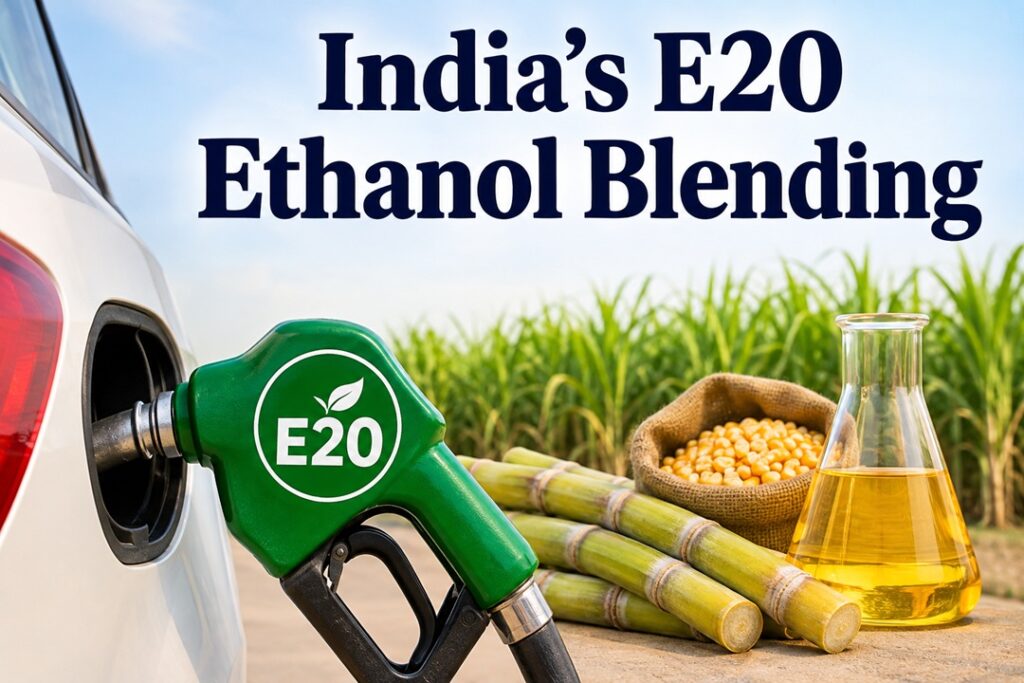
E20 is a motor fuel containing 20% anhydrous ethanol and 80% petrol by volume, conforming to the Indian fuel quality standard IS 17021.
Ethanol, an alcohol-based biofuel, is primarily produced from agricultural feedstocks such as sugarcane, maize and surplus food grains. Its blending with petrol is intended to reduce dependence on imported crude oil and promote domestic renewable energy sources.
Key Statistics on India’s Ethanol Blending Programme
- Fuel Quality Testing: The Centre reported that 893 samples tested across 27 States and Union Territories, including 56 samples from Karnataka, complied with the prescribed 19–21% ethanol range. Karnataka’s samples recorded an average of 19.30%.
- Foreign Exchange Savings: Since ESY 2014–15, the programme has generated foreign exchange savings exceeding ₹1.97 lakh crore.
- Crude Oil Substitution: Approximately 316 lakh metric tonnes of crude oil have been replaced through ethanol blending.
- Environmental Benefits: The initiative has reportedly reduced around 952 lakh metric tonnes of CO₂ emissions.
- Agricultural Benefits: More than ₹1.66 lakh crore has been transferred to domestic farmers through ethanol procurement.
- Procurement and Blending: During ESY 2025–26, OMCs procured 1,089 crore litres of ethanol and blended 1,134 crore litres against approximately 5,673 crore litres of petrol sales.
Evolution of Ethanol Blending in India
- Initial Experiments (2001–2003): India initiated pilot projects in selected States to assess the feasibility of blending 5% ethanol with petrol.
- National Policy on Biofuels, 2018: The policy expanded eligible feedstocks to include surplus food grains, damaged rice and maize, besides sugarcane-based sources.
- Advancement of E20 Target (2021–2022): The government advanced the target of achieving 20% ethanol blending from 2030 to ESY 2025–26, following the roadmap prepared by NITI Aayog.
- Nationwide Expansion (2023–2026): E20 petrol was progressively introduced across retail fuel stations, supported by updated fuel quality standards and automated blending infrastructure.
Major Government Initiatives
- National Policy on Biofuels: Established the regulatory framework for ethanol production, feedstock diversification and inter-state transportation.
- Interest Subvention Schemes: Provided financial assistance through concessional loans for establishing first-generation (1G) and second-generation (2G) ethanol production facilities.
- Automated Blending Infrastructure: Introduced calibrated blending systems at refinery depots to ensure accurate ethanol proportions and minimize manual intervention.
- Quality Coordination Cells (QCCs): Established multi-level fuel quality monitoring under the Centre for High Technology to assess compliance across the supply chain.
- Differential Ethanol Pricing: Introduced feedstock-based pricing mechanisms to encourage the participation of different agricultural sectors in ethanol production.
Why Has the Karnataka E20 Controversy Emerged?
The dispute centres on the Karnataka Government’s reported test results indicating ethanol concentrations of 26–31% in retail petrol, exceeding the prescribed E20 range.
The OMCs questioned the reliability of the testing exercise on several grounds:
- Procedural Irregularities: According to OMCs, samples were collected without their participation or joint labelling, allegedly contrary to the Essential Commodities Act, 1955, Control Order and Marketing Discipline Guidelines, 2024.
- Lack of Independent Verification: The state authorities reportedly did not provide retention samples, outlet-wise records and detailed laboratory reports to enable independent counter-testing.
- Methodological Concerns: The test certificates reportedly lacked sufficient information about the Gas Chromatography procedures, including sample dilution and calibration against appropriate reference fuels.
- Density Inconsistency: OMCs questioned the reported density values of 0.742–0.749 g/cc despite claims of higher ethanol concentrations. Since ethanol is denser than petrol, a higher ethanol proportion would generally increase the fuel’s density.
Thus, the disagreement highlights the importance of standardized sampling, reliable laboratory procedures and independent verification before drawing conclusions about fuel adulteration or over-blending.
Debate over Mileage Reduction and Consumer Costs
The controversy has also revived concerns about the impact of ethanol blending on vehicle performance and household expenditure.
| Concerns raised by activists | Position of the Ministry and automobile industry |
|---|---|
| A uniform 10% reduction in vehicle mileage due to E20. | Reported efficiency reduction is around 1–2% in E20-calibrated engines and 3–6% in older, non-calibrated vehicles. |
| Annual consumer fuel losses of approximately ₹62,000 crore. | The government considers applying a uniform mileage reduction to the entire vehicle fleet methodologically unsound. |
| Repair expenses of around ₹39,000 crore due to engine damage and corrosion. | OMCs point to the absence of evidence establishing a nationwide increase in systemic mechanical failures. |
| Retailers may benefit financially from excessive ethanol blending. | OMCs argue that additional ethanol procurement increases blending costs rather than creating a commercial advantage. |
The disagreement demonstrates that the economic impact of E20 cannot be assessed through a single mileage-loss assumption. Vehicle age, engine design, material compatibility, driving conditions and manufacturer specifications must also be considered.
Challenges Associated with E20 Implementation
- Vehicle Compatibility: Older vehicles may experience comparatively higher efficiency losses because they were not originally designed for higher ethanol concentrations.
- Consumer Awareness: Limited information about vehicle compatibility and mileage implications can create uncertainty among motorists.
- Testing Infrastructure: Differences in sampling procedures and laboratory capabilities can generate conflicting fuel quality assessments.
- Feedstock Availability: Large-scale ethanol production requires sustainable supplies of agricultural raw materials without creating excessive pressure on food security.
- Water and Land Requirements: Expansion of water-intensive sugarcane cultivation can increase pressure on groundwater and agricultural resources.
- Infrastructure Adaptation: Fuel storage, transportation and distribution systems require appropriate material compatibility to handle higher ethanol blends.
Way Forward
- Ensure Joint and Transparent Sampling: Fuel quality inspections should involve state authorities, OMC representatives and accredited laboratories, with proper documentation and retention samples.
- Strengthen Laboratory Standards: State testing facilities should be equipped with calibrated Gas Chromatography instruments and certified reference materials to ensure consistent results.
- Promote E20-Compatible Vehicles: Automobile manufacturers should accelerate the development of ethanol-compatible engines and fuel system components.
- Improve Consumer Protection: Provide clear information about vehicle compatibility, expected mileage variations and manufacturer recommendations.
- Introduce Digital Traceability: Publish automated depot-level blending records and quality testing results through accessible public dashboards.
- Ensure Sustainable Feedstock Diversification: Promote agricultural residues, damaged grains and second-generation biofuels to reduce dependence on water-intensive feedstocks.
- Undertake Independent Impact Assessments: Regularly evaluate E20’s effects on vehicle performance, emissions, agricultural incomes and consumer expenditure.
Conclusion
India’s E20 programme represents an important component of its strategy to strengthen energy security, reduce crude oil imports and promote domestic biofuel production. However, the Karnataka controversy underlines the need to reconcile technological expansion with scientific verification, regulatory transparency and consumer interests. A credible system of joint fuel quality audits, vehicle compatibility standards and sustainable feedstock management will be essential to ensure that ethanol blending delivers its intended economic and environmental benefits.
Source : India Today