
India’s Fuel Security Under Global Geopolitical Stress
Context
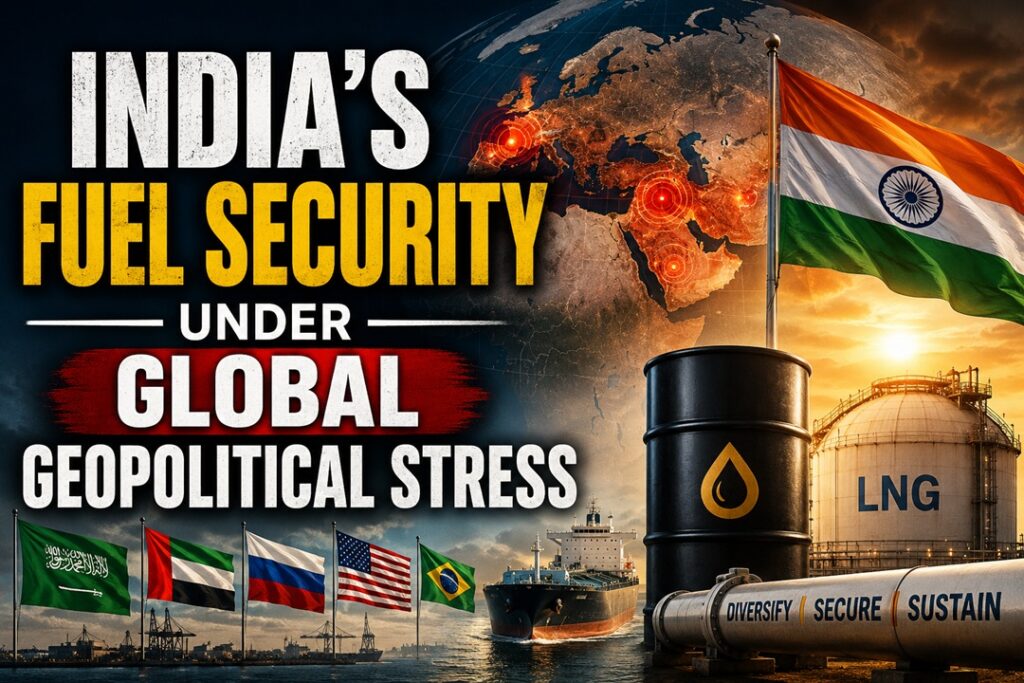
Escalating tensions across West Asia and disruptions in major maritime trade routes have once again exposed India’s dependence on imported hydrocarbons, with global crude benchmarks witnessing sharp fluctuations.
Economic analysts warn that sustained volatility in international oil markets could weaken India’s growth momentum and intensify inflationary pressures through rising transportation and manufacturing costs.
India’s Fuel Security Under Global Geopolitical Stress
Understanding Fuel Security
Fuel security today extends far beyond merely obtaining crude oil at competitive prices. It now includes supply-chain resilience, diversification of suppliers, strategic preparedness, and the ability of an economy to absorb geopolitical disruptions without major economic instability.
It refers to a nation’s capacity to ensure uninterrupted access to energy resources at affordable rates while safeguarding itself against external conflicts, shipping disruptions, and market shocks.
Major Indicators of India’s Energy Dependence
Heavy Reliance on Imports
India fulfills more than four-fifths of its crude oil demand through imports, making the economy highly sensitive to international price movements.
Maritime Route Exposure
A substantial share of India’s crude shipments passes through the Strait of Hormuz, one of the world’s most strategically sensitive sea lanes.
Expanding Consumption Demand
India remains among the largest global consumers of petroleum, with energy demand steadily rising alongside urbanisation and industrial expansion.
Changing Supplier Composition
Russia has emerged as a leading supplier of discounted crude to India in recent years, significantly altering India’s traditional import structure dominated by Gulf nations.
Present Condition of India’s Energy Architecture
Diversified Import Strategy
India has broadened its supplier network by sourcing crude from Russia, the Gulf region, and the United States.
Example: Increased procurement of discounted Russian crude enabled India to cushion the impact of earlier global price spikes.
Continued Structural Weakness
Domestic hydrocarbon production remains insufficient compared to national consumption requirements.
Example: Limited domestic output keeps India exposed to exchange-rate volatility and global freight disruptions.
Emerging Green Transition Risks
The renewable energy transition has created fresh dependence on critical minerals such as lithium, cobalt, and rare earth elements.
Example: India still relies heavily on external processing networks for battery-grade minerals and advanced clean-energy components.
Global Conflicts Affecting Energy Stability
Russia–Ukraine Crisis
The conflict demonstrated the vulnerability created by overdependence on a single energy supplier.
Example: European countries rapidly reduced dependence on Russian gas after supply disruptions intensified.
West Asian Instability
Regional conflicts in West Asia have highlighted the strategic importance of maritime chokepoints for global oil movement.
Example: Any disruption in the Strait of Hormuz immediately affects global crude prices and freight insurance costs.
Growing Maritime Security Threats
Rising attacks and tensions along shipping routes have increased risks for commercial energy transport.
Example: Naval deployments have become necessary to secure commercial oil and LPG shipments in sensitive waters.
Strategic Stockpiling by Nations
Countries are increasingly building massive strategic reserves to prepare for future supply emergencies.
Example: Several advanced economies maintain emergency petroleum reserves sufficient for months of consumption.
Consequences of Energy Insecurity
Inflationary Pressures
Higher fuel prices raise transportation and logistics costs, contributing to broader inflation across sectors.
Example: Rising crude prices increase the cost of food distribution, fertilisers, and industrial production.
Vulnerability of Trade Routes
Dependence on narrow maritime corridors creates serious supply-chain risks during regional tensions.
Example: Any blockade or conflict near critical sea lanes can delay energy imports and disrupt industrial activity.
Exporters Gaining Strategic Leverage
Oil-producing nations gain stronger pricing influence during periods of geopolitical instability.
Example: Gulf producers continue to play a decisive role in balancing global energy supply.
Critical Mineral Dependence
Control over rare-earth processing and battery minerals is becoming a strategic geopolitical tool.
Example: Concentration of mineral processing capacity in a few countries may affect India’s renewable-energy ambitions.
Measures Required
Expand Strategic Petroleum Reserves
India should significantly enhance emergency crude storage capacity to withstand temporary supply disruptions.
Strengthen Maritime Security
Naval capabilities and international maritime cooperation must be enhanced to secure critical shipping lanes.
Lower Crude Dependence
Rapid electrification of transport and greater adoption of renewable energy can reduce oil intensity.
Build Domestic Mineral Ecosystems
India needs large-scale investments in processing facilities for lithium, cobalt, and rare earth minerals.
Maintain Supplier Diversification
A broad and flexible import basket can reduce overdependence on any single region or country.
Conclusion
India has demonstrated considerable adaptability in managing recent energy disruptions through supplier diversification and tactical procurement strategies. However, long-term vulnerability persists due to high import dependence and exposure to geopolitical flashpoints.
Sustainable energy security will require stronger strategic reserves, resilient maritime infrastructure, reduced oil intensity, and self-reliance in critical mineral processing to shield the economy from future global shocks.
Source : The Hindu