
India’s Gen Z Employment Crisis: Demographic Dividend at Risk
Context
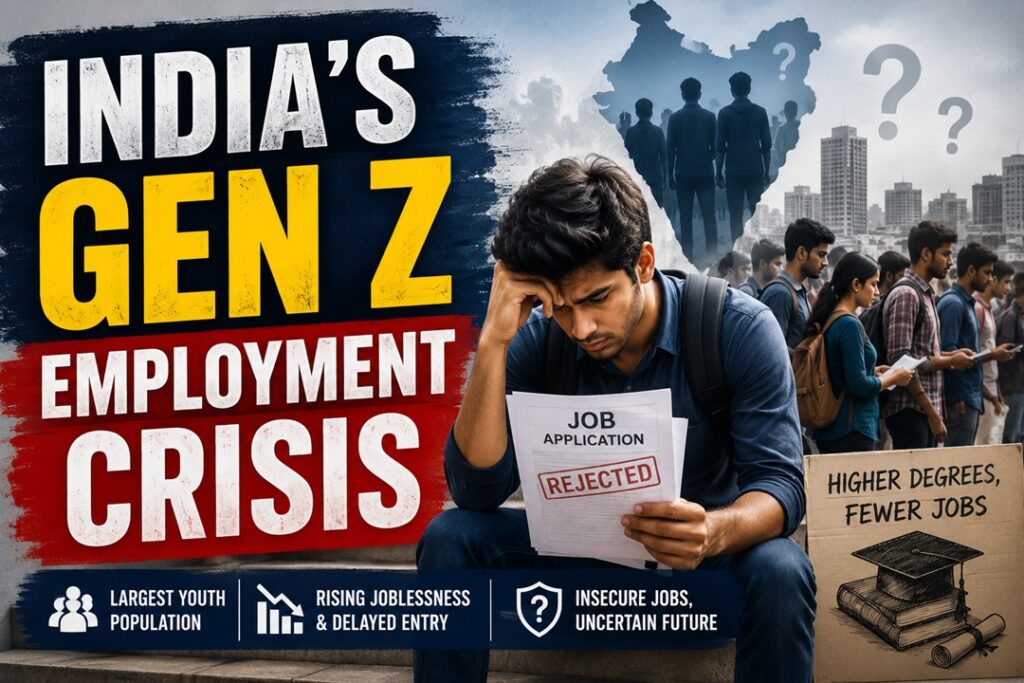
Despite possessing the world’s largest youth population, India is experiencing increasing concerns over delayed entry into the labour market, high youth unemployment, and the rise of insecure forms of employment. Recent labour market trends indicate that unless education, skills, and employment opportunities are better aligned, India’s demographic dividend could gradually transform into a demographic burden.
Understanding Gen Z and Millennials
Generation Z (Gen Z)
- Refers to individuals born between 1997 and 2012.
- They are currently the youngest working-age generation entering India’s labour market.
- This generation has grown up in a digital economy shaped by rapid technological change.
Millennials (Generation Y)
- Includes people born between 1981 and 1996.
- They represent the more experienced segment of India’s workforce with comparatively higher employment levels.
India’s Youth Advantage
- According to United Nations (2025) estimates, India has nearly 371 million youth, making it the country with the largest youth population in the world.
- This demographic advantage can generate long-term economic growth only if young people obtain productive and quality employment.
Employment Trends among Gen Z
Labour Force Composition
- According to the Periodic Labour Force Survey (PLFS) 2023–24, India has around 29.94 crore working-age Gen Z individuals compared to nearly 35 crore Millennials.
Delayed Labour Market Entry
- A large share of Gen Z remains in education before entering employment.
- About 41.7% of young men and 38.4% of young women are still pursuing studies.
Gender Differences
- Around 27.1% of young women primarily perform domestic responsibilities compared to only 0.32% of young men.
- Household responsibilities significantly reduce female labour force participation.
Nature of Employment
Among Gen Z males:
- Around 15.8% work as unpaid family workers.
- Nearly 12.3% are engaged in casual employment.
- About 14.8% hold regular salaried jobs.
Among Gen Z females:
- Around 35% mainly perform domestic work.
- Nearly 10.7% serve as unpaid family workers.
- Only 4.7% receive regular wages.
Comparison between Gen Z and Millennials
Labour Force Participation Rate (LFPR)
- Gen Z: 41.7%
- Millennials: 75%
Rural–Urban Comparison
- Rural Gen Z: 44.1%
- Urban Gen Z: 37.2%
Gender-wise Participation
- Rural males: 59.3%
- Urban males: 51.3%
- Rural females: 28%
- Urban females: 21.1%
The data indicates that labour force participation remains significantly lower among women and urban youth.
Unemployment Scenario
Overall Unemployment
- Gen Z: 11.9%
- Millennials: 2%
Urban Youth
- Urban young men: 17.1%
- Urban young women: 22.6%
Graduate Unemployment
Among Gen Z graduates:
- Male unemployment: 29%
- Female unemployment: 36.9%
Among Millennial graduates:
- Male unemployment: 5.2%
- Female unemployment: 13.8%
The figures demonstrate that higher educational qualifications alone do not guarantee employment, highlighting a serious mismatch between education and labour market demand.
Major Reasons Behind the Gen Z Employment Crisis
Skill Mismatch
- Educational institutions often fail to provide industry-relevant practical skills.
- Employers increasingly seek job-ready candidates with technical and digital competencies.
Technological Transformation
- Automation, Artificial Intelligence (AI), and digital technologies are reducing demand for routine occupations.
- New employment opportunities require advanced digital and analytical skills.
Weak School-to-Work Transition
- Limited internships, apprenticeships, vocational education, and industry exposure delay the transition from education to employment.
Barriers to Female Employment
- Household responsibilities.
- Limited childcare facilities.
- Unsafe public transport.
- Workplace discrimination and lack of flexible employment options.
Growth of Informal Employment
- Expansion of contract work, gig work, and temporary employment has reduced job security.
- Many young workers lack social security and employment protection.
Social Consequences
- Rising frustration among educated youth.
- Declining trust in institutions.
- Increased protests and social unrest.
- Greater risks to long-term social stability.
Impact of the Employment Crisis
Economic Impact
- Underutilisation of India’s demographic dividend.
- Lower productivity.
- Reduced economic growth.
- Slower income generation.
Social Impact
- Growing disappointment among educated youth.
- Rising mental stress and uncertainty.
- Increased migration in search of employment.
- Weakening confidence within families.
Gender Impact
- Women remain disproportionately excluded from formal employment.
- Female economic participation continues to remain significantly below potential.
Structural Impact
- Increasing informalisation weakens employment quality.
- Lack of job security reduces long-term economic resilience.
Ethical Dimensions
Equity and Social Justice
- Every young citizen should have equal access to education, skills, and employment irrespective of gender, income, or location.
Accountability of Education
- Investments in higher education should lead to meaningful employment opportunities.
- Persistent unemployment undermines both public and private investment in education.
Responsibility of the State
- Governments must create policies that support employment generation, skill development, and inclusive economic growth.
- Ensuring dignified employment is essential for social stability.
Measures Needed
Expand Labour-Intensive Industries
- Promote manufacturing.
- Strengthen MSMEs.
- Encourage green industries.
- Expand service-sector employment.
Improve Skill Development
- Align education with industry needs.
- Expand vocational education.
- Increase apprenticeships and internships.
Increase Women’s Employment
- Improve childcare support.
- Ensure safe transportation.
- Promote flexible work arrangements.
- Encourage women-friendly workplaces.
Promote Formal Employment
- Encourage regular employment contracts.
- Expand social security coverage.
- Incentivise formal sector hiring.
Strengthen Industry–Education Linkages
- Build partnerships between educational institutions and industries.
- Introduce practical and employment-oriented curricula.
Way Forward
India’s greatest strength lies in its youthful population, but this advantage can be realised only if sufficient quality employment opportunities are created. Structural reforms aimed at improving education, strengthening skill development, encouraging labour-intensive industries, promoting formal employment, and increasing women’s labour force participation are essential. Without these measures, India’s demographic dividend could gradually evolve into a demographic challenge, affecting long-term economic growth and social stability.
Source : The Hindu