
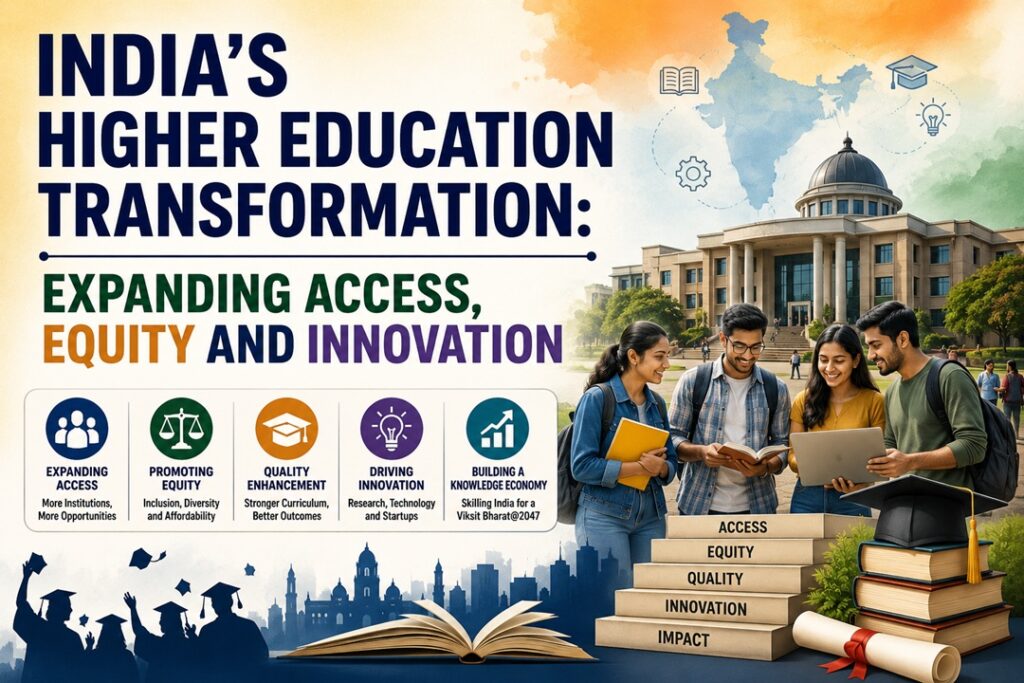
India’s Higher Education Transformation: Expanding Access, Equity and Innovation
Context
Higher education is emerging as a key driver of India’s transition towards a knowledge economy, supporting human capital development, technological advancement, social mobility and innovation-led growth.
How has India’s higher education landscape evolved?
- Rapid Growth of Institutions – India has significantly expanded its higher education ecosystem over the past decade.
- The number of universities increased from 760 in 2014–15 to 1,289 in 2023–24, registering growth of around 69.6%.
- Colleges increased from 38,498 to 48,246, marking a rise of 25.3%.
- Standalone institutions grew from 12,276 to 15,221, an increase of approximately 24%.
- The expansion has strengthened the institutional and geographical reach of higher education.
- It has opened greater opportunities for students from regions and communities that were historically underrepresented.
- However, quantitative expansion needs to be matched with improvements in academic standards, accreditation, faculty strength, research capabilities and learning outcomes.
Has higher education become more accessible?
- Increasing Student Participation – Enrolment in higher education has witnessed considerable growth.
- Total enrolment rose from 3.42 crore in 2014–15 to 4.50 crore in 2023–24, representing an increase of 31.5%.
- The Gross Enrolment Ratio (GER) increased from 23.7% to 30% during the same period.
- This represents progress towards the NEP 2020 target of achieving 50% GER by 2035.
- Enrolment expanded across various educational levels:
- Ph.D. enrolment increased from 1.17 lakh to 3.43 lakh, registering a rise of 192.89%.
- Postgraduate enrolment increased from 38.53 lakh to 57.85 lakh, or 50.15%.
- Undergraduate enrolment increased from 2.71 crore to 3.45 crore, or 27.27%.
- Diploma enrolment increased by 32.22%.
- Certificate enrolment grew by 22.55%.
- Integrated programmes recorded a substantial increase of 301.36%.
- The strong growth in doctoral and integrated programmes points towards increasing demand for advanced, specialised and multidisciplinary learning.
- At the same time, research infrastructure and institutional capacity must expand sufficiently to support this growing demand.
What progress has been made in women’s higher education?
- Strengthening Female Participation – Women have recorded significant gains in higher education participation.
- Female enrolment increased from 1.57 crore in 2014–15 to 2.24 crore in 2023–24, registering growth of 42.2%.
- Female GER increased from 22.9% to 31.2%.
- Female GER remained above male GER, which stood at 28.9% in 2023–24, for the seventh consecutive year.
- The Gender Parity Index (GPI) improved from 0.92 to 1.08.
- A GPI of 1 represents gender parity, while a value above 1 indicates comparatively higher female participation.
- Gender parity also improved among disadvantaged communities:
- SC GPI: 0.91 → 1.11
- ST GPI: 0.81 → 1.08
- Scholarships, financial support, institutional expansion and targeted inclusion policies have contributed to improving women’s participation.
How inclusive has the higher education system become?
- Broadening Social Representation – Participation from historically disadvantaged communities has increased.
- The share of SC enrolment increased from 13.44% to 15.5% between 2014–15 and 2023–24.
- The share of ST enrolment increased from 4.8% to 6.4%.
- OBC enrolment rose from 32.8% to 40.1%, representing the largest increase among the major social categories.
- GER among SC students increased from 18.9% to 27.8%.
- ST GER increased from 13.5% to 22.8%.
- These trends indicate progress towards equal educational opportunities, social justice and inclusive human-capital development.
Is India strengthening its STEM and research ecosystem?
- Expansion of STEM Education – Science, Technology, Engineering and Mathematics remain central to India’s technological ambitions.
- STEM enrolment increased from 91.5 lakh in 2014–15 to 1.02 crore in 2023–24, registering growth of approximately 11.5%.
- A stronger STEM ecosystem can support emerging industries such as:
- Artificial intelligence
- Semiconductors
- Biotechnology
- Renewable energy
- Advanced manufacturing
- Going forward, the focus needs to move beyond enrolment towards quality education, research productivity, innovation, employability and industry-academia collaboration.
How is India progressing towards globalisation of higher education?
- Growing International Engagement – Foreign student enrolment increased from 42,293 in 2014–15 to 58,134 in 2023–24, registering growth of approximately 37.5%.
- The increase indicates India’s growing potential as an international education destination.
- Greater international participation can facilitate:
- Cross-border academic collaboration
- Global research networks
- Knowledge exchange
- Cultural interaction
- International competitiveness of Indian institutions
What has happened to the teaching workforce?
- Expansion of Academic Manpower – The number of teachers increased from 14.73 lakh in 2014–15 to 17.32 lakh in 2023–24, representing growth of around 17.6%.
- The number of female teachers increased by 36.7%.
- Their share in the teaching workforce increased from 44.3% in 2022–23 to 44.9% in 2023–24.
- Further improvements are required in faculty recruitment, professional development, research opportunities and teacher-student ratios.
Has educational infrastructure improved?
- Upgrading the Learning Environment – Infrastructure availability has expanded across higher education institutions.
- In 2023–24:
- Libraries were available in 98% of universities, 98% of colleges and 98% of standalone institutions.
- Laboratories were available in 89% of universities, 85% of colleges and 94% of standalone institutions.
- Playgrounds were available in 94% of universities, 95% of colleges and 91% of standalone institutions.
- Continued investment in digital infrastructure, laboratories, healthcare facilities, skill-development centres and accessibility infrastructure can further improve the educational environment.
What are the major gaps that remain?
- Quality Deficit – Institutional expansion needs to be supported by stronger accreditation, academic standards and outcome-based education.
- Employability Gap – Universities need closer integration with vocational education, internships, apprenticeships and industry.
- Research Constraints – Greater R&D investment and stronger university-industry partnerships are essential.
- Regional Imbalances – Access and institutional development remain uneven across states and regions.
- Faculty Requirements – Recruitment, training, career progression and research opportunities require continued attention.
- Technology Inequality – Digital learning should not widen disparities between students with different levels of technological access.
- Accessibility Concerns – Higher education institutions need stronger facilities and support systems for Persons with Benchmark Disabilities (PwBD) and other vulnerable groups.
What reforms can accelerate the next phase?
- India should move from an institution-expansion model towards a quality, outcomes and innovation-oriented approach.
- Effective implementation of NEP 2020 should prioritise:
- Multidisciplinary education
- Flexible curricula
- Academic credit mobility
- Vocational integration
- Research and innovation
- Higher public and private investment can strengthen educational infrastructure and research capacity.
- Accreditation systems should become more robust and outcome-oriented.
- Faculty development programmes should be expanded to improve teaching and research capabilities.
- Stronger industry-academia partnerships can improve employability and innovation.
- Scholarships, hostels, digital connectivity and targeted financial assistance should be strengthened for disadvantaged students.
- Internationalisation should be promoted through global academic partnerships, joint research programmes and greater international student mobility while preserving India’s diverse educational ecosystem.
What should be the future direction?
- India’s higher education system has achieved considerable progress in institutional expansion, enrolment, women’s participation, social inclusion, STEM education and international engagement.
- The next stage should focus on quality, equity, employability, research, innovation and international competitiveness.
- Higher education must evolve beyond being a system for awarding degrees and become a strategic engine of human-capital formation, social transformation and technological advancement.
- Effective implementation of NEP 2020, supported by adequate financing, cooperative federalism, digital transformation and evidence-based governance, can help India convert its demographic strength into a skilled, innovative and globally competitive knowledge society.
Source : PIB