
India’s Infrastructure Transformation: Twelve Years of Integrated Development
Context
The Press Information Bureau (PIB) recently published a detailed assessment highlighting the progress achieved in strengthening India’s physical, digital, and social infrastructure over the last twelve years.
About India’s Infrastructure Transformation
What is it?
India’s infrastructure strategy has evolved from isolated construction projects to a comprehensive development model aimed at enhancing economic competitiveness, regional connectivity, and citizen welfare. Through large-scale investments, technology integration, and coordinated governance, infrastructure development has become a key driver of national growth and inclusion.
Major Achievements Across Infrastructure Sectors
Railways and Road Connectivity
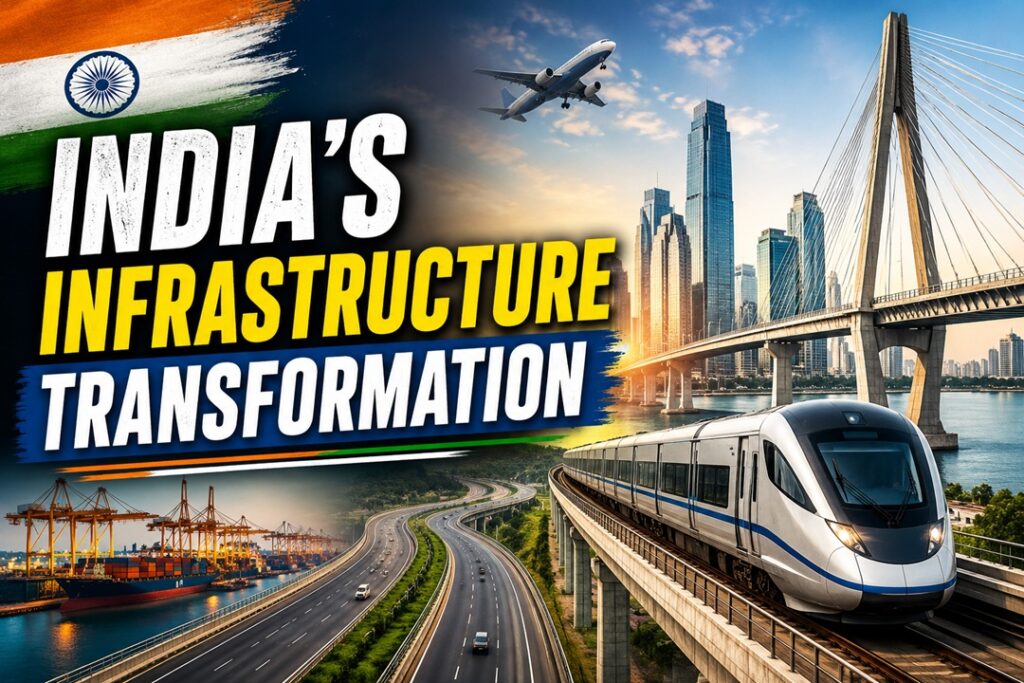
Railway Electrification Expansion: Electrified railway routes increased from nearly 20% before 2014 to 99.6% by March 2026, covering about 69,873 route kilometres.
Introduction of Modern Trains: India currently operates 162 Vande Bharat trains and 60 Amrit Bharat Express services, improving passenger mobility across regions.
Improved Rail Safety: The indigenous Kavach automatic train protection system (Version 4.0) has been implemented across 3,103 route kilometres and installed on 4,277 locomotives. Train accidents declined significantly from 135 in 2014–15 to 16 in 2025–26.
Expansion of Highway Infrastructure: India’s road network, the second largest globally, spans 63.73 lakh kilometres. Four-lane and above National Highways increased from 18,371 km in 2014 to 45,516 km by March 2026.
Enhanced Rural Accessibility: Under the Pradhan Mantri Gram Sadak Yojana (PMGSY), road development allocations increased substantially, resulting in connectivity for 99.6% of eligible rural settlements.
Urban Transport, Aviation and Maritime Infrastructure
Growth of Regional Air Connectivity: Operational airports increased from 74 in 2014 to 165 in 2026. The UDAN scheme has facilitated travel for 1.64 crore passengers through 665 routes. Digi Yatra services have been utilized by over 9.3 crore passengers at 38 airports.
Metro Rail Network Expansion: Metro systems grew from 248 km in 2014 to more than 1,155 km across 26 cities by 2026, making India home to the world’s third-largest metro rail network.
Modernization of Ports: Major port handling capacity expanded from 873 MMTPA to 1,726 MMTPA between 2014 and 2026. Cargo turnaround time reduced from 94 hours to 48.8 hours while ports generated annual surpluses exceeding ₹10,900 crore.
Development of Inland Waterways: Operational national waterways increased from 5 to 111, raising inland cargo transportation from 29 MMT in 2014 to 218 MMT by 2026.
Water Supply, Housing and Energy Security
Expansion of Household Water Access: Rural tap water connections increased from 3.23 crore households in 2019 to 15.86 crore households by June 2026, achieving nearly 82% coverage.
Affordable Housing Progress: Under PMAY-Urban, 98.10 lakh houses have been completed out of 125.31 lakh sanctioned units. PMAY-Gramin has delivered over 3.06 crore rural homes.
Strengthening Energy Availability: India reduced its power deficit from 4.2% in 2014 to just 0.03% in 2025–26. Installed power generation capacity reached 532.74 GW, with renewable energy targets achieved ahead of schedule.
Wider LPG Access: LPG coverage expanded from 55.9% in 2014 to 107.2% in 2026, supported by an active consumer base of 33.39 crore.
Digital Public Infrastructure and Governance
Rapid Internet Expansion: Internet subscriptions crossed 100 crore, while average monthly data consumption per user rose from 61.66 MB in 2014 to 24.01 GB in 2025.
Strengthening the JAM Framework: Aadhaar enrolments exceeded 144 crore, while Jan Dhan accounts reached 57.71 crore, enhancing financial inclusion and welfare delivery.
UPI’s Global Leadership: The Unified Payments Interface (UPI) processed 2,264 crore transactions worth ₹29.53 lakh crore in March 2026 alone and is operational across eight countries.
Project Monitoring through PRAGATI: Since 2015, the PRAGATI platform has reviewed 382 major infrastructure projects worth over ₹85 lakh crore and addressed nearly 2,958 implementation bottlenecks.
Key Challenges in Infrastructure Development
Delays in Local-Level Clearances
Despite streamlined central approval systems, project execution often faces delays due to procedural issues at municipal and state levels.
Infrastructure Development in Difficult Terrain
Transport projects in Himalayan and other ecologically sensitive regions require higher investments, advanced engineering solutions, and continuous environmental safeguards.
Limited Utilization of Public Wi-Fi Networks
Although PM-WANI has established more than 4.10 lakh public Wi-Fi hotspots, widespread availability of low-cost mobile data has restricted their usage.
Land Acquisition and Legal Disputes
Compensation-related litigation and administrative complexities continue to slow land acquisition for highways, freight corridors, and other large projects.
The Way Forward
Fast-Track Industrial Infrastructure Projects
Accelerate the establishment of planned industrial hubs under the BHAVYA initiative to attract manufacturing investments and strengthen supply chains.
Expand Rail Safety Technologies
Speed up deployment of Kavach 4.0 across remaining railway routes to improve operational safety and reduce accident risks.
Achieve Universal Rural Water Coverage
Maintain sustained investment under the extended Jal Jeevan Mission to bridge the remaining household tap water coverage gap.
Mobilize Private Capital for Infrastructure
Promote Infrastructure Investment Trusts (InvITs) and asset monetization mechanisms to generate resources for new infrastructure creation.
Strengthen Global Digital Partnerships
Expand international adoption of Indian digital platforms such as UPI and DigiLocker to facilitate cross-border trade, payments, and digital governance.
Conclusion
India’s infrastructure journey over the past decade reflects a transition from fragmented project execution to integrated, technology-enabled development. The combination of large-scale transport networks, digital public infrastructure, improved public services, and enhanced governance mechanisms has contributed significantly to economic growth, connectivity, and citizen welfare while laying the foundation for long-term sustainable development.
Source : PIB