
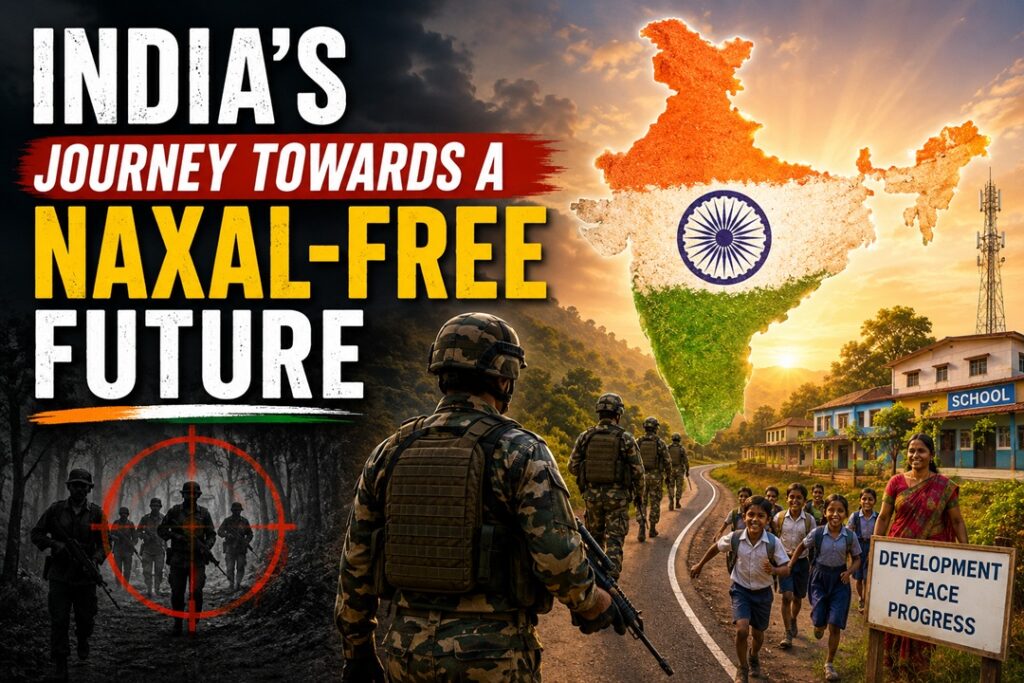
India’s Journey Towards a Naxal-Free Future
Context
India has achieved a landmark breakthrough in internal security by bringing Left-Wing Extremism (LWE) to the verge of elimination. The transformation of former insurgency-affected regions into development-oriented areas has been driven by a coordinated blend of security operations, infrastructure expansion, and welfare-focused governance.
India’s Comprehensive Framework Against Left-Wing Extremism
Overview
The decline of Naxalism in India is the result of a long-term strategy that combined effective security interventions with socio-economic development initiatives. Rather than relying solely on military responses, the Government adopted an integrated model centered on three guiding principles:
- Vishwaas (Trust Building)
- Nirman (Infrastructure & Development)
- Jan Kalyan (Citizen Welfare)
This approach sought not only to neutralize insurgent groups but also to address the underlying causes of alienation and underdevelopment in tribal regions.
Major Indicators of Progress
Sharp Reduction in Affected Areas
- The number of LWE-affected districts declined from 126 in 2014 to only 2 districts by 2026.
- Districts categorized as “most affected” reduced from 35 to zero.
Significant Fall in Violence
- Extremist-related incidents dropped from 870 in 2014 to 234 in 2025.
- Fatalities declined from 310 to 100 during the same period.
Increase in Surrenders
- Between 2024 and March 2026, 3,927 extremists surrendered.
- 2,337 cadres laid down arms during 2025 alone.
Disruption of Financial Support Networks
- Investigative agencies targeted funding channels and seized assets worth several crores.
- The National Investigation Agency (NIA) confiscated assets exceeding ₹40 crore, while additional recoveries were made by the Enforcement Directorate (ED) and state agencies.
The Three-Dimensional Model of Success
1. VISHWAAS: Strengthening Security and Public Confidence
Enhanced Security Presence
- Fortified police stations increased from 66 to 597.
- 408 CAPF camps were established in remote and vulnerable areas.
Improved Operational Mobility
- 68 night-landing helipads were created to facilitate troop movement, surveillance, and medical evacuations.
Integrated Security Coordination
- Specialized units such as CoBRA, District Reserve Guard (DRG), and Greyhounds worked together through coordinated operations.
Technology-Enabled Counter-Insurgency
- Deployment of UAVs, satellite monitoring, mobile intelligence systems, and AI-assisted data analysis improved surveillance capabilities.
Focused Security Campaigns
- Strategic operations including Operation Double Bull and Operation Black Forest successfully dismantled extremist strongholds.
2. NIRMAN: Accelerating Development in Former Conflict Zones
Expansion of Road Connectivity
- More than 12,249 km of roads have been constructed in previously inaccessible tribal areas.
Bridging the Digital Gap
- Over 9,600 mobile towers were installed.
- Around 96% of previously disconnected villages now have mobile connectivity.
Financial Inclusion Initiatives
- Establishment of:
- 1,804 bank branches
- 1,321 ATMs
- 74,720 banking correspondents
- 6,025 post offices
Education and Skill Development
- Construction of:
- 179 Eklavya Model Residential Schools (EMRS)
- 46 Industrial Training Institutes (ITIs)
- 49 Skill Development Centres (SDCs)
- Technical and vocational training provided to over 90,000 youth and women.
3. JAN KALYAN: Rehabilitation and Social Empowerment
Comprehensive Rehabilitation Package
Surrendered extremists are offered:
- Financial assistance up to ₹5 lakh
- Monthly support of ₹10,000 for 36 months
- Housing assistance under Pradhan Mantri Awas Yojana (PMAY)
Educational Support for Families
- Children of surrendered cadres receive free education up to Class XII, helping break the cycle of violence.
Focused Tribal Development
- Programs such as PM-JANMAN and Dharti Aaba Janjatiya Gram Utkarsh Abhiyan address gaps in housing, drinking water, and basic infrastructure.
Bastar: A Model of Transformation
From Conflict Zone to Development Hub
For decades, Bastar in Chhattisgarh was one of the most severely affected LWE regions. A major shift occurred with the establishment of the Bastariya Battalion in 2017, recruiting 1,143 local tribal youth and improving trust between communities and security forces.
Infrastructure Expansion
- Over 3,240 km of roads constructed.
- 889 mobile towers installed across the region.
Innovative Community Service Initiative
In 2026, the Shaheed Veer Gunda Dhur Seva Dera program began converting former security camps into public service centers offering:
- Healthcare facilities
- Agricultural assistance
- Digital governance services
Challenges Ahead
Maintaining Infrastructure Assets
Continuous funding is required to maintain roads, telecom networks, and public facilities in difficult terrain.
Increasing Participation in Skill Programs
Greater awareness and outreach are needed to ensure tribal youth benefit from training opportunities.
Preventing Residual Extremist Activity
Security agencies must remain vigilant in the remaining affected pockets to prevent regrouping of insurgent elements.
Protecting Tribal Rights
Long-term stability depends on safeguarding tribal land, livelihoods, and natural resources from exploitation.
Future Priorities
Replicating Community Service Centers
Expand the Bastar model of converting former security camps into public welfare hubs.
Completing Educational Infrastructure
Accelerate the operationalization of pending EMRS institutions in tribal regions.
Promoting Tribal Livelihoods
Connect local artisans and producers with digital marketplaces and e-commerce platforms.
Encouraging Youth Engagement
Strengthen sports, cultural exchanges, and community participation programs to foster social integration.
Conclusion
India’s journey towards a Naxal-free future highlights the success of an integrated approach that combines security, development, and welfare. The transformation of former conflict zones into regions of connectivity and opportunity demonstrates how inclusive governance can address the roots of extremism. Sustaining these achievements through continued investment in tribal welfare, infrastructure, and community empowerment will be crucial for ensuring long-term peace and stability.
Source : PIB