
India’s Rural Development Model as a Tool of Global Diplomacy
Context
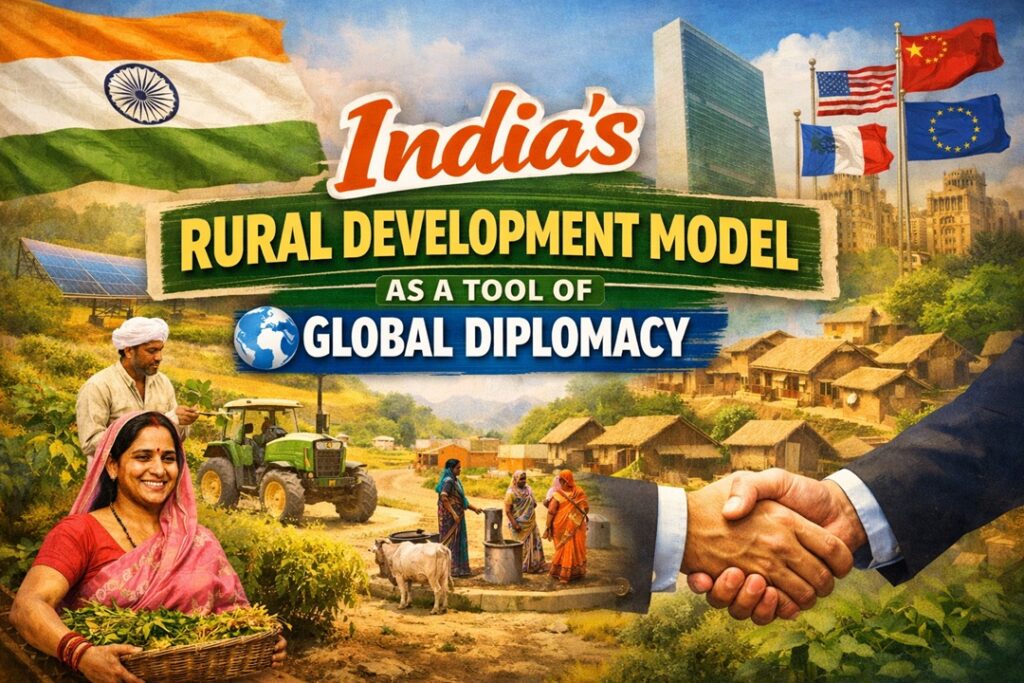
India’s flagship National Rural Livelihood Mission (NRLM) has transitioned from a domestic poverty reduction initiative into a key instrument of India’s external engagement, shaping rural transformation strategies across the Global South.
Conceptual Shift: Rural Innovation as Foreign Policy Tool
Meaning:
India’s rural outreach diplomacy involves exporting indigenous social innovations—especially Self-Help Group (SHG) frameworks—to developing nations, particularly in Africa. The emphasis has moved from aid-based assistance to capacity-building through institutional replication, focusing on women-led financial inclusion and decentralized governance.
Scale and Impact: Evidence from the Ground
- Outreach: Presence in 742 districts, covering 10+ crore households with over 90 lakh SHGs.
- Credit Expansion: Bank linkage exceeding ₹12 lakh crore; capitalization support above ₹51,000 crore.
- Women Empowerment: Around 2 crore women earning annual incomes above ₹1 lakh.
- Budgetary Push: ₹19,200 crore allocation in Union Budget 2026–27, highlighting policy priority.
Core Design Elements: India’s Rural Transformation Model
- Financial Inclusion Architecture: SHG–Bank linkage system ensures collateral-free institutional credit.
- Layered Institutional Framework: SHGs federated into village, cluster, and block-level organizations for sustainability.
- Grassroots Service Delivery: Community cadres (e.g., Banking Sakhis) act as last-mile service providers.
- Economic Diversification: Transition from subsistence agriculture to micro-enterprises and non-farm livelihoods.
- Digital Integration: Real-time monitoring of credit flows, repayments, and Direct Benefit Transfers (DBT).
Global Outreach: Diplomacy through Development Models
- Indigenous Model Export: India promotes context-driven solutions rather than Western templates.
- South-South Synergy: Countries like Ethiopia, Kenya, Tanzania, and Rwanda adopt Indian frameworks via peer learning.
- Gateway for Tech Collaboration: Opens avenues in digital governance, fintech, and agri-tech partnerships.
- Soft Power Enhancement: Positions India as a leader offering scalable, cost-effective poverty solutions.
Constraints and Structural Bottlenecks
- Political Resistance: Decentralized SHG systems may conflict with centralized governance structures.
- Context Sensitivity: Indian socio-economic models may not fully align with diverse cultural settings.
- Capacity Limitations: Large-scale implementation demands administrative and technical readiness.
- Digital Divide: Weak digital infrastructure in partner countries can hinder replication.
- Institutional Sustainability: Ensuring accountability and financial discipline remains challenging.
Strategic Roadmap: Strengthening Global Replicability
- Knowledge Platforms: Create institutional mechanisms for continuous India–Africa policy exchange.
- Pilot Interventions: Test SHG-based models in localized socio-cultural contexts abroad.
- Capacity Building: Expand fellowships and exposure visits for foreign policymakers.
- Institutional Linkages: Connect Indian training bodies with global counterparts.
- Impact Assessment: Develop joint monitoring frameworks to evaluate outcomes and refine models.
Conclusion
The NRLM exemplifies India’s evolution from a recipient of development ideas to a provider of scalable governance models. By centering women-led empowerment and financial inclusion, India is crafting a distinctive development narrative that strengthens its leadership role in the Global South while offering practical solutions to multidimensional poverty.
Source : The Hindu