
Nobel Chemistry 2026: Molecular Asymmetry and the Origins of Chirality
Context
Henri Kagan of France and Kenso Soai of Japan were awarded the 2026 Nobel Prize in Chemistry for their work on non-linear effects and autocatalysis in asymmetric organic synthesis. Their research explains how tiny molecular asymmetries can be amplified, helping scientists understand why particular molecular forms dominate in chemistry and biological systems.
Understanding Chirality
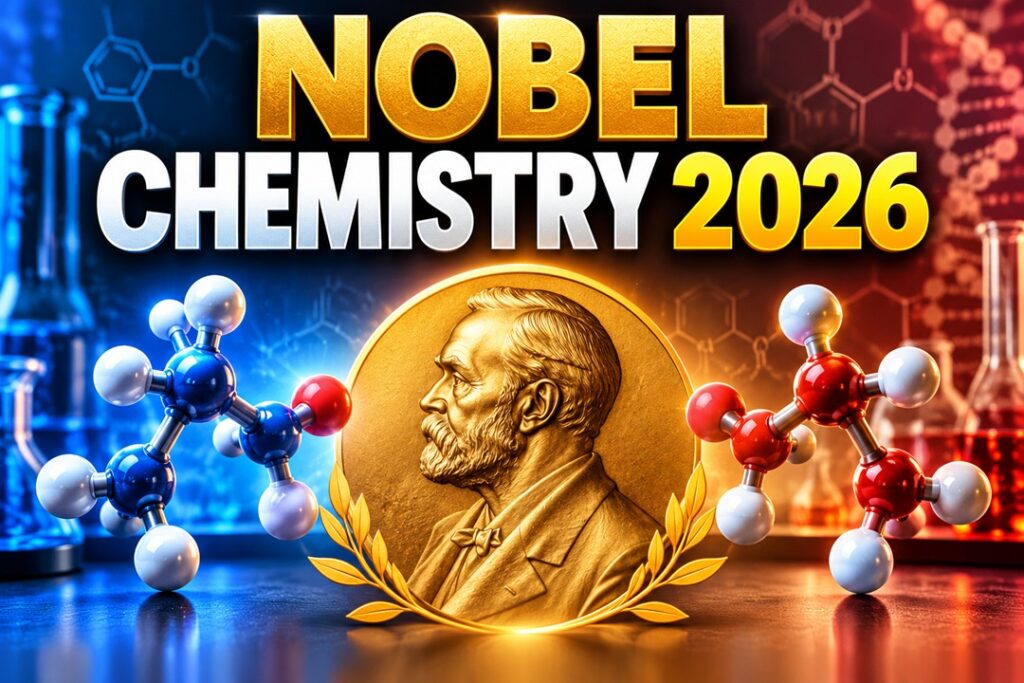
Chirality is a structural property in which a molecule exists in two forms that are mirror images but cannot be superimposed on each other. This is comparable to the relationship between the left and right hands.
These mirror-image forms are called enantiomers.
Although enantiomers often have similar physical properties in non-chiral environments, they can interact very differently with chiral biological molecules, including enzymes and receptors.
Importance of Asymmetric Synthesis
Asymmetric synthesis aims to preferentially produce one enantiomer rather than an equal mixture of both forms. This is especially important because biological systems are inherently chiral.
The selective production of a particular molecular form has important applications in:
- Pharmaceutical development
- Biochemistry
- Agrochemicals
- Materials science
- Production of biologically active compounds
Role of Autocatalysis
Autocatalysis occurs when a product of a chemical reaction helps accelerate the same reaction, creating a feedback mechanism.
The Nobel-recognised research demonstrates how non-linear chemical effects can amplify a small initial molecular imbalance, eventually producing a strong predominance of one molecular form.
Connection with Biological Systems
The research helps explain why living organisms frequently favour one particular molecular orientation.
Enzymes, receptors and other biological molecules recognise compounds based on their three-dimensional structures. Thus, two enantiomers with the same chemical composition can interact differently and produce distinct biological effects.
Understanding how molecular asymmetry becomes amplified therefore provides insights into both modern chemical synthesis and the emergence of molecular handedness in biological systems.
Broader Scientific Significance
The work demonstrates that chemical processes can involve powerful feedback mechanisms in which a very small molecular difference develops into a significant imbalance.
It strengthens scientific understanding of asymmetric organic synthesis, molecular recognition, autocatalysis and biological chirality.
Conclusion
The 2026 Nobel Prize-winning research shows how minute molecular differences can be amplified into major chemical outcomes. It deepens our understanding of chirality and asymmetric synthesis while providing valuable insights into the molecular foundations of biological organisation.
Source : The Hindu