
Plug-in Hybrid Electric Vehicles (PHEVs): A Transition Pathway for Cleaner Mobility
Context
The emergence of mainstream PHEVs such as the MG Hector Tomahawk, with an electric-only range of over 115 km and a claimed total range exceeding 1,100 km, has renewed attention on hybrid technologies as India seeks to reduce transport-sector emissions while addressing charging and range concerns.
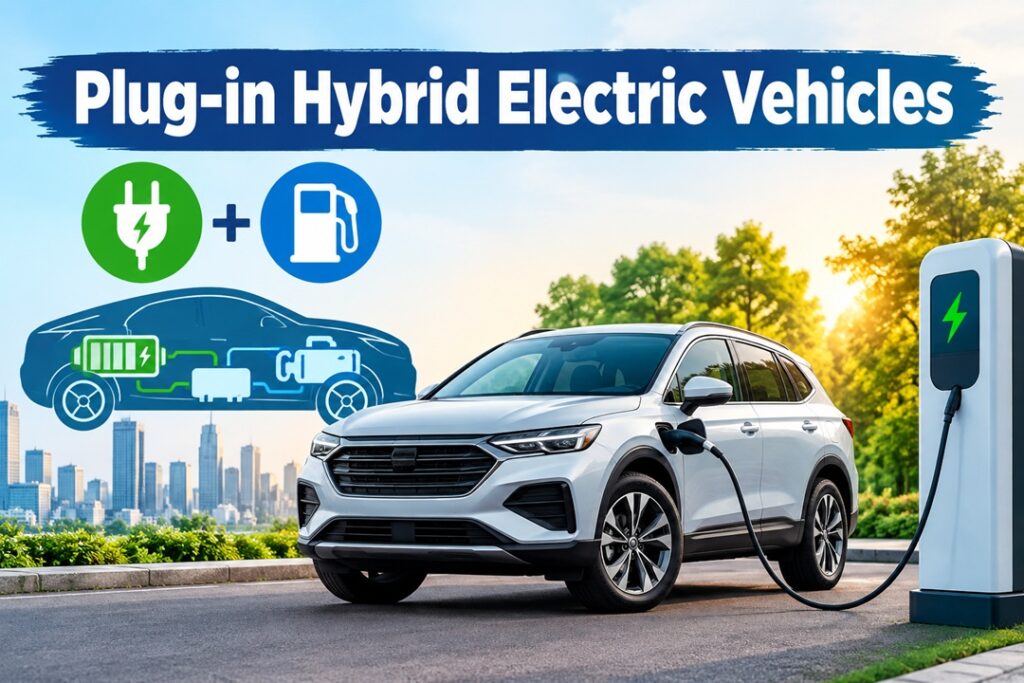
A Plug-in Hybrid Electric Vehicle (PHEV) combines an internal combustion engine (ICE), an electric motor and a rechargeable battery that can be charged from an external electricity source. This distinguishes it from conventional hybrids, which generally cannot be plugged in.
Understanding Electric-Mobility Technologies
The major technologies include:
- BEVs (Battery Electric Vehicles): Operate entirely on electricity stored in batteries.
- HEVs (Hybrid Electric Vehicles): Combine an ICE and electric motor but normally cannot be externally charged.
- PHEVs: Combine an ICE and electric motor with an externally rechargeable battery.
- FCEVs (Fuel Cell Electric Vehicles): Generate electricity through hydrogen fuel cells to power the vehicle.
PHEVs therefore occupy an intermediate position between conventional fuel-powered vehicles and fully electric vehicles.
HEV, PHEV and BEV: Key Differences
| Feature | HEV | PHEV | BEV |
|---|---|---|---|
| Internal combustion engine | Yes | Yes | No |
| Electric motor | Yes | Yes | Yes |
| External charging | No | Yes | Yes |
| Electric-only operation | Limited | Relatively high | Entire driving range |
| Fuel dependence | Higher | Lower | None during operation |
| Dependence on charging infrastructure | Low | Moderate | High |
How Do PHEVs Operate?
A PHEV can switch between or combine its two propulsion systems depending on driving conditions.
- The battery and electric motor can power the vehicle for shorter journeys.
- The petrol engine can provide propulsion when the battery is depleted or during longer journeys.
- Both systems can operate together when additional power is required.
- The battery can be replenished through external charging, while regenerative braking and the vehicle’s powertrain can also recover some energy.
This configuration allows a user to undertake regular urban travel primarily in electric mode while retaining the ICE for longer-distance journeys.
Advantages of PHEVs
1. Lower fuel consumption:
When regularly charged and driven in electric mode, PHEVs can substantially reduce petrol consumption compared with conventional ICE vehicles.
2. Reduced range anxiety:
The presence of an ICE provides additional driving range when charging facilities are unavailable.
3. Greater flexibility during the charging transition:
PHEVs can provide electric mobility without requiring the same level of charging availability as a BEV.
4. Potential emission reductions:
Greater reliance on electric propulsion can lower tailpipe emissions, particularly when the vehicle is frequently charged and used within its electric range.
5. Transitional role:
PHEVs can provide consumers with exposure to electric driving while retaining the familiarity and flexibility of conventional vehicles.
Limitations and Concerns
Higher purchase cost:
PHEVs incorporate both an ICE powertrain and a comparatively large battery, increasing manufacturing and ownership costs.
Greater technical complexity:
Maintaining two propulsion systems creates additional mechanical, electronic and maintenance requirements.
Benefits depend on user behaviour:
A PHEV that is rarely plugged in may operate largely like a conventional hybrid or fuel-powered vehicle, reducing the expected fuel and emission benefits.
Additional weight:
The combination of an engine, fuel system, electric motor and battery adds weight and creates packaging challenges.
Not a zero-emission vehicle:
Unlike BEVs, PHEVs continue to depend on fossil fuels when the ICE is used. Their environmental performance therefore cannot automatically be equated with that of a fully electric vehicle.
PHEVs and Flex-Fuel Vehicles: Different Pathways
PHEVs and Flex-Fuel Vehicles (FFVs) address transport decarbonisation through different technological routes.
- FFVs use ICEs capable of operating on varying petrol-ethanol blends, supporting greater use of biofuels.
- PHEVs combine an ICE with electric propulsion and an externally rechargeable battery.
- FFVs primarily pursue fuel diversification, while PHEVs seek greater electrification of vehicle use.
Thus, the two technologies can contribute to reducing conventional fossil-fuel dependence but through different mechanisms.
Way Forward
India’s mobility strategy can accommodate multiple technologies while progressively moving towards lower-emission transport. This would require:
- Expanding reliable and interoperable charging infrastructure.
- Increasing the share of clean electricity so that vehicle electrification delivers greater lifecycle emission benefits.
- Strengthening domestic production of batteries, power electronics and other critical components.
- Developing effective battery recycling and end-of-life management standards.
- Improving consumer awareness about the importance of regularly charging PHEVs.
- Following a technology-neutral approach while progressively increasing the penetration of genuinely zero-emission vehicles.
Conclusion
PHEVs can function as a bridge between conventional mobility and full electrification, particularly where charging infrastructure and range remain concerns. However, their effectiveness depends heavily on charging behaviour, electricity-source cleanliness and the broader expansion of zero-emission transport.
Source : The Indian Express