
Pumped Storage Hydropower: Strengthening India’s Renewable Energy Reliability
Context
The Ministry of Power and the Central Electricity Authority (CEA) have emphasised the growing importance of Pumped Storage Projects (PSPs) as India’s non-fossil fuel capacity crosses 300 GW and the country advances towards its target of 500 GW by 2030. These projects can help manage renewable energy fluctuations and ensure a reliable electricity supply.
Understanding Pumped Storage Hydropower (PSH)
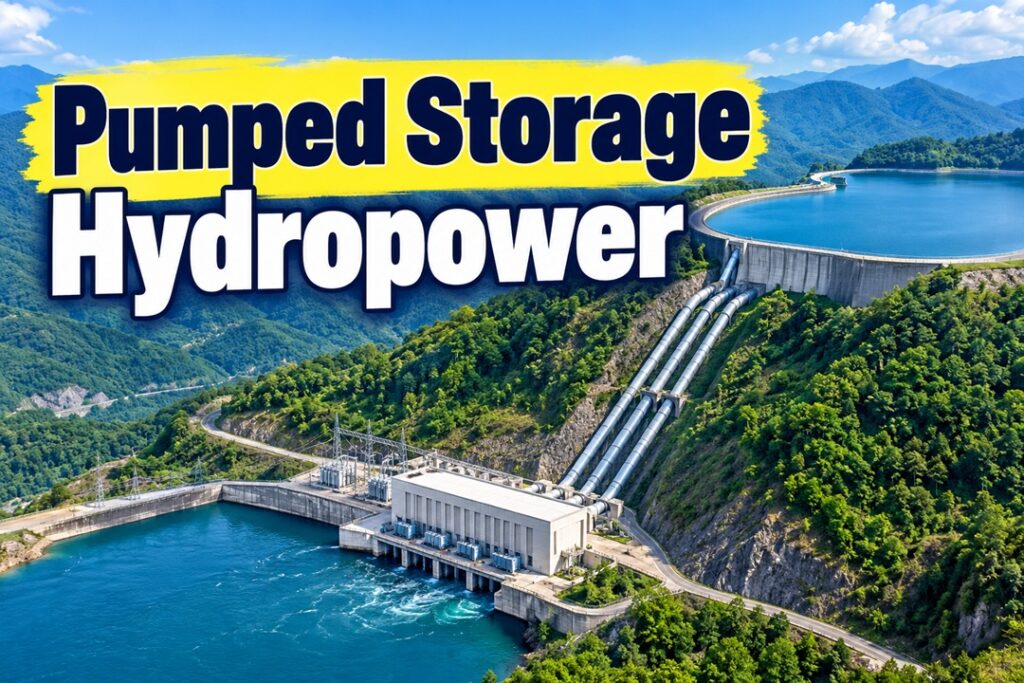
Pumped Storage Hydropower is a long-duration energy storage technology that stores electricity in the form of gravitational potential energy using two water reservoirs at different elevations. It functions like a large-scale rechargeable battery.
- Energy storage: During periods of surplus electricity, particularly when solar generation is high, water is pumped from the lower reservoir to the upper reservoir.
- Power generation: When electricity demand rises or renewable generation declines, water flows downhill through turbines to generate electricity.
- Grid stability: PSPs help balance fluctuations in solar and wind power, meet peak demand and improve the reliability of the electricity grid.
Types of Pumped Storage Projects
- On-stream projects: Both reservoirs are associated with a natural river or connected watercourse.
- Off-stream open-loop projects: Reservoirs are located outside the main river channel, with at least one reservoir connected to an existing river or water body.
- Off-stream closed-loop projects: Both reservoirs are situated away from naturally flowing perennial watercourses, reducing direct interference with river systems.
India’s Pumped Storage Potential and Current Status
India possesses substantial geographical potential for expanding pumped hydro storage, although its operational capacity remains below that of leading countries.
- Global position: India ranks fourth globally in installed pumped storage capacity, with 7.43 GW, behind China, Japan and the United States.
- Identified potential: The CEA has identified 320 potential sites with an aggregate capacity of 345.38 GW.
- Regional distribution: The Western Region has the highest identified potential at 129.72 GW, followed by the Southern Region at 97.76 GW.
- Project pipeline: Of the 7.43 GW operational capacity, another 15.87 GW is under implementation, while 10.40 GW has been appraised or concurred by the CEA.
- Future requirements: Storage demand is projected to reach 73.93 GW by 2031–32, comprising 26.69 GW of pumped storage and 47.24 GW of battery storage.
These figures indicate that India has significant scope to expand storage infrastructure, but converting identified potential into operational capacity will require substantial investment and timely project execution.
Why Pumped Storage Matters for India’s Energy Transition
1. Integrating renewable energy
Solar and wind power are variable by nature. PSPs can absorb excess daytime solar generation and release stored energy during evening demand peaks, reducing renewable energy curtailment.
2. Providing long-duration storage
Pumped storage can typically deliver electricity for 6–12 hours or longer, depending on reservoir capacity and operating conditions. This makes it suitable for balancing prolonged mismatches between electricity generation and demand.
3. Improving grid reliability
PSPs can provide rapid power response, frequency regulation and peak-load support, helping maintain grid stability as the share of renewable electricity increases.
4. Supporting energy security
Unlike battery systems that depend on imported critical minerals and cell supply chains, pumped storage relies substantially on civil engineering, steel, concrete and electromechanical equipment. Greater domestic manufacturing can strengthen India’s energy independence.
5. Offering long-term infrastructure value
Pumped storage facilities can operate for 40–60 years or more with appropriate maintenance. Although initial construction is expensive, their long service life can distribute capital costs over several decades.
Pumped Storage vs Battery Energy Storage Systems
| Parameter | Pumped Storage Hydropower | Battery Energy Storage Systems |
|---|---|---|
| Typical application | Long-duration storage and peak supply | Short-duration storage and rapid response |
| Storage duration | Generally 6–12 hours or more | Commonly 2–4 hours, depending on configuration |
| Infrastructure | Requires reservoirs, elevation differences and suitable terrain | Modular units that can be installed near demand centres |
| Lifespan | Often 40–60 years or longer | Battery cells commonly require replacement over a shorter operating life |
| Supply-chain dependence | Relies substantially on civil works and heavy electrical equipment | Lithium-ion systems depend on battery materials and cell manufacturing |
| Deployment | Site-specific and construction-intensive | Generally faster and more flexible to deploy |
Both technologies are complementary rather than competing solutions. Pumped storage is well suited to large-scale, long-duration requirements, while batteries offer modular deployment and rapid-response services.
Government Initiatives to Promote Pumped Storage
- Guidelines for Pumped Storage Projects, 2023: Provide a policy framework for project development, encourage off-stream schemes and support the utilisation of suitable abandoned mining sites.
- Inter-State Transmission System (ISTS) charge waiver: Eligible PSP projects awarded for construction before June 30, 2028, can receive a 100% waiver of ISTS charges for 25 years from commercial operation, subject to applicable conditions.
- Simplified regulatory procedures: Changes to concurrence requirements and appraisal procedures aim to reduce approval delays, particularly for off-stream closed-loop projects.
- Environmental appraisal reforms: Relaxed appraisal requirements for eligible closed-loop projects seek to reduce procedural burdens while retaining applicable environmental safeguards.
- Financial and infrastructure support: Budgetary assistance for enabling infrastructure, including roads, bridges and ropeways, can improve project viability.
- Competitive procurement: Tariff-Based Competitive Bidding frameworks can encourage transparent project allocation and improve cost discovery.
- Digital project monitoring: The CEA’s Jal Vidyut DPR online tracking portal aims to accelerate the preparation and approval of detailed project reports.
Major Challenges in Scaling Up PSPs
1. High capital requirements
Pumped storage projects may require investments of approximately ₹5–7 crore per MW, along with four to six years of construction. High upfront expenditure and lengthy gestation periods increase financing costs and project risks.
2. Geographical and geological constraints
Suitable elevation differences, stable geological formations and appropriate reservoir locations are essential. Fractured rock, seepage, landslides and seismic vulnerabilities can raise construction costs and threaten project safety.
3. Water-sharing disputes
Projects involving connected river systems may encounter disagreements between states over water allocation, reservoir operations and evaporation losses. These disputes can delay approvals and complicate project management.
4. Energy losses during storage
Pumping water uphill and subsequently generating electricity involves conversion losses. With round-trip efficiency generally around 70–80%, the economic viability of a project depends partly on access to inexpensive surplus electricity.
5. Environmental and social concerns
Reservoir construction may require land acquisition and can affect local communities, forests, biodiversity and drainage patterns. Even closed-loop projects need careful assessment of water availability and ecological impacts.
6. Delayed project execution
Clearances, land acquisition, transmission connectivity, financing and complex engineering requirements can delay construction and prevent identified storage potential from becoming available when needed.
Way Forward
1. Prioritise closed-loop projects and mine-pit conversion
Develop off-stream projects in suitable locations, including abandoned open-cast coal mines and depleted quarries. This can reduce dependence on natural river systems and make productive use of existing disturbed land.
2. Create viable electricity price signals
Expand Time-of-Day (ToD) tariffs and improve market mechanisms so that electricity used for pumping during surplus-generation periods is cheaper than the electricity sold during peak demand. This would improve project revenues and commercial viability.
3. Strengthen storage obligations and power procurement
Implement Energy Storage Obligations effectively and encourage distribution companies to enter into bankable power purchase agreements. Predictable demand and long-term revenue arrangements can attract private investment.
4. Accelerate approvals without weakening safeguards
Coordinate environmental, forest, land and transmission approvals through integrated project planning. Geological investigations and environmental assessments should remain rigorous, particularly in ecologically sensitive and seismically vulnerable regions.
5. Promote domestic technology and manufacturing
Support research, development and local production of reversible pump-turbines, variable-speed equipment, control systems and other specialised components. This can reduce import dependence and improve project execution capabilities.
6. Integrate hydro storage with batteries
Adopt a diversified storage strategy in which pumped storage meets long-duration requirements while battery systems provide short-duration balancing and rapid grid services. Coordinated planning can lower overall system costs and improve reliability.
Conclusion
Pumped Storage Hydropower can become a cornerstone of India’s clean energy transition by converting surplus renewable electricity into dependable power during periods of high demand. However, the country’s identified potential of 345.38 GW will translate into meaningful energy security only through faster project execution, commercially viable tariffs, effective power procurement and responsible environmental planning. A coordinated combination of pumped storage, batteries and renewable generation will be essential to achieving reliable, affordable and sustainable electricity supply on the path to Viksit Bharat 2047.
Source : PIB