
Recognising Women’s Unpaid Work: Strengthening Labour Statistics and Gender Equality
Context
The Ministry of Statistics and Programme Implementation (MoSPI) has initiated efforts to collect data on unpaid domestic and care work to understand how these responsibilities influence women’s employment. Integrating such information into the Periodic Labour Force Survey (PLFS) can help address gaps in India’s labour statistics and improve gender-responsive policymaking.
Understanding Women’s Unpaid Work
Women’s unpaid work broadly includes two interconnected forms of economic and social contribution:
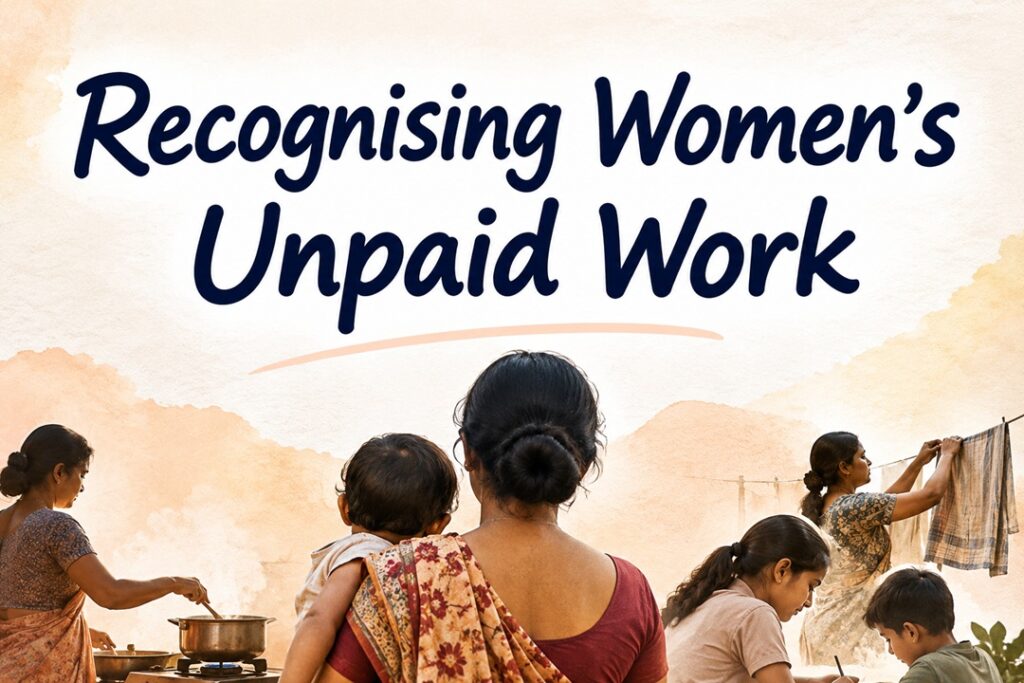
- Unpaid Domestic Work: Household activities such as cooking, cleaning, washing, shopping and maintaining the home without financial compensation.
- Unpaid Care Work: Providing physical, emotional and personal care to children, elderly persons, persons with disabilities and other dependent family members without remuneration.
Although these activities sustain households and support the wider economy, they are often excluded from conventional measures of economic production and employment.
How Does Unpaid Work Influence Women’s Employment?
- Restricted Labour Force Participation: Extensive household and caregiving responsibilities limit women’s ability to seek, enter or remain in paid employment.
- Constrained Employment Choices: Women may opt for home-based jobs, flexible working arrangements or employment closer to their residences to balance domestic responsibilities.
- Greater Informalisation: The need to accommodate care responsibilities often pushes women towards informal, insecure and poorly protected employment.
- Persistent Wage Inequalities: Career interruptions, reduced working hours and limited occupational mobility contribute to lower earnings and slower professional advancement.
- Increasing Time Poverty: Women, particularly those with young children or dependent family members, experience disproportionate time constraints, leaving fewer opportunities for education, skill development and paid work.
What are the Major Challenges in Measuring Unpaid Work?
– Lack of Survey Comparability: The Labour Force Survey (LFS) and Time Use Survey (TUS) follow different methodologies, definitions and objectives, making it difficult to establish consistent relationships between unpaid work and employment.
– Limited Scope of Labour Force Surveys: Existing labour force surveys primarily capture employment status and economic activities, offering inadequate insights into how domestic responsibilities affect women’s employment decisions.
- They provide limited understanding of how unpaid care obligations influence the working conditions and career choices of women already employed.
– Inadequate Occupational Classification: The TUS uses a restricted National Industrial Classification (NIC), 2008, with information available only at the two-digit level.
- This restricts detailed examination of how particular occupations interact with household and caregiving responsibilities.
– Insufficient Disaggregated Information: Existing datasets do not adequately explain why women with comparable domestic responsibilities experience different employment outcomes across income groups, occupations and social circumstances.
– Under-recognition of Economic Contributions: Conventional employment indicators often fail to capture the productive value of unpaid household and care activities, making women’s contributions statistically less visible.
Why is Integrating Unpaid Work Data into PLFS Important?
– Evidence-Based Policymaking: Linking employment information with unpaid work indicators can help identify the barriers affecting women’s workforce participation and employment continuity.
– Comprehensive Labour Statistics: Regularly collecting information on domestic and care responsibilities alongside employment data would provide a more realistic picture of women’s economic activities.
– Promoting Gender Equality: Better evidence can support targeted interventions to improve women’s access to employment, skill development and career opportunities.
– Understanding Wage Inequalities: Data on time constraints and care-related employment compromises can help explain some of the factors contributing to the gender pay gap.
– Economic Valuation of Care Work: Improved measurement can strengthen efforts to recognise the economic and social contribution of unpaid domestic activities.
– Capturing Invisible Economic Activities: Better statistical coverage can identify women engaged in subsistence production and peripheral economic activities that conventional employment indicators may overlook.
Way Forward
– Develop an Integrated Statistical Framework: Harmonise PLFS and TUS indicators to establish a comprehensive relationship between unpaid responsibilities and labour market outcomes.
– Strengthen Care Infrastructure: Expand affordable childcare facilities, elderly care services and community-based support systems to reduce the disproportionate burden on women.
– Recognise the Economic Value of Unpaid Work: Incorporate unpaid domestic and care activities into broader economic assessments and development planning.
– Promote Gender-Responsive Workplaces: Encourage flexible working arrangements, adequate maternity benefits, equal remuneration and opportunities for career progression.
– Improve Survey Methodologies: Strengthen occupational classifications, improve data comparability and collect more detailed gender-disaggregated information.
– Encourage Shared Domestic Responsibilities: Promote greater participation of men in household and caregiving activities to ensure a more equitable distribution of unpaid work.
Conclusion
Recognising unpaid work is essential for understanding the actual extent of women’s economic contribution and the structural barriers limiting their employment opportunities. Integrating care-related indicators into PLFS can make India’s labour statistics more comprehensive and support evidence-based policies. Ultimately, reducing the unequal burden of unpaid work is crucial for advancing gender equality, women’s economic empowerment and inclusive growth.
Source : The Indian Express