
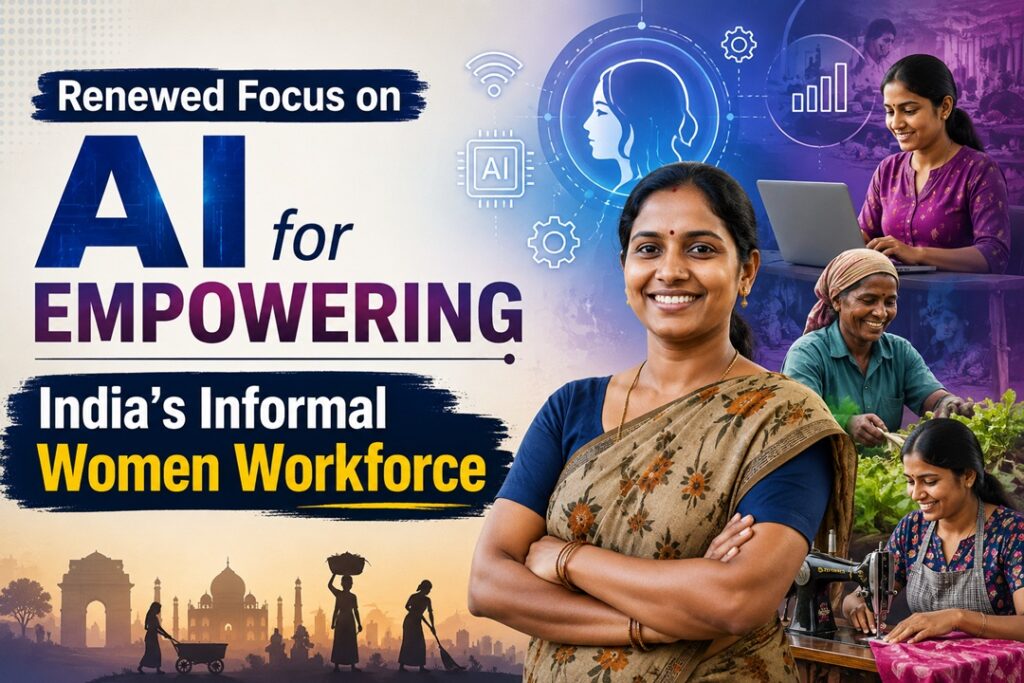
Renewed Focus on AI for Empowering India’s Informal Women Workforce
Context
Renewed attention has been drawn to ensuring that the productivity gains from Artificial Intelligence (AI) are shared equitably with India’s informal women workers. Policymakers and experts have highlighted that without gender-responsive AI governance, inclusive digital infrastructure, and equitable access to AI tools, rapid technological advancement could widen existing gender, income, and digital inequalities instead of reducing them.
About AI & India’s Informal Women Workforce
What is it?
Artificial Intelligence is increasingly being integrated into India’s informal economy to support women working in farming, home-based industries, domestic services, and small businesses. Technologies such as multilingual chatbots, predictive analytics, voice-based assistants, and AI-powered advisory platforms can improve productivity, financial inclusion, and market access.
Instead of replacing workers, inclusive AI solutions can bridge socio-economic gaps by offering services in regional languages, addressing mobility limitations, and creating easier access to government schemes and digital markets.
Important Facts & Figures
Large Informal Workforce
Around 82% of employed women in India are engaged in the informal sector, including agriculture, household enterprises, and small-scale businesses.
Women Dominate Agricultural Employment
According to the Periodic Labour Force Survey (PLFS) 2023–24, nearly 76.9% of rural working women depend on agriculture, making AI-based agricultural advisory services especially significant.
Positive Impact of AI Adoption
A 2024 evaluation of Farmer.Chat, implemented across 12 Indian states, found that 61% of women users reported better livelihoods within six weeks, while their engagement levels were two to three times higher than those of male users.
Existing AI Ecosystem
India has already created enabling digital infrastructure through initiatives such as the IndiaAI Mission, BHASHINI multilingual platform, and the AI Governance Framework (2025) to promote responsible AI deployment.
Policy Measures for Women-Centric AI Development
Conducting Equity Assessments
Introduce mandatory social and gender impact evaluations for AI systems used in employment, welfare delivery, financial services, and public governance to ensure fair outcomes.
Gender-Focused AI Investments
Allocate dedicated resources for overcoming barriers such as digital literacy, language accessibility, affordability, and online safety while designing AI programmes.
Community-Based Digital Capacity Building
Expand AI awareness and digital skill development through programmes like DAY-NRLM, Skill India, DDU-GKY, and women’s Self-Help Groups (SHGs).
Strengthening Digital Security
Implement stricter safeguards against AI-generated misinformation, deepfakes, and cyber harassment through stronger enforcement of IT regulations and AI content identification mechanisms.
Major Concerns
Bias in AI Systems
AI models trained on incomplete or biased datasets may unintentionally reinforce existing social and gender inequalities.
Lack of Explainability
Opaque AI decision-making in areas like credit approval, employment selection, or welfare distribution reduces accountability and public trust.
Online Harassment and Deepfakes
Growing misuse of AI technologies for creating fake content and targeted harassment discourages women’s participation in digital platforms.
Accessibility Challenges
Many AI applications still lack user-friendly interfaces, regional language support, and designs suited to women with limited literacy or digital exposure.
Future Strategy
Promote Inclusive AI Standards
Ensure that all publicly funded AI solutions undergo fairness testing, support local languages, and provide transparent explanations for automated decisions.
Expand Regional Language AI
Scale voice-enabled AI services using platforms like BHASHINI to deliver personalised information on farming, finance, healthcare, and markets.
Outcome-Oriented Digital Training
Focus skill development on practical applications such as using digital payment systems, accessing e-commerce platforms, and improving income opportunities.
Improve Cyber Protection Framework
Establish faster complaint-resolution systems, regional-language cyber support services, and stronger coordination among government agencies to combat online abuse.
Conclusion
India’s journey towards Viksit Bharat 2047 requires ensuring that the benefits of Artificial Intelligence are shared across every section of society, particularly women in the informal economy. By prioritising inclusive AI design, stronger digital protection, multilingual accessibility, and community-driven digital literacy, AI can become a powerful instrument for women’s economic empowerment, greater workforce participation, and sustainable inclusive development.
Source : The Hindu