
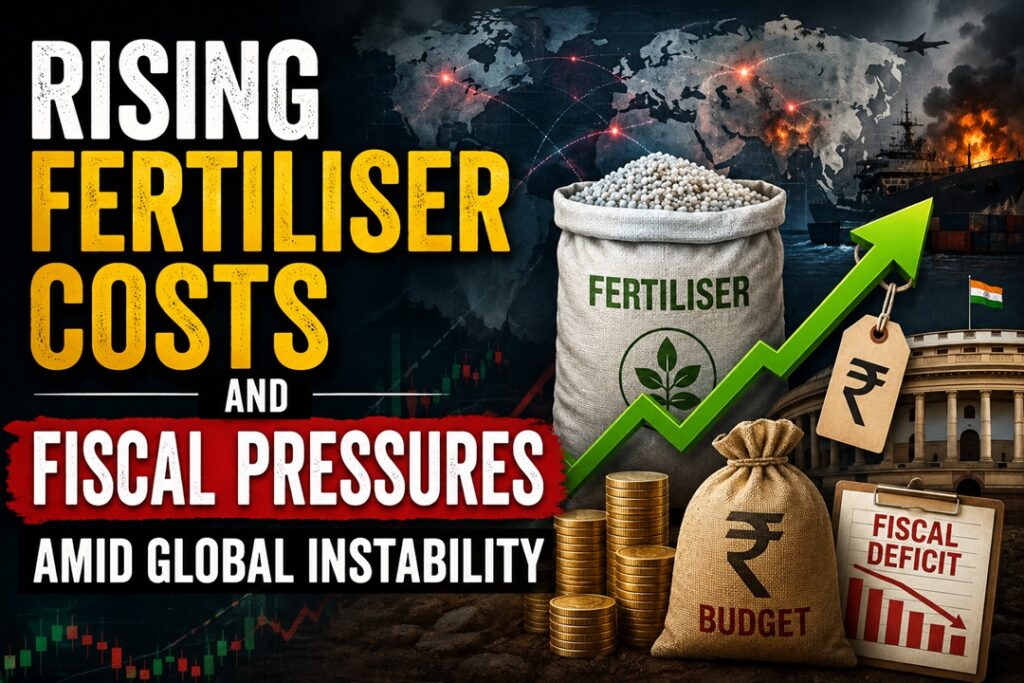
Rising Fertiliser Costs and Fiscal Pressures Amid Global Instability
Context
Escalating tensions across West Asia have disrupted global commodity markets, resulting in higher input costs for agriculture and creating fresh fiscal challenges for India’s economy.
What are the Major Fertilisers Used in Indian Agriculture?
Fertilisers: Fertilisers are indispensable agricultural inputs that replenish soil nutrients, improve productivity, and support national food security objectives.
India’s farming sector depends significantly on the balanced application of Nitrogen (N), Phosphorus (P), and Potassium (K) nutrients.
The key fertiliser categories include:
Urea
- The most widely consumed nitrogenous fertiliser in India.
- Extensively used in foodgrain crops such as paddy and wheat, along with cash crops like sugarcane.
Diammonium Phosphate (DAP)
- A major source of phosphorus and nitrogen.
- Supports root formation and enhances crop establishment during initial growth stages.
Muriate of Potash (MOP)
- Provides potassium required for plant strength, water-use efficiency, and resistance against diseases.
NPK Complex Fertilisers
- Multi-nutrient formulations containing varying combinations of nitrogen, phosphorus, and potassium.
- Tailored to suit diverse soil conditions and cropping patterns.
How Dependent is India on Fertiliser Imports?
Growing Subsidy Burden
- The fertiliser subsidy expenditure is estimated to increase to nearly ₹3.4 trillion in FY27, compared to the original allocation of ₹1.7 trillion.
Fiscal Constraints
- Measures adopted to shield consumers from rising fuel prices have simultaneously reduced government revenue collections.
Import Reliance
- India remains among the largest global consumers of fertilisers and depends substantially on imports of both finished fertilisers and raw materials, making it vulnerable to international price volatility.
Understanding India’s Fertiliser Support Framework
To ensure affordable fertilisers and protect agricultural incomes, India follows a two-pronged subsidy mechanism.
Controlled Pricing for Urea
- Urea is sold at a government-fixed Maximum Retail Price (MRP) of around ₹268 per 45-kg bag.
- The government bears the difference between the actual production/import cost and the regulated retail price.
Nutrient-Based Subsidy (NBS) Programme
- Introduced in 2010 for non-urea fertilisers such as DAP and MOP.
- Subsidies are linked to the nutrient content of fertilisers, while companies retain flexibility in determining retail prices.
Digital Disbursement Mechanism
- Since 2018, subsidy payments have been processed through the Direct Benefit Transfer (DBT) framework.
- Fertiliser companies receive subsidy payments only after sales are authenticated through Point-of-Sale (PoS) devices.
Why is FY27 Expected to Witness Greater Fiscal Stress?
The ongoing geopolitical disturbances have generated simultaneous pressure on government expenditure and revenue.
Escalating Fertiliser Costs
- Rising international prices of fertiliser inputs and imports could push subsidy expenditure to nearly ₹3.4 trillion, almost double the budgeted estimate.
- This would exceed the previous peak subsidy level recorded during the Russia–Ukraine conflict period.
Loss of Fuel Tax Revenue
- To contain the impact of higher crude oil prices on consumers, the government reduced additional excise duties on petrol and diesel.
- The move compensated oil marketing companies for temporary under-recoveries but resulted in a significant decline in revenue receipts.
How is India Strengthening Fiscal Stability?
Despite mounting external pressures, several policy measures are helping maintain macroeconomic resilience.
Preserving Capital Investments
- The government has retained its planned ₹12.2 trillion capital expenditure programme, prioritising infrastructure creation and long-term growth.
No Immediate Need for Additional Grants
- Since global uncertainties were partially factored into Budget 2026-27 projections, major supplementary allocations are presently not anticipated.
Accelerated Disinvestment Efforts
- The Department of Investment and Public Asset Management (DIPAM) has intensified stake sales in Public Sector Undertakings (PSUs) through the Offer for Sale (OFS) route.
- Significant progress has already been made toward achieving annual disinvestment targets.
Strengthening Financial Markets
- Coordinated efforts by the Ministry of Finance and the RBI aim to attract greater Foreign Portfolio Investment (FPI).
- Reforms are being pursued to enhance the global integration of Indian Government Securities (G-Secs) and support currency stability.
What Should be the Future Course of Action?
Promote Domestic Fertiliser Production
- Expand indigenous manufacturing capacity and reduce dependence on imported fertiliser inputs.
- Encourage innovations such as nano-urea and alternative feedstocks like coal gasification.
Enhance Nutrient Efficiency
- Promote balanced fertiliser use and precision agriculture to reduce wastage and subsidy pressures.
Maintain Growth-Oriented Spending
- Continue prioritising productive capital expenditure while ensuring prudent fiscal management.
Strengthen Supply Chain Security
- Diversify import sources and build strategic reserves of critical fertiliser inputs to reduce exposure to geopolitical disruptions.
India’s strong domestic demand, manufacturing momentum, and resilient services sector provide a solid foundation for growth. However, sustaining this momentum will require reducing fertiliser import dependence while preserving fiscal discipline and infrastructure-led development.
Source : Business Standard