
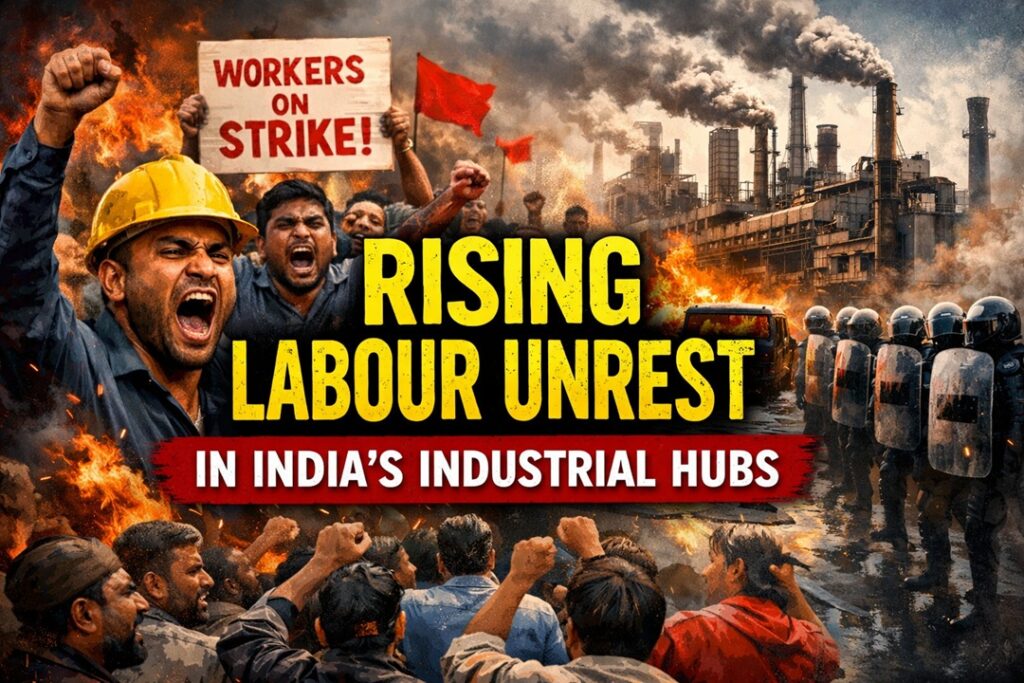
Rising Labour Unrest in India’s Industrial Hubs
Context
Factory workers in major industrial centres such as Noida and Manesar have recently engaged in violent protests, reflecting growing discontent over stagnant wages and poor working conditions.
Nature of the Issue
Labour unrest in India reflects intensifying tensions between industrial workers and employers/state authorities. A major trigger is the widening gap between wages and the rising cost of living, coupled with uncertainty surrounding the implementation of newly introduced Labour Codes.
Key Trends & Evidence
Inflation–Wage Mismatch: Industrial worker inflation (CPI-IW) surged by nearly 25% (2021–2026), whereas wage growth in states like Haryana remained around 15%, eroding real incomes.
Uneven Minimum Wages: Prior to revisions, Haryana’s unskilled wage (~₹11,274) lagged far behind the central benchmark (~₹20,000+), fueling dissatisfaction.
Delayed Revisions: States such as Uttar Pradesh and Haryana failed to revise minimum wages within the mandated five-year cycle, leading to prolonged wage stagnation.
Rising Cost of Living: Migrant workers face steep expenses, including inflated LPG prices in informal markets due to global supply disruptions.
Drivers Behind the Protests
Real Income Decline: Static base wages have not kept pace with rising costs of essentials like food, rent, and fuel.
Policy Uncertainty: Announcement of Labour Codes (2025) raised expectations regarding wages and social security, but lack of implementation has caused frustration.
Extended Work Hours Concerns: Provision for 12-hour workdays under flexible schedules is perceived as exploitative without proportional compensation.
Global Spillovers: Disruptions such as tensions in the Strait of Hormuz and West Asian conflicts have increased production costs, affecting wage payments and job stability.
Steps Taken by Authorities
Temporary Wage Adjustments: Uttar Pradesh and Haryana announced interim hikes to contain unrest.
Central Benchmarking: The Union government revised wages for central sphere establishments to above ₹20,000/month (2024).
Regulatory Clarifications: Draft rules for Labour Codes were issued to address concerns on working hours and rest periods.
Persisting Concerns
Domestic Issues:
- Implementation Gap: Labour Codes notified but not operational in most states.
- Inter-State Disparities: Variations in wage levels may trigger industrial relocation to low-cost regions.
- Weak Collective Bargaining: Reduced clarity on trade union recognition limits workers’ negotiating power.
- Information Gaps: Misinterpretation of wage provisions has led to unrealistic expectations.
External Pressures:
- Energy Inflation: Rising fuel prices disproportionately impact migrant workers’ disposable income.
- Trade Constraints: Global tariffs and logistics disruptions compress industrial profitability.
- Supply Chain Disruptions: Events like the Strait of Hormuz crisis increase input costs for industries.
Policy Imperatives
Regular Wage Revision Mechanism: Enforce automatic and timely revision of minimum wages across states.
Expedite Labour Code Implementation: Finalize and notify rules to remove ambiguity regarding working conditions and pay.
Strengthen Worker Representation: Ensure robust mechanisms for trade union recognition and dispute resolution.
Inflation Indexation: Align wage components more closely and frequently with CPI-IW trends.
Targeted Welfare Support: Provide temporary subsidies (e.g., energy support) during periods of high inflation.
Conclusion
The recent labour unrest underscores a structural imbalance where wage growth has failed to keep pace with inflation and policy delays. Addressing this requires a shift from ad hoc measures to a transparent, rule-based labour governance framework. Sustainable industrial harmony will depend on restoring the balance between productivity, fair wages, and worker welfare.
Source : The Indian Express