
Safeguarding India’s Critical National Infrastructure
Context
The rapid expansion of digital technologies such as Artificial Intelligence, Internet of Things, and Operational Technology networks has increased the vulnerability of India’s critical national infrastructure to cyberattacks and remote disruptions. As essential sectors become increasingly interconnected, ensuring cybersecurity and resilience has become a major national security priority.
Introduction
Critical National Infrastructure forms the backbone of a country’s economy, governance, and public welfare. In the era of digital transformation, sectors such as power, transport, finance, telecommunications, and healthcare are increasingly dependent on interconnected digital systems. While technological integration improves efficiency and service delivery, it also exposes these systems to cyber threats, espionage, and sabotage. Protecting India’s critical infrastructure is therefore essential for national security, economic stability, and public safety.
What is Critical National Infrastructure
Definition: Critical National Infrastructure refers to the essential assets, facilities, systems, networks, and services whose disruption or destruction would severely affect national security, public safety, economic stability, or governance.
Importance: These systems support the functioning of the state and are indispensable for the delivery of essential services to citizens.
Key Data and Statistics
Rising Global Cyberattacks: Cyberattacks targeting critical infrastructure sectors such as energy and transportation have increased significantly worldwide, often involving state-sponsored actors.
Weak Security Compliance: Many public sector utilities still rely on basic security audits rather than advanced firmware-level cybersecurity checks.
IoT Vulnerabilities: A large number of industrial Internet of Things systems remain exposed to attacks due to outdated security credentials.
Threats to Financial Systems: India’s banking and digital payment infrastructure faces a very high volume of cyber probes and Distributed Denial of Service attacks daily.
Major Critical Infrastructure Sectors in India
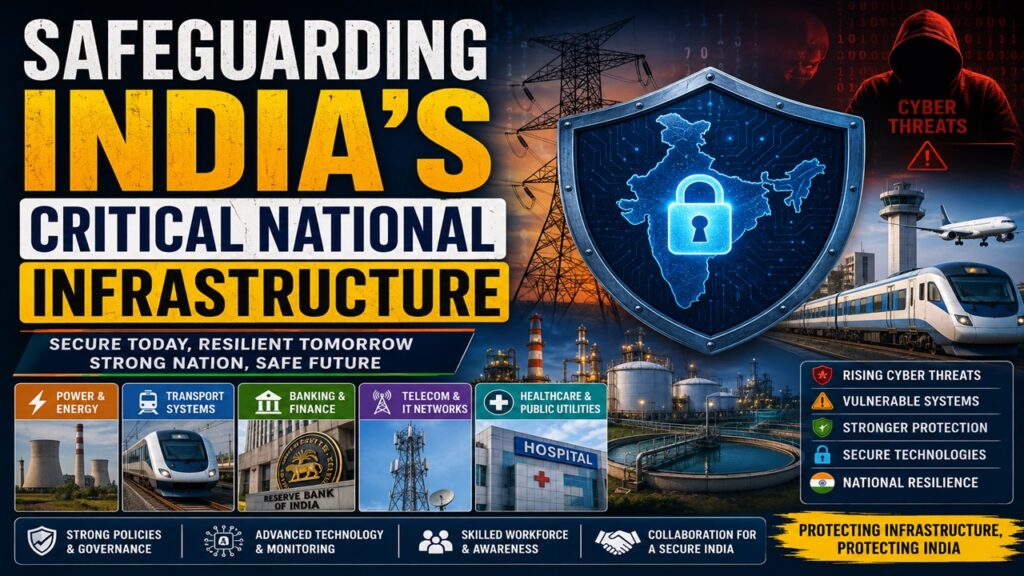
Power and Energy Infrastructure: Includes thermal and nuclear power plants, renewable energy parks, transmission grids, and load dispatch centers.
Transport Infrastructure: Covers railway control systems, airports, shipping ports, highway toll systems, and logistics networks.
Banking and Financial Sector: Includes digital payment gateways, stock exchanges, banking servers, and financial transaction systems.
Telecommunication and IT Networks: Comprises national data centers, telecom towers, undersea communication cables, and satellite communication systems.
Healthcare and Public Utilities: Includes hospitals, water treatment plants, oil and gas pipelines, and police communication systems.
Challenges Associated with CNI Security
Convergence of IT, OT, and IoT Systems: Integration of operational technology with internet-connected systems increases exposure to cyberattacks.
Use of Unverified Foreign Components: Weak procurement standards sometimes allow potentially insecure foreign hardware to enter sensitive infrastructure systems.
Delays in Security Certification: Long certification timelines for cybersecurity verification create procurement bottlenecks and increase dependence on unverified systems.
Evolving Nature of Cyber Warfare: State-sponsored cyber groups increasingly target civilian infrastructure networks to gain strategic advantages during conflicts.
Supply Chain Vulnerabilities: Complex supply chains make it difficult to ensure end-to-end security of hardware and software components.
Initiatives Taken by India
Establishment of NCIIPC: The National Critical Information Infrastructure Protection Centre serves as the nodal agency for protecting critical information infrastructure.
Role of CERT-In: The Indian Computer Emergency Response Team monitors cyber threats, manages incident response, and issues cybersecurity advisories.
Trusted Telecom Portal: Telecom operators are required to procure equipment only from trusted and verified sources.
Advanced Hardware Testing: The Standardization Testing and Quality Certification Directorate has strengthened hardware testing mechanisms for imported digital equipment and IoT devices.
Significance of Securing Critical Infrastructure
National Security Protection: Prevents disruption of essential services and safeguards strategic assets from cyber warfare.
Economic Stability: Protects financial systems, trade networks, and industrial operations from large-scale losses.
Public Safety Assurance: Ensures uninterrupted delivery of essential services such as electricity, healthcare, water supply, and transportation.
Strengthening Digital India: Supports India’s transition toward a technologically advanced and digitally integrated economy.
Way Forward
Adoption of Zero-Trust Security Architecture: Introduce strict authentication mechanisms for all connected devices and networks.
Reforming Procurement Systems: Strengthen verification standards for hardware and software used in critical sectors.
Expansion of Cybersecurity Testing Facilities: Increase the number of authorized testing laboratories to reduce certification delays.
Use of Artificial Intelligence for Threat Detection: Deploy AI-based systems to identify abnormal network activities and cyber intrusions in real time.
Regular Cybersecurity Drills: Conduct joint exercises involving government agencies, armed forces, and private infrastructure operators to improve preparedness.
Capacity Building and Skill Development: Enhance cybersecurity awareness and technical expertise among infrastructure operators and government personnel.
Conclusion
The security of India’s critical national infrastructure is fundamental to safeguarding national sovereignty, economic resilience, and public welfare. As digital technologies become deeply embedded in essential sectors, the risk of cyber threats and infrastructure disruptions continues to grow. Strengthening institutional coordination, adopting advanced cybersecurity frameworks, and promoting indigenous technological capabilities will be crucial for building a secure and resilient infrastructure ecosystem in India.
Source : The Hindu