
Snow Leopard Conservation in India: Population Assessment and Ecological Significance
Context
On International Snow Leopard Day, observed on October 23, the Ministry of Environment, Forest and Climate Change highlighted India’s first Snow Leopard Population Assessment in India (SPAI). The assessment estimated a population of 718 snow leopards, including 477 in Ladakh, strengthening the focus on conserving India’s fragile high-altitude ecosystems.
About the Snow Leopard
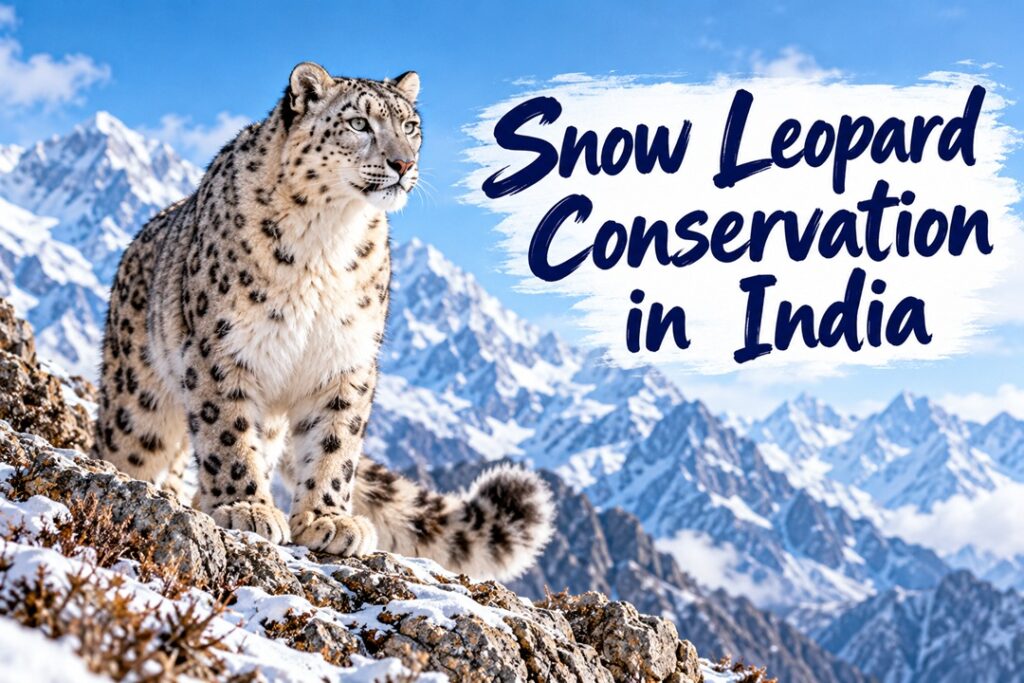
The Snow Leopard (Panthera uncia), popularly called the “Ghost of the Mountains,” is a solitary, carnivorous big cat adapted to the cold and rugged mountain landscapes of Central and South Asia. It occupies a crucial position in mountain food chains as an apex predator.
Habitat and Distribution
- Altitude: Generally inhabits elevations between 3,000 and 5,400 metres in the Himalayas, although it occurs at lower elevations in parts of Mongolia and Russia.
- Landscape: Prefers cold, dry alpine and sub-alpine environments, including rocky slopes, cliffs, ridges and deep ravines.
- Global distribution: Found across 12 range countries — Afghanistan, Bhutan, China, India, Kazakhstan, Kyrgyz Republic, Mongolia, Nepal, Pakistan, Russia, Tajikistan and Uzbekistan.
- Major habitat concentration: China contains approximately 60% of the snow leopard’s global habitat.
- Conservation status: Classified as Vulnerable on the IUCN Red List.
Unique Adaptations of the Snow Leopard
- Powerful hind limbs: Enable it to leap distances of up to six times its body length, helping it navigate steep and rocky terrain.
- Long, bushy tail: Maintains balance on narrow mountain ledges, stores fat and provides warmth when wrapped around the body.
- Camouflaging coat: Thick, pale-grey fur with dark rosettes blends with rocky surroundings, helping the animal remain concealed.
- Large home ranges: Its territorial range can vary from around 30–65 sq. km to over 1,000 sq. km, depending on prey availability and habitat conditions.
- Cold-weather adaptations: Broad, fur-covered paws distribute body weight over snow, while enlarged nasal cavities and a deep chest support survival in cold, high-altitude environments.
- Specialised diet: Primarily hunts mountain ungulates such as bharal (blue sheep), ibex and argali.
Snow Leopard Population Assessment in India (SPAI)
India’s first systematic national assessment established an important baseline for monitoring the species and strengthening conservation planning.
- Estimated population: 718 snow leopards.
- Ladakh: Recorded 477 individuals, representing the largest share of India’s estimated population.
- Significance: Provides scientific information to guide habitat protection, population monitoring and the allocation of conservation resources across snow leopard landscapes.
The assessment also highlights the importance of coordinated monitoring across mountain regions, where difficult terrain and low population densities make wildlife surveys challenging.
Ecological Significance
- Maintaining ecological balance: As an apex predator, the snow leopard helps regulate populations of wild herbivores and contributes to the stability of mountain food webs.
- Protecting biodiversity: Conservation of its habitat benefits numerous other species inhabiting alpine and sub-alpine ecosystems.
- Safeguarding water security: Healthy mountain ecosystems support river catchments that supply water to downstream communities and agricultural regions.
- Indicator of ecosystem health: Changes in snow leopard populations can provide insights into habitat quality, prey availability and broader ecological pressures.
- Promoting community-based conservation: Its protection encourages sustainable pastoral practices and cooperation between conservation agencies and mountain communities.
Major Challenges to Conservation
- Habitat degradation and fragmentation: Infrastructure development, roads and other human activities can disturb habitats and restrict wildlife movement.
- Human–wildlife conflict: Snow leopards occasionally prey on livestock, creating economic losses and retaliatory killing.
- Climate change: Rising temperatures can alter alpine habitats, shift the distribution of prey and increase pressure on mountain ecosystems.
- Poaching and illegal trade: The species remains vulnerable to illegal hunting and trafficking.
- Limited scientific monitoring: Remote terrain, harsh weather and the elusive nature of the animal make regular population assessments difficult.
Conservation Initiatives
- Project Snow Leopard: India’s landscape-based conservation initiative promotes the protection of high-altitude wildlife through community participation and ecosystem-level management.
- Global Snow Leopard and Ecosystem Protection Program (GSLEP): An international collaboration among snow leopard range countries to secure viable populations and their habitats.
- Protected areas and habitat management: National parks, wildlife sanctuaries and other conservation landscapes help preserve essential habitats and prey species.
- Community participation: Livestock insurance, improved livestock protection and alternative livelihood opportunities can reduce conflict between pastoralists and wildlife.
- Scientific monitoring: Camera traps, genetic sampling and systematic surveys help improve population estimates and track ecological changes.
Way Forward
- Strengthen long-term population monitoring using standardised scientific methods and periodically update national estimates.
- Protect wildlife corridors and improve ecological safeguards for infrastructure projects in snow leopard habitats.
- Expand community-led conservation, including livestock compensation and insurance mechanisms to reduce retaliatory killings.
- Integrate climate adaptation into high-altitude ecosystem management and monitor changes in prey distribution.
- Improve cross-border cooperation among range countries to address illegal wildlife trade and conserve connected mountain landscapes.
Conclusion
The snow leopard is both a symbol of Himalayan wilderness and a key component of mountain ecosystem stability. India’s estimate of 718 individuals provides an essential baseline for future conservation efforts. Combining scientific monitoring, habitat protection and community participation will be crucial to ensuring the long-term survival of this elusive species and the ecosystems it represents.
Source : TOI