
Solid Waste Management Rules, 2026 and the Challenges of Centralised Waste Governance
Context
The revised Solid Waste Management Framework, 2026, introduced in place of the earlier 2016 regime and operational from April 1, 2026, aims to address India’s escalating urban and rural waste crisis through stricter compliance, decentralised treatment, and technology-enabled monitoring.
About the Solid Waste Management Framework, 2026
Objective of the Framework
The revised framework intends to
- Strengthen waste segregation at origin,
- Ensure accountability of high-volume waste producers,
- Encourage scientific waste treatment,
- Minimise landfill dependency,
- Clear accumulated legacy garbage sites,
- Advance resource recovery and recycling, and
- Introduce digital compliance systems.
Administrative Authority
- Implementing Ministry – Ministry of Environment, Forest & Climate Change.
- Legal Basis – Issued under the Environment (Protection) Act, 1986.
- Constitutional Basis – Linked to Article 253, enabling Parliament to fulfil international environmental obligations arising from agreements such as the 1972 Stockholm Conference.
Governance Dimension
Solid waste management intersects with
- Environmental protection,
- Public sanitation,
- Public health,
- Urban planning,
- Rural administration, and
- Local self-governance, which falls under the State List.
Major Features of the 2026 Regulations
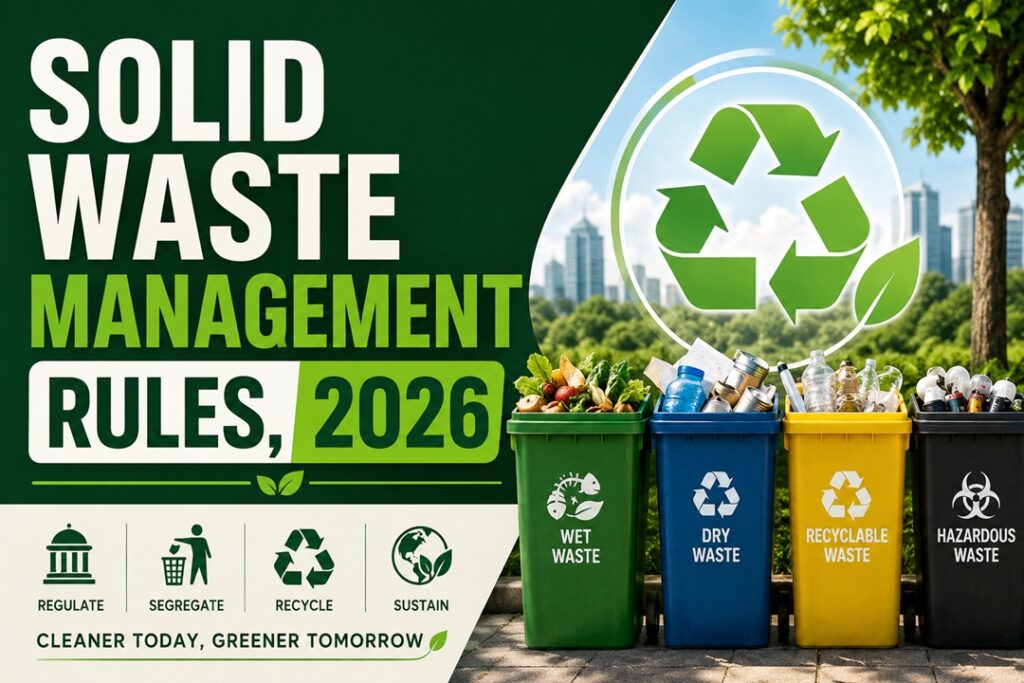
Multi-Layer Waste Segregation
Mandatory separation of waste into
- Biodegradable waste,
- Recyclable dry waste,
- Sanitary waste, and
- Hazardous/special-care waste.
Obligations of Bulk Waste Producers
Large establishments such as
- Hotels,
- Educational institutions,
- Commercial complexes, and
- Large residential societies
must process biodegradable waste within their premises based on prescribed thresholds.
Role of Urban & Rural Local Bodies
Municipalities and panchayats are entrusted with
- Collection,
- Segregation,
- Transportation, and
- Coordination with waste recovery centres.
The rules also encourage local bodies to explore carbon credit generation.
Material Recovery Facilities (MRFs)
MRFs are recognised as dedicated centres for
- Sorting recyclable waste,
- Depositing e-waste,
- Managing sanitary waste, and
- Channelising specialised waste streams for processing.
Refuse-Derived Fuel (RDF)
The rules define RDF as fuel generated from processed municipal waste containing high-calorific non-recyclable materials such as
- Plastics,
- Paper, and
- Textiles.
Industries are encouraged to utilise RDF as an alternative energy source.
Legacy Dumpsite Reclamation
- Landfills are restricted only to inert and non-recoverable waste.
- Higher landfill charges are imposed for mixed or untreated waste disposal.
- Mandatory mapping and assessment of old dumpsites.
- Time-bound biomining and bioremediation processes introduced.
Technology-Based Monitoring
A central online platform has been proposed for
- Tracking waste generation,
- Collection,
- Processing,
- Disposal, and
- Progress of legacy waste remediation.
Compliance Audits
- Annual landfill audits by State Pollution Control Boards.
- District Collectors to supervise landfill performance and compliance.
Special Provisions for Ecologically Sensitive Regions
For
- Hilly regions,
- Island territories, and
- Tourist-intensive areas,
local authorities may impose user charges on visitors and regulate tourist inflow depending on waste-handling capacity.
Institutional Oversight
- Creation of Central and State-level implementation committees.
- State committee to be chaired by the Chief Secretary or UT Administrator.
Major Challenges in the 2026 Rules
Uniform Governance Approach
A standardised national framework may ignore the diverse realities of
- Metropolitan cities,
- Mountain settlements,
- Coastal villages,
- Island territories, and
- Tribal habitations,
all of which require customised waste-management systems.
Rural Capacity Deficit
Many gram panchayats face shortages in
- Skilled personnel,
- Transport infrastructure,
- Technical expertise,
- Digital systems, and
- Financial resources
needed for advanced segregation and reporting systems.
Concerns Over Excessive Centralisation
Although States are asked to formulate waste strategies, the framework remains heavily guided by centrally determined rules, reducing State-level innovation.
Dashboard-Centric Governance
Central monitoring platforms may convert States and local bodies into mere data-reporting agencies rather than active governance partners.
This could divert administrative focus toward compliance reporting rather than actual service delivery.
Limited Public Participation
- Rural governance has gram sabhas for accountability.
- Urban areas often lack effective ward-level participatory forums.
Waste governance reports should be accessible to local councils and citizens instead of remaining confined to central databases.
Fiscal Stress on Local Bodies
The framework significantly increases responsibilities of municipalities and panchayats without guaranteeing predictable and formula-based financial support.
This may result in
- Incomplete implementation,
- Inflated compliance claims, or
- Administrative evasion.
Rising Litigation Risks
Non-compliance may trigger
- Public Interest Litigations (PILs),
- Judicial monitoring, and
- Prolonged legal interventions,
which could shift focus from administrative reform to courtroom disputes.
Suggested Alternatives
Flexible State-Level Models
States could be allowed to design customised waste-management regulations for an initial transition period while adhering to broad national environmental standards.
Gradual Implementation Strategy
Implementation could follow a phased approach:
- Megacities,
- Metropolitan areas,
- Medium towns,
- Small municipalities, and finally
- Rural regions with simplified systems.
Metropolitan Waste Authorities
Large urban agglomerations require dedicated metropolitan waste authorities involving
- Elected representatives,
- State governments,
- Technical experts, and
- Citizen groups.
Cooperative Federal Data System
A shared data architecture involving States and local bodies could transform digital monitoring into a capacity-building mechanism rather than a compliance-driven exercise.
Way Forward
For effective implementation, the framework should be guided by
- National minimum environmental standards,
- Greater State flexibility,
- Empowered local governments,
- Stable financial support mechanisms, and
- Strong citizen accountability systems.
Without balancing central ambition with local capacity, waste accumulation may continue despite regulatory expansion.
Source: The Hindu