
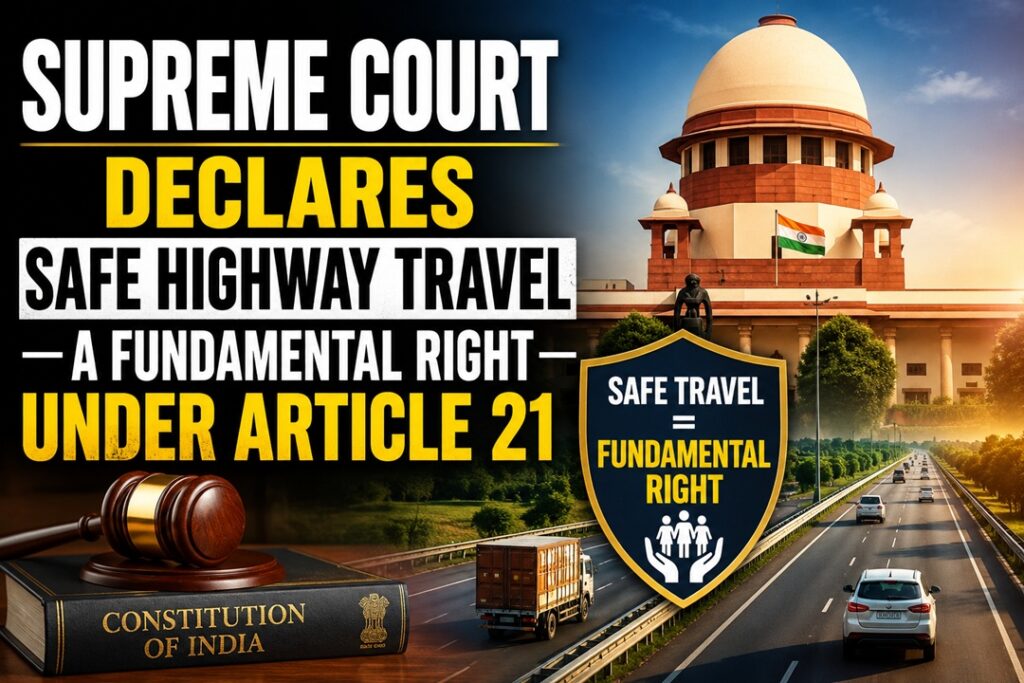
Supreme Court Declares Safe Highway Travel a Fundamental Right Under Article 21
Context
The Supreme Court of India, while exercising its extraordinary constitutional powers under Article 142, has declared the Right to Safe Travel on National Highways as an integral part of the Right to Life and Personal Liberty under Article 21. The ruling came during a suo motu examination of two fatal road accidents, reinforcing the State’s constitutional responsibility to ensure safer road infrastructure and transportation systems.
Supreme Court’s Power to Ensure Complete Justice
What is Complete Justice?
Complete Justice refers to the extraordinary constitutional authority vested exclusively in the Supreme Court of India to provide effective remedies when existing laws, procedures, or statutory frameworks are inadequate to address a particular injustice. This residual jurisdiction enables the Court to uphold constitutional values and protect citizens’ rights beyond procedural limitations.
The doctrine allows the Supreme Court to intervene in exceptional situations where strict adherence to legal procedures may hinder the delivery of substantive justice.
Constitutional Provisions Supporting Judicial Intervention
Article 142 (Power to Do Complete Justice):
Empowers the Supreme Court to pass any decree or order necessary for doing complete justice in any matter pending before it.
Article 21 (Right to Life and Personal Liberty):
Guarantees protection of life and personal liberty and has been judicially expanded to include several derivative rights, including the recently recognised right to safe travel on National Highways.
Article 226 (Writ Jurisdiction of High Courts):
Authorises High Courts to issue writs for enforcement of legal and fundamental rights, though their powers remain more limited than those available under Article 142.
Article 141 (Law Declared by the Supreme Court):
Provides that the law declared by the Supreme Court is binding on all courts and authorities across the country.
Importance of the Complete Justice Doctrine
Filling Legislative and Regulatory Gaps
The Supreme Court acts as a constitutional safeguard when legal provisions are absent or insufficient to address emerging challenges and public concerns.
Example: The Court may issue directions based on constitutional principles where statutory frameworks fail to provide adequate remedies.
Removing Procedural Barriers to Relief
The Court can transcend procedural constraints and technical limitations to prevent injustice and ensure effective relief.
Example: Judicial precedents have clarified that ordinary statutory restrictions cannot curtail the Supreme Court’s constitutional obligation to protect justice.
Adapting Constitutional Rights to Contemporary Needs
The doctrine enables the judiciary to respond to evolving social realities and strengthen the protection of individual rights.
Example: Judicial recognition of rights relating to privacy, dignity, and personal autonomy reflects this adaptive constitutional approach.
Transforming Public Welfare into Enforceable Rights
The Court may elevate critical public welfare concerns into constitutional obligations when fundamental rights are at stake.
Example: Safe highway travel has now been recognised as a component of Article 21, imposing a constitutional duty upon governments to improve road safety.
Challenges Associated with Article 142 Powers
Concerns Over Separation of Powers
Extensive judicial intervention may sometimes be perceived as encroaching upon domains traditionally reserved for the executive and legislature.
Example: Detailed directions regarding highway safety standards may overlap with policy-making functions.
Absence of Clear Operational Guidelines
The broad wording of Article 142 leaves significant room for judicial discretion, potentially resulting in inconsistent application.
Example: The Supreme Court has repeatedly emphasised the need for caution and restraint while exercising this extraordinary jurisdiction.
Unequal Availability of Remedies
High Courts do not possess powers equivalent to Article 142, resulting in differing levels of judicial relief across institutions.
Example: High Courts cannot issue the same comprehensive directives available to the Supreme Court under its complete justice jurisdiction.
Implementation and Administrative Constraints
Government agencies may face practical difficulties in implementing extensive judicial directives within limited financial and administrative capacities.
Example: Road safety reforms often require coordinated action involving engineering, enforcement, education, and emergency response mechanisms.
Way Forward
Formulate Principles for Judicial Self-Restraint
Develop clear standards to ensure Article 142 is invoked only in exceptional circumstances where existing remedies are inadequate.
Institutionalise Expert Consultation
Establish technical advisory panels to assist the judiciary in matters involving infrastructure, public safety, and complex policy issues.
Create a Repository of Article 142 Judgments
A dedicated public database can enhance transparency, consistency, and predictability in the exercise of extraordinary judicial powers.
Promote Faster Legislative Responses
Mechanisms should be developed to enable timely legislative action when courts identify significant legal or policy gaps.
Strengthen Accountability Mechanisms
Independent monitoring bodies can ensure effective implementation of judicial directions and improve compliance by public authorities.
Conclusion
The Supreme Court’s recognition of safe travel on National Highways as a fundamental right under Article 21 highlights the transformative role of Article 142 in protecting citizens and addressing governance gaps. While concerns regarding judicial overreach remain relevant, the doctrine of complete justice continues to serve as a crucial constitutional mechanism for safeguarding rights and advancing public welfare when conventional legal remedies prove insufficient.
Source : The Hindu