
Transition from MGNREGA to VB-G RAM G: Implications for Rural India
Introduction
The Union Government has enacted the Viksit Bharat-Guarantee for Rozgar and Ajeevika Mission (Gramin) Act, 2025, popularly known as VB-G RAM G, which will come into force from July 1, 2026. The new legislation replaces the two-decade-old Mahatma Gandhi National Rural Employment Guarantee Act (MGNREGA), marking a major restructuring of India’s rural employment framework. Recently, the Ministry of Rural Development released eight draft rules for its implementation and invited public feedback before final notification.
Context of MGNREGA
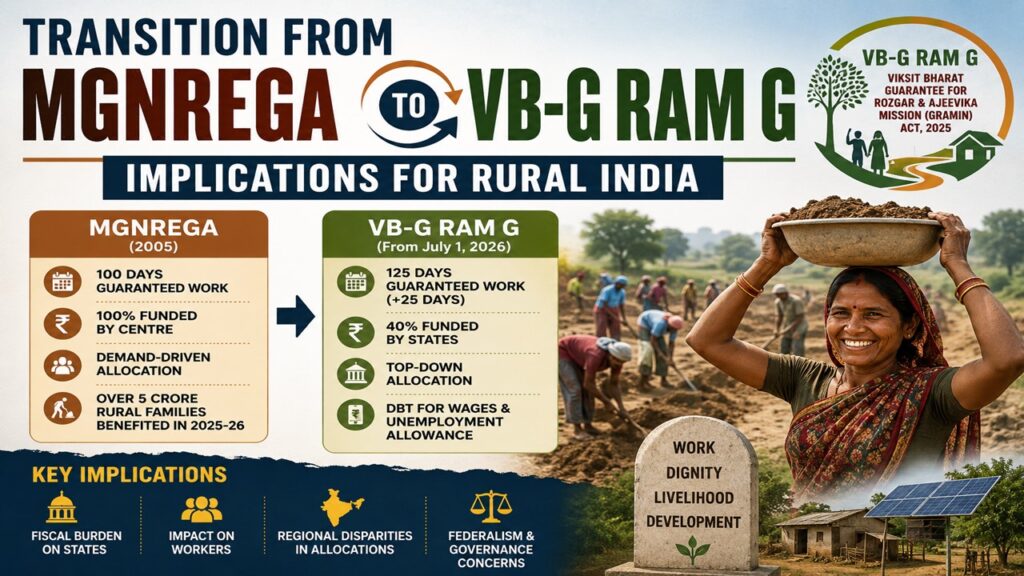
Meaning and Objective: MGNREGA, enacted in 2005, was India’s flagship rural employment programme that guaranteed 100 days of wage employment annually to rural households willing to undertake unskilled manual work.
Coverage and Importance: The scheme supported more than five crore rural families in 2025-26 and played a major role in rural livelihood security, poverty reduction, and demand generation in the rural economy.
Funding Pattern: Under MGNREGA, the Union Government bore 100% of the wage expenditure, making it largely Centre-funded.
Key Features of VB-G RAM G
Increased Employment Guarantee: The new scheme increases guaranteed employment from 100 days to 125 days annually, thereby expanding livelihood opportunities for rural households.
Seasonal Employment Pause: A 60-day pause during peak agricultural sowing and harvesting seasons has been introduced to ensure adequate labour availability for farming activities.
Direct Benefit Transfer Mechanism: Wage payments and unemployment allowances will be transferred directly into bank or post office accounts through Direct Benefit Transfer (DBT), improving transparency and reducing leakages.
Continuation of Existing Job Cards: Existing MGNREGS job cards will remain valid after e-KYC verification until new Gramin Rozgar Guarantee Cards are issued by state governments.
Changes in Fiscal Structure
Shift in Funding Burden: Unlike MGNREGA, states will now bear 40% of the scheme’s expenditure, significantly increasing their fiscal responsibility.
Special Category Exceptions: Northeastern and Himalayan states, along with Union Territories with legislatures, will receive 90% central funding, while Union Territories without legislatures will continue to receive 100% central support.
Fiscal Challenges for States: States with high rural employment demand and weaker fiscal capacity may face difficulties in meeting additional expenditure obligations.
Changes in Allocation Mechanism
From Demand-Driven to Top-Down Allocation: Under MGNREGA, allocations were based on labour demand projected by states. Under VB-G RAM G, the Centre will determine normative allocations for each state.
Use of Finance Commission Formula: The Sixteenth Finance Commission’s horizontal devolution formula will guide resource allocation among states.
Likely Impact on States: States such as Tamil Nadu, Andhra Pradesh, Rajasthan, and Maharashtra may receive relatively lower allocations, whereas Uttar Pradesh, Bihar, Madhya Pradesh, Assam, Gujarat, Haryana, and Punjab may benefit from higher allocations.
Centralisation of Financial Control: The revised allocation mechanism increases the Union Government’s control over fund distribution, reducing state flexibility in responding to local employment demand.
Performance-Based Allocation System
Withheld Allocation Provision: A portion of the allocation may be reserved and distributed based on performance indicators.
Performance Criteria: Indicators include timely wage payments, compliance with social audits, percentage of work completion, and other parameters specified by the Centre.
Implications for States: States failing to meet performance standards may experience reduced fund flows, potentially affecting implementation quality and employment generation.
Excess Expenditure Responsibility
State Liability for Additional Demand: If employment demand exceeds the normative allocation, states must bear the entire additional expenditure beyond the Centre’s contribution.
Risk for High-Demand States: States with large rural populations and high unemployment may face severe fiscal stress during periods of economic distress or agricultural crises.
Eight Draft Rules Released by the Government
Institutional Framework Rules: National Level Steering Committee Rules and Central Gramin Rozgar Guarantee Council Rules establish the governance structure of the scheme.
Administrative and Financial Rules: Administrative Expenses Rules and Expenditure Rules define procedures for financial management and state expenditure beyond normative allocation.
Transparency and Accountability Rules: Grievance Redressal Rules and Payment Procedure Rules aim to strengthen accountability and ensure timely wage disbursal.
Transition Management Rules: Transitional Provisions Rules facilitate a smooth shift from MGNREGA to VB-G RAM G.
Allocation Rules: Objective Parameters for Normative Allocation Rules define the criteria for state-wise fund allocation.
Major Concerns and Implications
Concerns for Federalism: The move from a demand-driven model to centrally determined allocations raises concerns regarding cooperative federalism and state autonomy.
Concerns for Workers: Although the increase in guaranteed workdays is beneficial, uncertainty regarding wage rates and the seasonal employment pause may affect worker security.
Concerns for States: Additional financial obligations could disproportionately impact fiscally stressed states and widen regional disparities.
Administrative Challenges: Effective implementation will depend on timely DBT payments, robust grievance mechanisms, and transparent social audits.
Conclusion
The VB-G RAM G Act, 2025 represents a significant transformation in India’s rural employment architecture. While the expansion of guaranteed workdays and the emphasis on transparency are positive developments, the increased financial burden on states and the centralisation of fund allocation raise important concerns regarding fiscal federalism and rural welfare. The success of the new framework will depend on balanced Centre-State cooperation, adequate funding support, and efficient implementation mechanisms to ensure sustainable rural livelihoods and inclusive development.
Source: Indian Express