
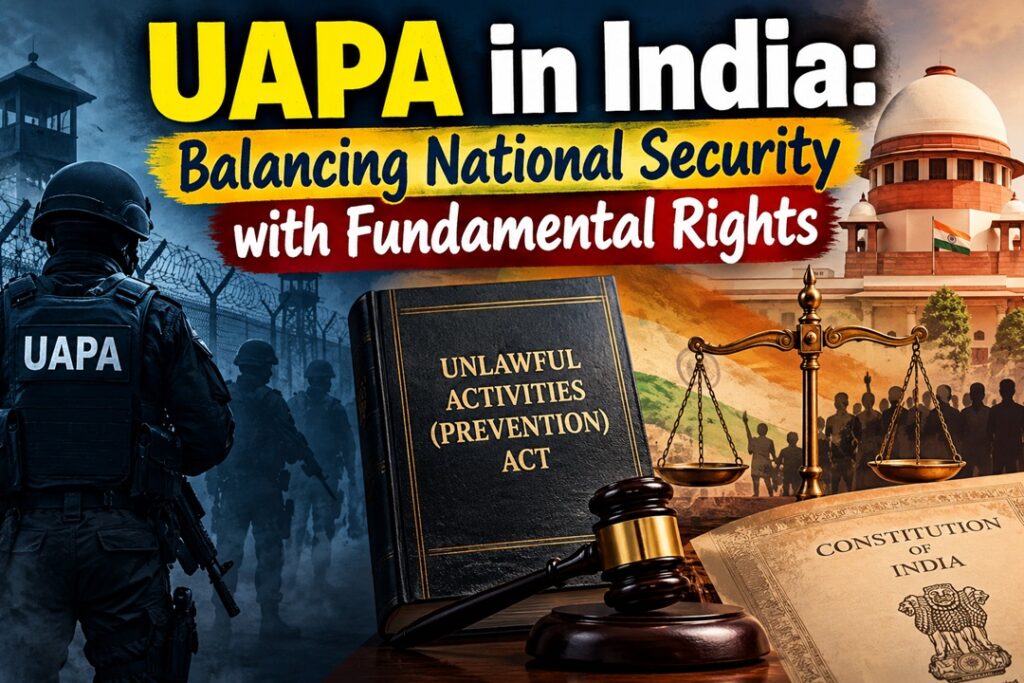
UAPA in India: Balancing National Security with Fundamental Rights
Context
The death anniversary of former Delhi University professor G.N. Saibaba has renewed debate over the functioning of the Unlawful Activities (Prevention) Act (UAPA). His acquittal after nearly a decade of incarceration has highlighted concerns regarding prolonged pre-trial detention, restrictive bail provisions and the potential misuse of anti-terror laws, raising questions about the balance between national security and constitutional freedoms.
What is the UAPA?
The Unlawful Activities (Prevention) Act, 1967, is India’s principal legislation for addressing unlawful activities and terrorism. It aims to protect the sovereignty, unity and territorial integrity of the country.
Unlike ordinary criminal laws, the UAPA contains stringent provisions concerning arrest, investigation, bail and the designation of terrorist organisations and individuals. Although intended to strengthen national security, its implementation has generated concerns about due process and civil liberties.
Evolution of the UAPA
- Constitutional foundation (1963): The 16th Constitutional Amendment empowered Parliament to impose reasonable restrictions on certain fundamental freedoms in the interests of India’s sovereignty and integrity.
- Enactment in 1967: The original legislation primarily addressed activities threatening national unity and territorial integrity.
- Changes after TADA and POTA: Following the lapse of the Terrorist and Disruptive Activities (Prevention) Act in 1995 and the repeal of the Prevention of Terrorism Act in 2004, the UAPA increasingly became the principal central anti-terror legislation.
- Major amendments: Changes in 2004, 2008, 2012 and 2019 progressively expanded its counter-terrorism framework, including the regulation of terrorist organisations and the designation of individuals as terrorists.
Major Provisions of the UAPA
1. Broad scope of offences
The Act criminalises unlawful activities threatening India’s sovereignty and territorial integrity, alongside terrorist acts intended to threaten national security or create terror among the public.
2. Restrictive bail provisions
Section 43D(5) places a stringent limitation on bail where the court finds reasonable grounds for believing that the accusation is prima facie true. This makes securing bail substantially more difficult than under ordinary criminal law.
3. Extended investigation period
Section 43D(2) permits an extension of the period for filing a chargesheet from 90 days to a maximum of 180 days, subject to the statutory conditions. It also permits police custody of up to 30 days.
4. Individual designation as a terrorist
The 2019 amendment empowered the Central Government to designate individuals as terrorists under Section 35, in addition to the existing provisions for banning terrorist organisations.
5. Property seizure and forfeiture
Section 25 provides for the seizure of property suspected of being connected with terrorist activity, subject to the prescribed legal procedures.
6. Extraterritorial application
The Act extends to specified offences committed outside India by Indian citizens and, in relevant circumstances, by other persons, including offences involving Indian-registered ships and aircraft.
Significance of the UAPA for National Security
The legislation provides investigating agencies with a framework to address complex security threats that may extend across state and national boundaries.
- Disrupting terrorist financing: It enables action against financial networks, suspected terror proceeds and funding channels supporting terrorist activities.
- Addressing organised terror conspiracies: Its provisions facilitate investigations into interconnected networks and coordinated terrorist operations.
- Restricting violent organisations: The government can declare organisations unlawful under the Act, subject to the applicable legal framework, thereby restricting their activities and financing.
- Strengthening national security coordination: It provides a common statutory framework for tackling terrorism, insurgency and related threats that may require inter-state investigation.
However, the existence of stringent legal powers does not, by itself, establish their effectiveness. Their success must also be assessed through credible prosecutions, convictions, timely trials and respect for constitutional rights.
Major Concerns Regarding the UAPA
1. Low Conviction Rates and Prolonged Trials
A major concern is the gap between arrests and final convictions. When cases remain unresolved for years, accused persons may spend substantial periods in prison before their guilt is established.
The case of G.N. Saibaba illustrates the human consequences of prolonged incarceration followed by acquittal. His experience raises questions about investigative quality, judicial delays and remedies for wrongful detention.
2. Process Becoming Punishment
The stringent bail threshold under Section 43D(5), combined with the extended investigation period, can result in prolonged detention before trial.
In cases involving numerous accused persons and extensive evidence, delays in framing charges and conducting proceedings can undermine the presumption of innocence and the right to a speedy trial.
3. Potential Chilling Effect on Democratic Dissent
Broadly worded provisions may create uncertainty about the boundary between legitimate political expression and punishable unlawful activity.
Journalists, activists, students and civil society members may face serious consequences when allegations involving conspiracy or links with banned organisations are investigated under the Act. Legitimate criticism of the government, however, should not automatically be equated with terrorism.
4. Ambiguity Surrounding Membership and Association
Questions arise when allegations rely heavily on ideological association, literature or alleged links with prohibited organisations rather than demonstrable participation in criminal activity.
The law must distinguish between peaceful association or expression and intentional participation in terrorist activities. At the same time, evidence of actual involvement cannot be disregarded merely because the accused claims an ideological motivation.
5. Humanitarian Consequences of Incarceration
Long periods of imprisonment can cause serious physical, psychological, social and financial harm, particularly to elderly persons and those with disabilities or serious medical needs.
The death of Father Stan Swamy while in custody, amid proceedings connected with the Bhima Koregaon case, intensified public scrutiny of prison conditions, access to medical care and the consequences of delayed trials.
Important Supreme Court Judgments on the UAPA
- NIA v. Zahoor Ahmad Shah Watali (2019): The Supreme Court adopted a restrictive approach to judicial assessment of evidence at the bail stage under Section 43D(5), limiting detailed evaluation of the prosecution’s case at that stage.
- Union of India v. K.A. Najeeb (2021): The Court clarified that statutory restrictions on bail do not eliminate constitutional courts’ powers to grant bail when prolonged incarceration and the unlikelihood of a timely trial threaten fundamental rights, particularly Article 21.
- Arup Bhuyan review judgment (2023): The Supreme Court revisited its earlier interpretation concerning membership of unlawful organisations, holding that continued membership could attract punishment under the applicable statutory provisions. The decision renewed debate over the distinction between passive association and active participation in unlawful conduct.
These judgments demonstrate the continuing tension between effective counter-terrorism enforcement and judicial protection of personal liberty.
Way Forward
1. Revisit the bail framework
Section 43D(5) should be reviewed to ensure meaningful judicial scrutiny of the prosecution’s material, particularly where detention has become prolonged and the trial is unlikely to conclude within a reasonable period.
2. Set safeguards against excessive delays
Courts should closely monitor the progress of UAPA cases, prioritise prolonged-incarceration matters and enforce timelines wherever legally feasible. Any additional statutory safeguards should preserve established legal procedures, including the right to default bail where applicable.
3. Clarify the scope of offences
Definitions relating to unlawful activities, terrorist acts and membership should be precise enough to distinguish violent or criminal participation from peaceful dissent, academic discussion and lawful association.
4. Strengthen investigative accountability
Investigating agencies should be required to build cases on reliable, corroborated evidence. Independent review and effective judicial oversight can help reduce arbitrary prosecution and improve the quality of investigations.
5. Provide remedies for wrongful prosecution
Appropriate compensation, rehabilitation and institutional accountability mechanisms should be considered for individuals who suffer demonstrable harm due to wrongful incarceration or serious procedural failures.
6. Improve prison safeguards
Authorities must ensure timely medical care, humane detention conditions and appropriate safeguards for vulnerable prisoners, while complying with judicial directions and applicable law.
Conclusion
The UAPA remains an important instrument for addressing terrorism and threats to national security. However, its legitimacy depends not only on the strength of its enforcement powers but also on the fairness of its implementation. The experience of G.N. Saibaba highlights the grave consequences that prolonged incarceration and delayed justice can have on individual liberty.
A credible counter-terrorism framework must combine effective investigation with judicial accountability, speedy trials and constitutional safeguards. Protecting national security and preserving fundamental rights are complementary responsibilities of a constitutional democracy, not competing objectives.
Source : The Hindu